

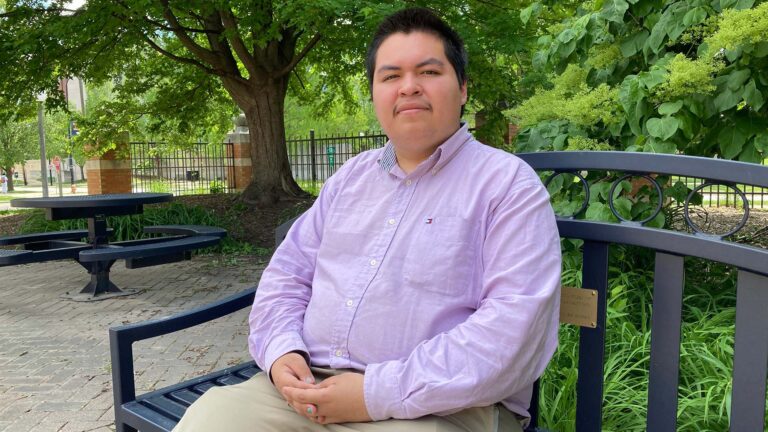
Reynaldo Camas-Aranda’s uncle loved to garden at the family’s home in Cicero, near Chicago. He loved growing tomatoes and chilies that would all go into sauces and salsas.
He loved making Italian recipes, like stuffed shell pasta and spaghetti. But specifically for his nephew, Camas-Aranda’s uncle would always cook chilaquiles. He would make the dish way too early in the morning for Camas-Aranda’s sleep schedule, setting a fried egg on top of salsa and tortilla pieces.
Chilaquiles were probably the last thing Camas-Aranda’s uncle made for him before he was deported.
“He was very much someone who cared, who worked hard, and a lot of people in the community knew him,” Camas-Aranda said.
U.S. Border Patrol agents arrested Camas-Aranda’s uncle on October 20, during President Trump’s Operation Midway Blitz in Chicago, according to the Department of Homeland Security. His uncle lost his deportation case in January and was sent to Mexico.
Camas-Aranda grew up in a house with his uncle, aunt and mother in Cicero, a town that neighbors Chicago. The deportation has broken up his household and forced the University of Illinois Urbana-Champaign rising senior to be the main provider for his family.
IPM News is not using Camas-Aranda’s uncle’s name, because Camas-Aranda has not been able to get in touch with him to get permission.
‘Every part of that process was not fair’
Camas-Aranda was on his way to class one day in October when he got a call from his mother, asking how to locate someone detained by Immigration and Customs Enforcement.
With his class starting in 10 minutes, Camas-Aranda asked if the question could wait. His mother said it could, so he attended the rest of his classes before calling her back.
That was when he learned federal agents had detained his uncle.
His uncle loved to bike around the neighborhood, using it as an excuse to talk with neighbors.
Camas-Aranda said his uncle was on the way to the store on his bicycle when he was arrested. He said the agents took him to the federal detention center in Broadview, Illinois and then later to the North Lake Processing Center in Michigan.
“I was able to call him. Every time I called him, he was in a good mood, joking. He joked a lot, ‘I’m just on vacation,’” Camas-Aranda recalled.
The family had to navigate an immigration and detention system that was often confusing. They needed to figure out the number that DHS uses to track detainees. Camas-Aranda’s aunt tried to find a lawyer who could represent her husband while detained in Michigan, but the lawyer willing to represent the family had a long waitlist.
That meant while Camas-Aranda was home for winter break, his family logged onto the virtual immigration hearing without a lawyer. As the tech-savvy family member and the only one with a laptop, he was responsible for getting them into the conferencing software at 7 a.m.
The family thought they were just attending Camas-Aranda’s uncle’s hearing. In reality, it was a block of time with many hearings. The detainees with lawyers went first. Then each detainee without a lawyer.
Hours later, Camas-Aranda’s uncle got to plead his case. He said the hearing lasted five minutes before the judge rejected his uncle’s application to stay.
“I felt a lot of anger, because again I think the system wasn’t fair. Every part of that process was not fair,” Camas-Aranda said.
From the requirement of paying to call detention centers to his uncle’s quick transfer out of state to the lack of access to a lawyer, he said the experience was confusing and frustrating.
Last year, DHS launched Operation Midway Blitz in the Chicago area, arguing the state’s sanctuary policies had made the city “a magnet for criminals.”
But Camas-Aranda’s uncle had never been arrested. According to the Chicago Sun-Times, 81 percent of those arrested during Operation Midway Blitz had no criminal conviction unrelated to immigration status.
“I don’t think it really matters, but he had a clean criminal record,” Camas-Aranda said.
A DHS spokesperson said by email that Camas-Aranda’s uncle was deported because he “illegally entered the country,” not because of an arrest record.
Camas-Aranda’s uncle has a place to stay in Mexico
About 30 years ago, Camas-Aranda’s aunt, uncle and mother moved from a small town called Chichila in Guerrero, Mexico to the U.S.
It was a time of increased immigration from Mexico to the U.S. Researchers have linked that increase to the North American Free Trade Agreement, which increased trade between the two countries and also put small-scale Mexican farmers out of business.
The goal for Camas-Aranda’s family was to earn enough in the U.S. to support those staying in Mexico.
“All their money would go back to their families,” Camas-Aranda said. “Growing up, I would hear about the projects that they were working on over there, like making sure that they had running water or that they had a TV or they had a washer.”
Even as a college student, Camas-Aranda treats his money the same way.
“Even if it’s something small like 20 bucks. 20 bucks carries a lot more weight back in Mexico than it does here,” he said.
As far as Camas-Aranda knows, his aunt, uncle and mom never had visas to enter the country. He was born in the US, and is the only one with citizenship and a U.S. passport — which he carries in his pocket, even to IPM’s interview.
He does not think his family worried about trying to find a path to citizenship.
“I think they were hopeful that maybe they could just live a normal life,” he said.
His aunt and uncle saved up enough while working in the U.S. to build a house in Chichila. That means his uncle now has a place to stay and family to reunite with in Mexico.
Camas-Aranda’s aunt is considering leaving the U.S. to live in Mexico with her husband. Even Camas-Aranda’s mom is considering it. Long years of being barred by immigration status from flying back to visit family have worn on both of them.
“When my grandma passed away, it was very hard for both of them to not be able to go to my grandma’s funeral, not being able to grieve with their family back in Mexico,” he said.
His grandfather is aging as well, and his mom keeps thinking about going back.
Camas-Aranda wants to support her wishes. He just hopes she can wait one more year. His scholarship requires a parent to live in Illinois, and he wants her to see him graduate and walk the stage.
“Everything that I have been capable of has been because of her,” Camas-Aranda said.
The deportation has left Camas-Aranda as his family’s breadwinner
The deportation of Camas-Aranda’s uncle has left him as his family’s sole provider, since his aunt and mother are not working. He said his aunt worked until a medical issue prevented her from continuing. His mother was taking care of an elderly person until that person passed away.
“Even before my uncle was detained, the increase in food and rent and everything definitely has an impact and this definitely went over the edge,” he said. “We’re much more into being paycheck to paycheck.”
He works as a student programming coordinator at U of I’s Latina/o student center, La Casa Cultural Latina. He mostly supports his mother financially, but he covered his aunt’s half of utilities too.
“I wish I could provide more,” he said.
Camas-Aranda said his paychecks alone cannot cover the rent at the family’s home in Cicero, so he is looking for a new place for his mother to stay. He is urging her to consider living in Urbana-Champaign because of the lower rents and lighter presence of immigration enforcement.
Camas-Aranda knows it is a lot for a college student to shoulder.
“I keep thinking about my fellow college students and how different their experiences are,” he said.
He said he is living day by day. He has energy some days and some days where he wonders why he should even bother studying. His mentors and support system at U of I help. It also helps him to be involved in activism around issues like immigration.
“What I strive for and hope for is to create a future in which students, kids, don’t have to live through what we live through,” Camas-Aranda said.
In the meantime, his plans for the summer are to help his family move.