

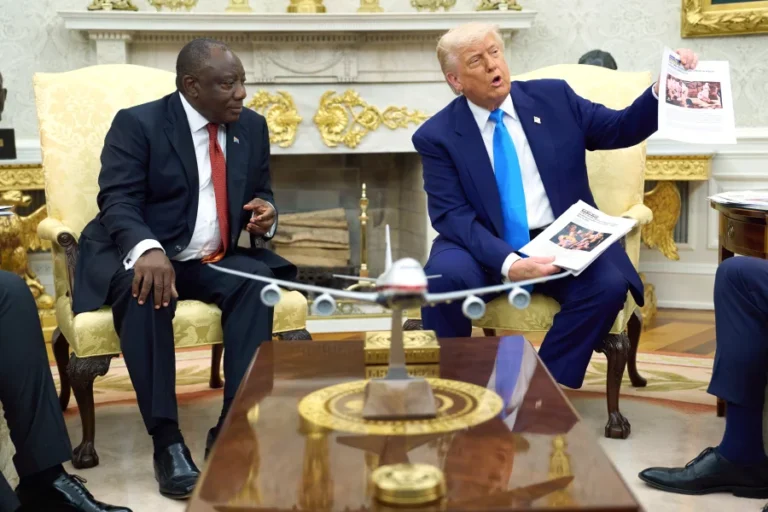
JOHANNESBURG — South African President Cyril Ramaphosa walked into an ambush when he met President Trump in the Oval Office on Wednesday.
After a cordial beginning, where Ramaphosa was at pains to stress his desire to improve relations with the United States, things turned hostile. Trump repeated false claims of a “white genocide” in South Africa and then ordered the lights dimmed to play videos he said supported his allegation.
Ramaphosa attempted to correct the U.S. leader, but mostly got talked over. He explained the videos of opposition politician Julius Malema singing an apartheid-era struggle song called “Kill the Boer” — which means farmer or Afrikaner — did not represent government policy.
In fact, Malema is a populist who was expelled from Ramaphosa’s African National Congress party. Malema’s Economic Freedom Fighters party won just 7% of the vote at national elections last year.
“They are a small minority party,” Ramaphosa said. Trump then asked why Malema wasn’t arrested. Malema has been taken to court over the song, but South Africa’s constitution allows freedom of speech. Asked by reporters if he condemned the singing of the historic song, Ramaphosa said he did.
Trump also played a video that he said was of “a burial site” of murdered white farmers. Ramaphosa said: “Have they told you where this is? I’d like to know where this is?” South African media are reporting the video of white crosses is likely one that has been making the rounds on social media for years and is probably a memorial site.
Trump then showed the press copies of articles, claiming they proved white farmers were being murdered. He flipped through them one by one, saying “death, death.”
Ramaphosa’s agriculture minister, John Steenhuisen, who is white, also tried to explain the facts for Trump. As did South Africa’s richest man and a friend of Ramaphosa’s, business mogul Johann Rupert, who is also white.
But Ramaphosa’s delegation had always known it was a possibility. The U.S. administration has repeatedly slammed South Africa’s government for what it falsely claims is the systematic persecution of white Afrikaner farmers. Fifty-nine white Afrikaner South Africans who were granted refugee status by the Trump administration arrived in the U.S. last week.
During the Oval Office meeting Trump again said white farmers were having their land taken. That’s despite the fact that the South African authorities have not confiscated any farms under new laws that allow for expropriation without compensation in some rare circumstances. Whites — who account for some 7% of the country’s population — still own 70% of commercial farmland.
The list of the Trump administration’s grievances with South Africa are any diplomat’s nightmare. Trump cut aid to the country in February, his top officials have snubbed G20 events South Africa is hosting this year and the U.S. expelled South Africa’s ambassador. The U.S. administration is also angry that Pretoria — a firm Palestinian ally — has taken Israel to the International Court of Justice in The Hague over its war in Gaza.
Ramaphosa had wanted to use the meeting to set Trump straight regarding race relations in South Africa, but had also hoped to take a transactional tack and make a deal with Trump because a vital free trade agreement hangs in the balance amid other economic concerns.
Trump’s South African-born adviser, Elon Musk, was also present at the meeting, but he didn’t speak much. He has also been highly critical of South Africa and has slammed the country’s affirmative action laws, which he claims prevent his Starlink satellite company from entering the market. On Tuesday, reports suggested that Ramaphosa might offer the billionaire Tesla owner some kind of deal ahead of his White House meeting.
“I would say, if there was Afrikaner farmer genocide, I can bet you these three gentlemen would not be here, including my minister of agriculture,” Ramaphosa said.
But despite their presence and Ramaphosa’s gift to Trump of a book on golf, the meeting quickly spiraled out of control. Ramaphosa and his delegation remained calm and cordial despite the misinformation that was being repeated.
At one point reporters moved off topic and asked Trump about the plane Qatar gifted him, riling him. Ramaphosa cut in, saying, “I’m sorry I don’t have a plane to give you.”
“I wish you did,” Trump said, causing Ramaphosa to laugh. “I would take it.”
South African media will now be doing postmortems of the meeting for weeks, but initial takeaways are generally of the opinion that Ramaphosa — unlike Zelenskyy — had kept his composure despite some serious provocation.