

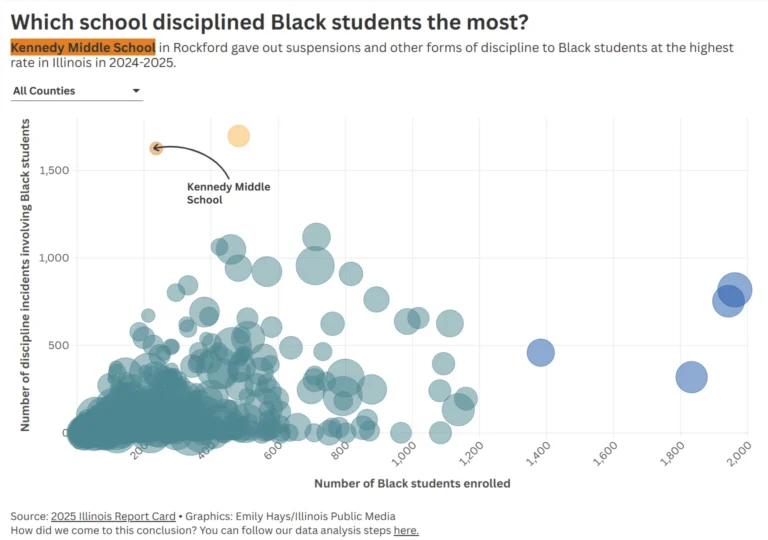
Schools in Illinois discipline Black students at much higher rates than white students. A Rockford middle school is an outlier for handing out the most discipline violations per Black student of any school in the state.
Peter Medlin has the story in part one of a three-part, statewide series on Black student discipline disparities.
It’s graduation day for Brothers for Change. It’s a new mentorship program in Rockford Public Schools led by the district’s Black male leaders like Prentiss Ragland, the assistant principal at West Middle School.
“It started,” said Ragland, “with identifying children that maybe oftentimes find themselves the farthest away from the metrics in terms of behavior, grades, and social emotional for all types of circumstances.”
Students smile with their certificates in West’s gymnasium where, after the ceremony, teams of Rockford teachers face off in a basketball game to raise money for the mentorship program.
Brothers for Change is one of the ways the district says it’s trying to reduce discipline problems, particularly for Black students.
Kennedy’s discipline data
They’re overdisciplined everywhere, but Kennedy Middle School in Rockford stands out. It’s a small school on the city’s west side where over 90% of students are low-income. It’s one of Rockford’s most low-income schools and has one of the highest percentages of Black students.
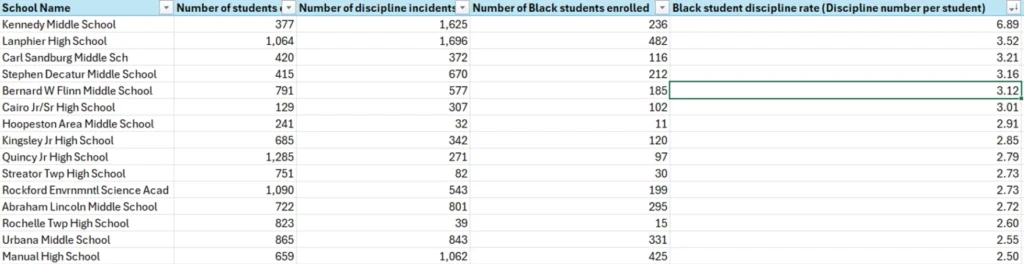
If you look at three major forms of discipline: in-school suspensions, out-of-school suspensions, and expulsions, Kennedy not only has the highest discipline rate per Black student of any school in Illinois, it’s more than twice as high as the next school on the list.
What’s really driving that at Kennedy are in-school suspensions, when — instead of being sent home — students are removed from their regular classroom, but spend the day or parts of multiple days in an “in-school suspension room.”
Kennedy has fewer than 400 students. But last year, those students received 193 out-of-school suspensions and 1,780 in-school ones. It’s not clear if just a small number of students are repeatedly receiving those suspensions.
And while 62% of Kennedy students are Black, they receive over 80% of the in-school suspensions.
It adds up to almost seven disciplinary actions per Black student.
Rockford’s discipline overhaul
David Graffy oversees student discipline and compliance for the district. He says that while the state has identified Rockford as over-relying on out-of-school suspensions, it has not identified it as disproportionately suspending students of color.
That’s true, but the state’s metric he’s referring to doesn’t include in-school suspensions and doesn’t look specifically at Black students.
Graffy also points out that Kennedy and Rockford Public Schools more broadly have significantly decreased out-of-school suspensions. But as those have gone down, in-school suspensions have shot up.
“While in-school suspension is certainly a better option than out of school suspending a student,” said Graffy, “you can’t replicate the actual conversations and the learning opportunities that the teachers can provide.”
He says the goal is to decrease out-of-school suspensions, but they’re trying to reduce in-school ones too.
It has been a big shift. A decade ago, state data shows Kennedy handed out a lot more out-of-school suspensions; 600 more kids a year than they are now. But now they’re in-school suspending 700 more students than they were back then. And Kennedy has far fewer students than it used to.
The impact of in-school suspensions
As Graffy says, the idea is that in-school suspensions are a better option. But a 2020 Texas A&M study suggests that’s not necessarily the case. The academic impact of in-school suspensions may be more severe than originally assumed. The study found that just one in-school suspension drastically increases a student’s chance of failing state achievement tests. And, since Black students receive more of these suspensions, they can be disproportionately pushed towards failure.
Those impacts may be mitigated if schools provide support during the in-school suspension, which Graffy says they often do in Rockford.
“I know certain in-school suspension teachers will do journaling activities,” he said, “where they’ll just give them a free-write activity to kind of talk about what it is that put them in there. Other ones will have guided questions.”
What earns an in-school suspension?
But what lands a student in the in-school suspension room to begin with? At Kennedy, nearly all of them fall into one of two categories: “violence without physical injury” and the more vague “other reasons.”
Graffy says it’s often given after the school tries a smaller consequence like lunch detention.
“One of the hard things we always have to balance is the needs of the many versus the needs of the few,” he said. “Obviously, each individual student is entitled to a free and appropriate public education, and we have to balance that against, well, if they’re disrupting learning for the other 28-30 students in a classroom, where does that line get drawn?”
While Kennedy has the highest Black student discipline rate, other Rockford middle schools are near the top of the list too. The top five middle schools in Illinois with the most discipline incidents and most in-school suspensions are nearly all Rockford middle schools.
And while Kennedy has reduced its out-of-school suspensions and some schools on the list give out many more, it’s worth noting those schools also often have two or three times as many students.
A Kennedy student speaks out
Victorious Batson just finished 7th grade at Kennedy Middle School. She says she’s had many in-school suspensions. Sometimes she’s written up for talking back to a teacher and sometimes for being late to class.
“I’m trying to be early,” she said, “but I can’t because I gotta grab my computer, and then go back, go to my locker, put my stuff down, and then the bell already rang.”
She says teachers often don’t let her use the bathroom during class, but if she goes during passing periods, it’s easy to be late.
Batson says in-school suspensions are terrible. She says the room is cold and they don’t get much help.
“Nothing,” said Batson. “Just look at your Chromebook. Do your work.”
She says her school uses them too much, instead of stepping in with smaller interventions that could stop a situation from escalating. Batson says her classmates are given in-school suspensions when they don’t deserve it and adds that it doesn’t provide real deterrence for students actually misbehaving.
“It’s just always ISS,” she said. “And they go back and do it.”
Can “Brothers for Change” actually make change?
The district and leaders like Prentiss Ragland hope initiatives like Brothers for Change and its counterpart Sisters for Change will give students an adult in their building who knows them and has their back, in case they run into these issues.
“You meet them on a level where they’re at,” said Ragland. “Then you elevate them to the level that you want them to be at.”
Students who improve their behavior, attendance, and grades get to go on special field trips, get snacks and extra recess.
Ragland says there are four parts of Brothers for Change. The first is building a relationship with their mentees. That’s what he was just doing with his new cohort, which included a few football players.
“He can’t stand his history class,” Ragland remembers one student saying. “He don’t like his teacher. They’re talking about boring stuff. I said, ‘What y’all talking about?’ He said, ‘Westward expansion.’ I asked him, ‘Are you familiar with the 49ers? Why is their helmet gold?’ I explained they were rushing to California to get the gold. What in the world is a 49er? That was the year. He’s like, ‘Oh!’ The teacher responded back like, ‘Wow, I don’t know what you said, but he came back and he’s starting to take interest.’ It’s just those little increments of growth and interest.”
In the second part, they encourage students to find a sports team or club so they feel like they’re part of their school’s culture. For the third part:
“We reconnect them with the teachers in the classroom,” he said. “Oftentimes the teachers are struggling because it’s a cultural disconnect.”
He says they try to bridge cultural gaps that can lead to problems in the classroom. Those cultural disconnects are real at a school like Kennedy where 62% of students are Black, but less than 7% of teachers are.
Kennedy fires a teacher
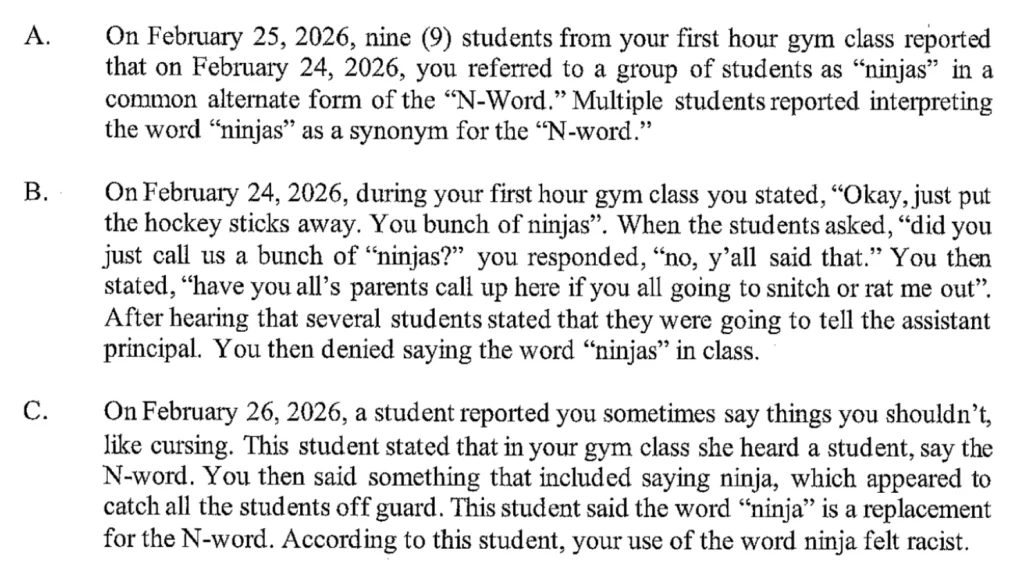
This spring, a Kennedy P.E. teacher was fired for using racial slurs and verbally abusing students, according to public records obtained by WNIJ.
The 7th grader, Batson, says she remembers the teacher using that language towards Black students.
“He didn’t like me,” said Batson. “He’d always just treat other kids differently. He just would always get mad.”
She says there are too many teachers who don’t listen.
The final part of the program brings in parents and families to make sure they feel involved and informed with what’s happening with their child.
A concerned Kennedy parent
Batson’s mom, Crystal Alexander, says she wishes she had that. She says the school district never contacted her about why her daughter was getting in-school suspensions. She wishes communication was better so she could try to help with whatever issues might be going on. Alexander says her daughter used to love school, but not anymore.
“My daughter’s whole attitude changed,” said Alexander. “She used to be happy-go-lucky all the time. And when she went to that school, it made her upset and angry a lot.”
As a mom, it’s hard for her to watch. And she’s not confident things will change.
Ragland hopes Brothers for Change and Sisters for Change can be just that.
This was the first year of the program. They had a few brothers and sisters working with a dozen or so students each. Next year the goal is to expand and hopefully build relationships that make students excited to come to school every day.