

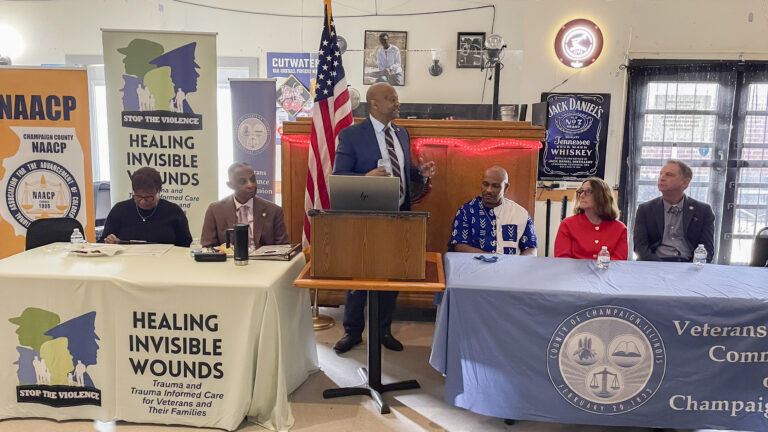
CHAMPAIGN — Applause echoed through American Legion Post 559 as veterans, families and community members gathered to honor the service, sacrifice and legacy of Black veterans on Saturday, Feb. 28.
The event, “Standing on the Shoulders of Giants: Honoring Our Veterans Service, Sacrifice and Legacy,” was organized by Healing Invisible Wounds, the NAACP Champaign County Branch and the Champaign County Veterans Assistance Commission, centered on recognition and resources for veterans whose contributions are often overlooked.
The afternoon opened with keynote remarks from Champaign Police Chief Timothy Tyler, a retired U.S. Army Reserve colonel of 35 years. He framed the gathering as more than a ceremonial tribute.
“We must pause to honor specific individuals who didn’t just walk through the doors, they forced them open for all of us to follow,” he said.
Tyler emphasized the connection between the honorees and the broader historical context, reminding the audience that it is resilience, not rank, that defines their impact. He urged audience members to remember veterans’ service not just during Black History Month.
“What does that mean for us today to stand on their shoulders?” he asked. “It means we cannot be a generation that forgets. Be the giants that the next generation would need to stand upon.”
Minnie Pearson, NAACP Campaign County Branch president, echoed Tyler’s sentiment when she addressed the crowd, highlighting the long history of Black patriots who fought for a nation that she said did not always fight for them.
She reminded everyone that truly honoring them means telling the full story – including the barriers they were forced to overcome.
“Service always demands sacrifice. For Black men, that sacrifice carried additional weight,” Pearson said. “Imagine you’re working and someone puts 1,000 pounds on your back and no one else’s. Think about that.”
The event also honored individuals whose service and dedication continue to shape Champaign County’s veterans community.
Among those recognized was Clarence Davis, who accepted two awards honoring his dedication to supporting local veterans and his service with the American Legion Post 559 color guard for more than two decades.
Accepting the recognition, Davis reflected on the collective sense of duty shared by service members.
“Taking care of this country has been such a bona fide thing for all of us, and we were happy to do it,” he said.
‘Without them I wouldn’t be here’
Beyond the ceremony, local leaders emphasized the ongoing support veterans need and the importance of representation within that work.
Robbie Walker, a retired veteran of five and a half years and executive director of Healing Invisible Wounds, said a lot of veterans carry invisible trauma and wounds after their service ends, and often, those struggles are overlooked.
Walker said Black veterans must overcome extra obstacles “that the average person may not be aware of… Sometimes people are triggered and they don’t know what those triggers are. Even when faced with racism or other obstacles, you have to work twice as hard and stay focused.”
For Walker, those realities drive his work to assist veterans with acquiring benefits, like compensation and pension, support during eviction, and resources for education and health care and family support.
That mission is carried forward by other leaders like Makiya Thomas, an active duty officer of the Illinois National Guard and U.S. Army, who is also board president of Healing Invisible Wounds.
“I don’t really see a lot of Black women, a lot of Black officers in the military, so I really try to have that representation whenever I can,” Thomas said. “Just to let them know that you can do it, if I can do it.”
Recalling earlier generations of Black service members — particularly women who served overseas with little recognition — Thomas said honoring those who came before her is deeply personal.
“It’s a special moment to give them homage because without them I wouldn’t be here,” she said.