

URBANA — On a brisk fall morning at the University of Illinois Arboretum in Urbana, hundreds of people gathered in song and motion.
They sang, “Earth my body, water my blood, air my breath and fire my spirit,” raising their arms, spinning in circles and fluttering their fingers. As the music faded, many shared smiles, embraces and tears.
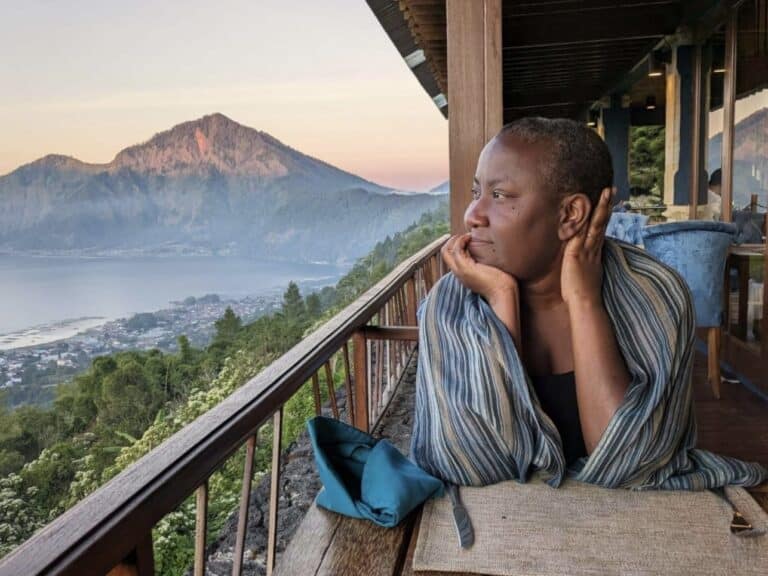
They had come together — artists, friends, colleagues and family — to celebrate the life of Latrelle Bright, a beloved director, performer, arts advocate and teaching professor.
Bright passed away on Sept. 21 after her previously treated breast cancer spread to her spine. She was 53.
A lifelong love for theater
Born in 1971 in Ocala, Florida, Latrelle Bright discovered her love for theater as a child, inspired by a Broadway production of “Annie.”
That love became her life’s calling. Bright joined the University of Illinois Urbana-Champaign in 2009 to help coordinate Inner Voices Social Issues Theatre, a program centered on social issues. In 2020, she became a teaching professor in the U of I’s Department of Theatre.
Over time, Bright grew into one of Champaign-Urbana’s most influential artistic leaders — a director, mentor and friend whose work transformed how theatre could bring people together.
“The performances that Latrelle would put out there in the community, not just at the Station Theatre, but everywhere else, really made you think and it challenged you,” said Sheila Parinas, a former board member at Urbana’s Station Theatre. “She wanted the audience to feel challenged. She wanted to bring something new — a new perspective.”
Bright directed at venues across the community, including the Station Theatre, Parkland College and the Krannert Center for the Performing Arts. Her work often explored social justice issues and centered marginalized voices, but she also had a deep appreciation for theater’s simple joy.
Brian Morgan, theatre director at Parkland College, recalled when Bright directed a production of “A Charlie Brown Christmas.”
“She just loved that she got to do this fluffy, fun theater thing,” Morgan said. “As serious a professional as she was, she loved that theater could be fun and silly, but also impactful and life-changing.”
Morgan said Bright’s greatest strength wasn’t just her raw passion for theater, but the humanity in her work. He said she saw everybody as an artist first.
“She knew how to not only be a professional in the room but also connect with you at a very human level, at a very empathetic level,” Morgan said. “It wasn’t just about the work, because she knew that the work would be at its best if we were all humans doing the work together, not just a cog in the machine.”
A directing style defined by trust — and vulnerability
No matter what kind of show she took part in, Bright created a space of openness and trust. Kendall Jeonson, president of the Station Theatre Board, stage-managed a show with her and said that trust defined her directing style.
“What makes her different from other directors I’ve worked with is that she trusts implicitly everyone,” Jeonson said. “There’s one thing, collaborating with people, and then there’s a completely separate thing if you’re collaborating and trusting them.”
That trust flowed both ways. Actor Courtney Malcolm remembered how Bright allowed herself to be moved by the work she helped create.
“I remember making her cry, like kind of moving her in a way with a specific monologue,” Malcolm said. “That just was flooring to me to be able to move this force of nature that was Latrelle. I think that was a huge strength of hers because she allowed herself to be moved.”
For many, Bright’s warmth extended far beyond the stage. Actor Kimberly Schofield — IPM News’ Morning Edition host — remembered how Latrelle’s energy could make anyone feel seen.
“She would see your performance and she would give a genuine compliment back to you, and in that compliment, sometimes it would be, ‘You are light,’ and she would hug you and her hands would just linger on your arm,” Schofield said. “And you could just feel like her own light radiating into you and you could feel that she was just so genuine in her compliment.”
Schofield recalled a pivotal point when she didn’t know where to go with theater, and how Bright grounded her with a simple conversation over tea.
“She really was a person who wanted people to shine as brightly as she did, and I don’t know that she even recognized how brightly she did shine, but she really did,” Schofield said.
‘She let every single person glow in their own right’
Latrelle Bright’s light was impossible to ignore, said Lisa Dixon, a professor emerita and former colleague.
“She’s a very petite woman with a brilliant smile, but when she walked into a room, it didn’t matter her physical stature — energy gravitated toward her,” Dixon said. “Not because she was trying to make it happen, but just because that’s what it wanted to do.”
Dixon created the Latrelle Bright Memorial Scholarship in Bright’s honor. It supports scholarships for undergraduate students in the Illinois Theatre acting program who have financial need. Dixon said Bright saw value in everyone’s story.
“She had genuine interest in what your story was, no matter who you were,” Dixon said. “And not only a genuine interest in that, but a genuine desire to make sure that your story could get told.”
At the University of Illinois, Bright continued to make an impact by encouraging the next generation of artists. Jacqueline Moreno, a recent graduate of the theater program who took almost all of Bright’s classes, said Bright was always willing to give people chances.
“She would consistently let us try and try again because for her it wasn’t failing,” Moreno said. “It was just tripping over ourselves for the first time. And she was helping us get back on our feet. She was amazing for that.”
Bright’s collaborations extended beyond the classroom. Physics professor Smitha Vishveshwara worked closely with Bright on Quantum Voyages, an interdisciplinary project about the quantum world that blended physics, theatre and music in a performance piece that followed two characters through the quantum realm.
“She let every single person glow in their own right and then she brought them together as a constellation,” Vishveshwara said. “She knew how to connect the most beautiful of patterns, you know, and make meaning. Make power, make beauty — make beauty in the truest sense, not surface deep.”
Vishveshwara said Bright didn’t shy away from ugly truths and always spoke up for people.
“I cannot imagine life without Latrelle. I really cannot. And it won’t be without Latrelle, because her legacy — it’s there,” Vishveshwara said. “I don’t even want to say legacy. It’s the light. It’s the gift. She has made my world into something more beautiful, elemental, powerful, magical, conceived, imagined than like anybody else. And that’s not going to go, you know, that’s not going to go.”
Steve Taylor, another Quantum Voyages collaborator, said Bright’s down-to-earth nature was just as remarkable as her brilliance.
“There’s a saying that you shouldn’t meet your heroes. But I think with Latrelle, I think a lot of us kind of saw her as a hero and she wasn’t like that at all,” Taylor said. “It would be great to go hang out with her, have drinks, ride on a bus, be on a long car ride, whatever. It was just great.”
Sophia Urban, a former mentee who helped organize Bright’s celebration of life, said they look up to Bright for her comfort with imperfection.
“She is very much a person that was able to embrace the fact that she doesn’t know everything. And that is something that was so powerful for me to witness of this person that I really respect and admire and look up to — wanting other people in the space to help her know things or to surprise her,” Urban said.
“She wasn’t afraid of that imperfection and was very honest about that in the room with actors, with designers. That I think also just made everyone who was involved in that process be so open to having their voice being really present.”
Lasting connections
Latrelle Bright’s husband, Rex Bennett, said Bright’s legacy was never meant to be carved in stone — but lived instead through connection.
“The legacy that she would want wouldn’t be the way we normally talk of legacy. I don’t think she really wants a monument, an edifice you know erected for Latrelle,” Bennett said.
He said most of what Bright did was ephemeral. Many of her plays weren’t recorded, so only those in attendance could experience the powerful act of creating together, which mattered more to Bright than any lasting record of the work itself.
“For these shows, she pulled together a group of people and that would become a temporary community. And sometimes, if she was lucky, there would be long-term connections to be formed.”
And now, Bennett said, it’s up to those she brought together to carry that legacy forward.
“This forming of community, the telling of stories — those are the things that I feel are her appropriate legacy,” Bennett said. “But those are also ephemeral things, right? So how do we, as those who remember Latrelle, as those who were pulled together into those communities — how can we make sure that those connections don’t just fade away?”