

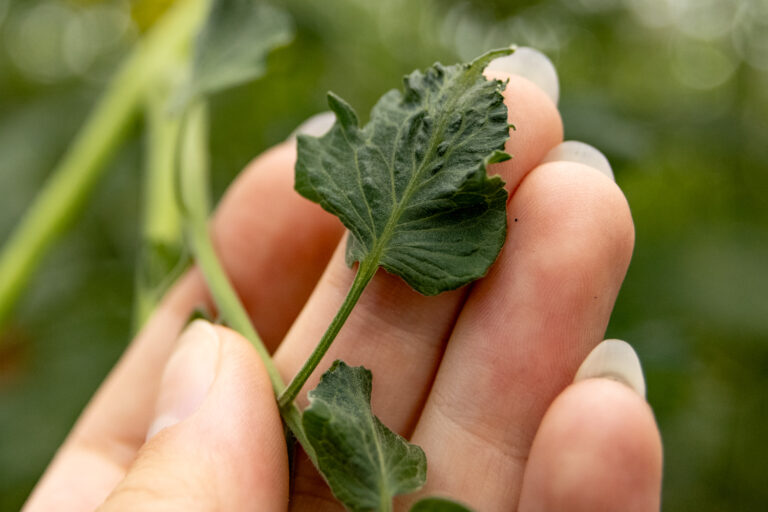
URBANA – Farm Manager John Williams walks through a greenhouse at Sola Gratia Farm surrounded by tomato plants that tower over him. He points to the curled leaves on one of the plants that he says was damaged by dicamba.
“Often, the plants response to that, getting hit with that pesticide is aborting fruit, just aborting flowers before they get pollinated,” he said.
Pesticides like dicamba applied to crops and lawns sometimes drift in the air for miles, harming plants and trees on public land or other farms.
There’s often no recourse for those with damaged plants.
“It’s a little bit unknown of how you get it addressed,” Williams said. “How could you potentially hold someone accountable?”
Dicamba is especially prone to drifting. Unlike other herbicides, it can vaporize even days after being applied in warmer weather and then travel for miles in the wind.
And that drift impacts the farm’s bottom line, according to Williams.
“We’ve now three years running being out here and having these extreme temperatures really seen a significant loss in some of our main crops – peppers, tomatoes,” he added.
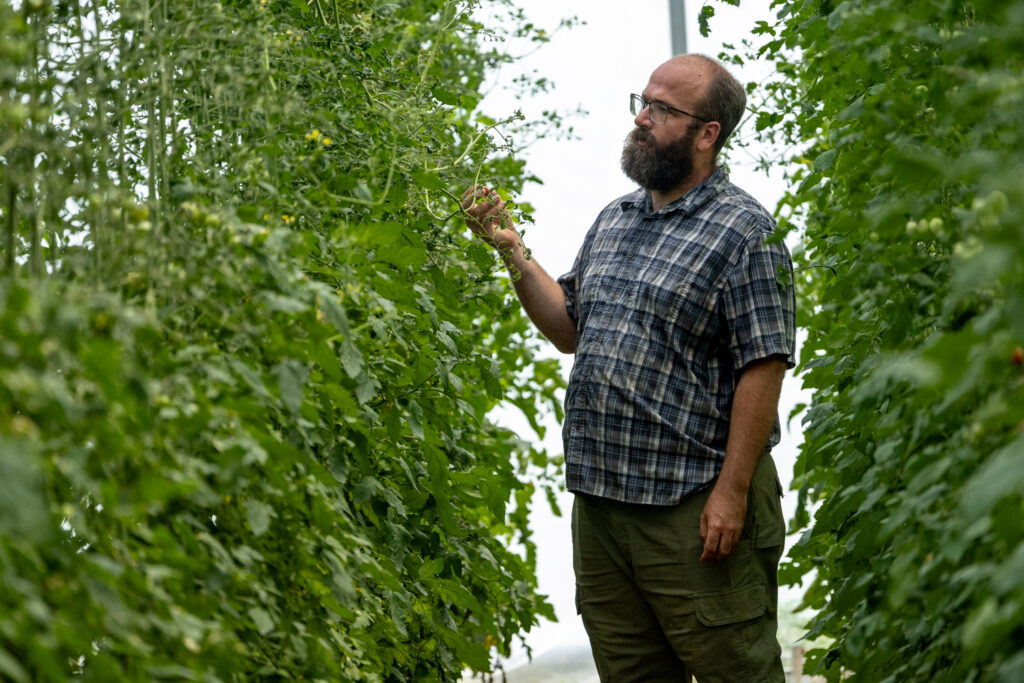
Williams has made complaints to the state for years.
“Illinois Department of Ag[riculture] doesn’t have the ability to hold people accountable unless they are neighboring properties,” he explained.
In a statement, the department said dicamba use must comply with federal and state restrictions. But experts say even then, dicamba can still drift for miles.
Kim Erndt-Pitcher is the Director of Ecological Health for Prairie Rivers Network, an Illinois-based non-profit focused on environmental advocacy.
“I have talked to many applicators that swear that they are using it responsibly, and they probably are following the law, the label to the letter,” she said. “However, if we get an 85°, 90° day three, four, five, six, seven, eight days later, that herbicide is gonna volatilize.”
What is regulated?
Dicamba can’t be applied to soybeans if the temperature exceeds 85° Fahrenheit, after June 20 or when the wind is blowing toward an adjacent residential area or an adjacent Illinois Nature Preserves Commission site, according to the Department of Agriculture. Applicators additionally must comply with recordkeeping and follow the federally approved pesticide label.
But dicamba isn’t just used on soybeans, according to University of Illinois Urbana-Champaign professor of weed science Aaron Hager.
“All the restrictions around dicamba are for two products only, and those are the two products that are labeled for us only in dicamba soybean,” he said. “There’s dozens of other dicamba products that are registered in the state, but they have other uses.”
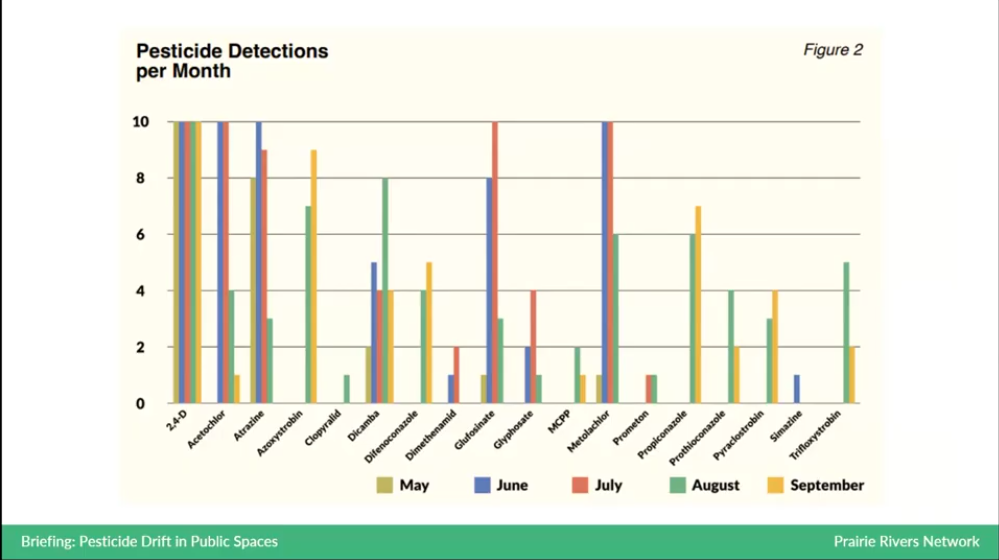
That means dicamba can be applied for other uses at any time, regardless of temperature, Hager said.
“Let’s say hypothetically it’s gonna be 89° today. According to label of the two soybean products, those cannot be applied that day,” he explained. “I can go spray every cornfield that I have with dicamba that day at 89°, because there’s no restrictions on the other products.”
Williams said Sola Gratia Farm is surrounded by houses and a golf course to the east. The nearest farm is half a mile away.
“The thing that we’re starting to kind of open our eyes and explore the potential is what damage is coming from [dicamba] use in nonagricultural spaces.”
It can be hard to determine the origin of pesticide drift, Hager said. Sometimes it is as simple as a neighboring field’s dicamba drifting next-door, but since dicamba can travel such far distances, it’s often more difficult.
“Now, if somebody was spraying five fields away, that comes up to be a different story,” he added. “They can’t necessarily look at every field around that area.”
‘A pesticide we can’t control’
The June 20 cutoff date is intended to stop dicamba use before the weather gets too hot and before sensitive plants become too vulnerable.
Erndt-Pitcher said the cutoff date isn’t enough to stop damage to trees and plants though.
“It seems that earlier in the year when there’s an event, a drift event, the more severe some of that cupping can be, because they’re impacting those growing leaves, right?,” she said. “So those herbicides are hitting the plants when these leaves are unfurling and growing, and that’s the most sensitive stage for them to be hit with a growth regulator.”
Prairie Rivers Network has been documenting pesticide drift in Illinois for nearly a decade. Data from 85 sites across the state from 2018 to 2025 found there was no endpoint to pesticide drift.
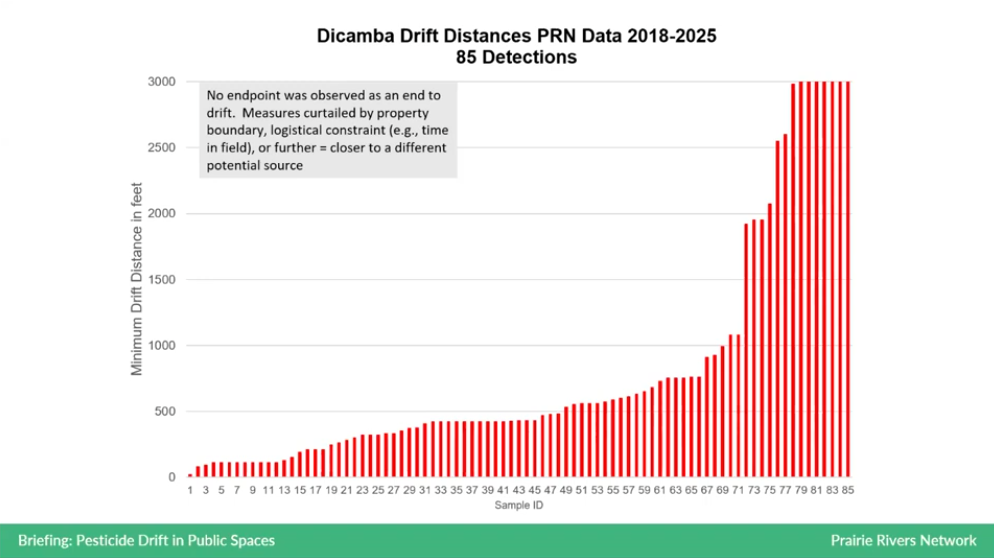
Erndt-Pitcher isn’t sure if there’s any regulations that would make dicamba safe to use.
“I don’t think we should be using a pesticide that we can’t control,” she said.
Hager said there’s very little science that supports dicamba use on soybeans and one of the state’s most problematic weed species has already developed resistance to it.
“It’s gonna be a very short term ‘solution, because if we continue to use it in this use pattern, we will evolve resistance to it on a very large scale in the very very near future.”