

Updated on Thursday, April 16, 2026 at 12:55 p.m. CT
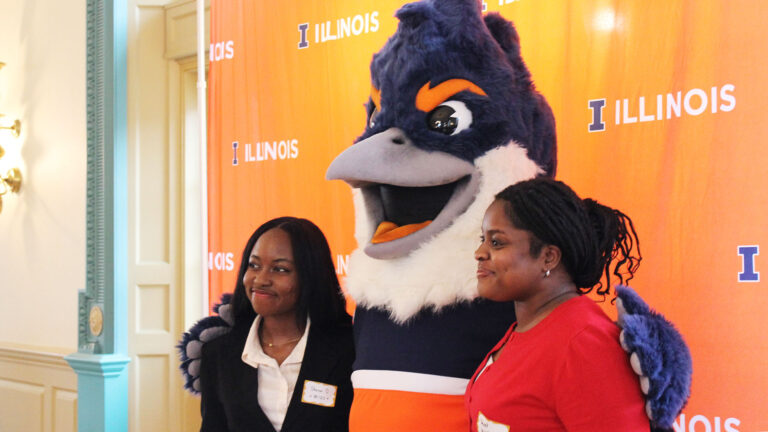
A student walks into a ballroom at the University of Illinois Urbana-Champaign wearing a six-foot tall bird costume. It represents the belted kingfisher, a blue and orange bird meant to match the school’s colors.
As soon as they step into the room, other students begin lining up to take pictures with the unofficial mascot.
Klaudia Babel is the social media coordinator for the King’s Guard, the student club pushing to make the kingfisher U of I’s new mascot. She said spontaneous photo lines form wherever the unofficial mascot goes.
“There are kingfishers that live over in Boneyard Creek [on campus]. They’re native to Illinois and North America, but kingfishers are found all over the world — just like our students are,” Babel said.
Twenty years ago, the National Collegiate Athletic Association (NCAA) told U of I it could not bring out its then mascot at championship games. The NCAA said Chief Illiniwek was hostile to Indigenous communities.
U of I retired the fictional chieftain in 2007, but it has not picked a new mascot. In a statement, university spokesperson Pat Wade said U of I hasn’t found a mascot yet that clearly shows it can bring the community together.
Other schools have moved on, and Native American faculty say the inaction at U of I is damaging the campus community. Students are trying to fill the void and unite the campus behind a new mascot, even as the old athletic symbol persists.
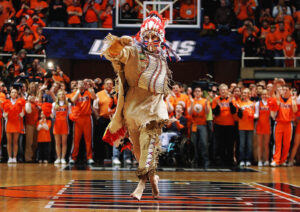
Native students and faculty have sought to discard the old symbol for decades
Multiple local bars near campus have Chief Illiniwek statues. Babel said at sporting events, dads sometimes shout “Chief! Chief!” at the student in the kingfisher costume.
Supporters of Chief Illiniwek said the feathered headdress, face paint and halftime dance honored Native Americans.
Many Native students and faculty at U of I saw it differently.
Joseph Gone is a member of the Aaniiih-Gros Ventre Tribal Nation in Montana and a professor at Harvard University. In the 1990s, he was a PhD student at U of I.
Gone focuses on mental health in Indigenous communities and points to research that shows exposure to Native American mascots shortens Native youths’ dreams for their future.
“We made the rounds and made all the arguments and offered the best rationales,” Gone said.
Gone and half a dozen other Native students at U of I believed they could educate the higher-ups on campus and get the Board of Trustees to eliminate the mascot.
“Many of the people we talked to privately acknowledged that those rationales and arguments made sense to them, but they were powerless to do anything,” he said.
It took a threat from the NCAA to push U of I to change. The school tried to appeal the policy on racist mascots and lost its second appeal in April 2006. They retired the mascot a year later.
U of I still maintains the Chief Illiniwek trademark. The school earned $40,000 in royalties from the trademark in 2025 and $5,200 in the first quarter of 2026, according to Wade.
Wade said maintaining the trademark “allows the university to manage and restrict unauthorized users” and that it represents a “small fraction of overall trademark-licensing revenue.”
Gone said the fact U of I continues to make money from the Chief imagery is a problem.
“There’s nothing good that comes from universities and institutions of higher education, whose commitment is to the pursuit of truth, to instead officially sponsor a harmful racial stereotype,” Gone said.
One Native American group is working with President Trump to keep old mascots
Political winds have shifted since the NCAA ruling 20 years ago.
President Trump threatened to hold up the Washington Commanders’ plans to build a new stadium last year if the team didn’t revert to its previous name.
And he has an ally in the Native American Guardians Association (NAGA).
Becky Clayton-Anderson is president of NAGA and an enrolled member of the Hidatsa in North Dakota. She grew up in Central Illinois and went to Sullivan High School, where the sports teams are the Redskins.
“My mom always taught us to be very proud to be the real Redskins, and if anyone was going to be offended by being the Redskins, it would be my mom,” Clayton-Anderson said.
NAGA has released statements and petitions in support of Trump. The Department of Education has supported NAGA’s latest lawsuit.
“We’re one step away from the Supreme Court, where we will win, showing that people trying to eliminate Native American names and images is discrimination against a race,” she said.
Clayton-Anderson said NAGA’s next step is to go back state-by-state to make schools reinstate names and images like Chief Illiniwek.
How Arkansas State moved on from its Native mascot
But many schools have moved on — and some administrators say they don’t want to go back.
Brad Bobo is associate athletic director for marketing at Arkansas State University. He said he is proud to have graduated from the school when the students were “the Indians,” but he says the old mascot had its own challenges.
“You were so mindful about not being disrespectful to Native Americans that honestly that you were a little bit handcuffed from a marketing and a licensing standpoint by what you could do with that nickname,” Bobo said.
The NCAA listed Arkansas State among 18 universities with hostile symbols. The organization told them to eliminate Native American mascots or obtain official support from a particular tribe.
When bigger schools like U of I lost their appeals, Arkansas State decided to change.
Bobo said the university put a document on its front page, allowing anyone to submit a mascot idea. The university also pulled together a committee where local business owners, alumni and staff all felt they had a say.
The sports teams became the “Red Wolves.” Bobo said the new mascot didn’t lead to any decline in alumni donations, because the process of getting there was so collaborative.
“Even though you don’t like being told you got to do something, changing I would tell you changing with was the best thing for us,” Bobo said.
Does finding a new mascot matter?
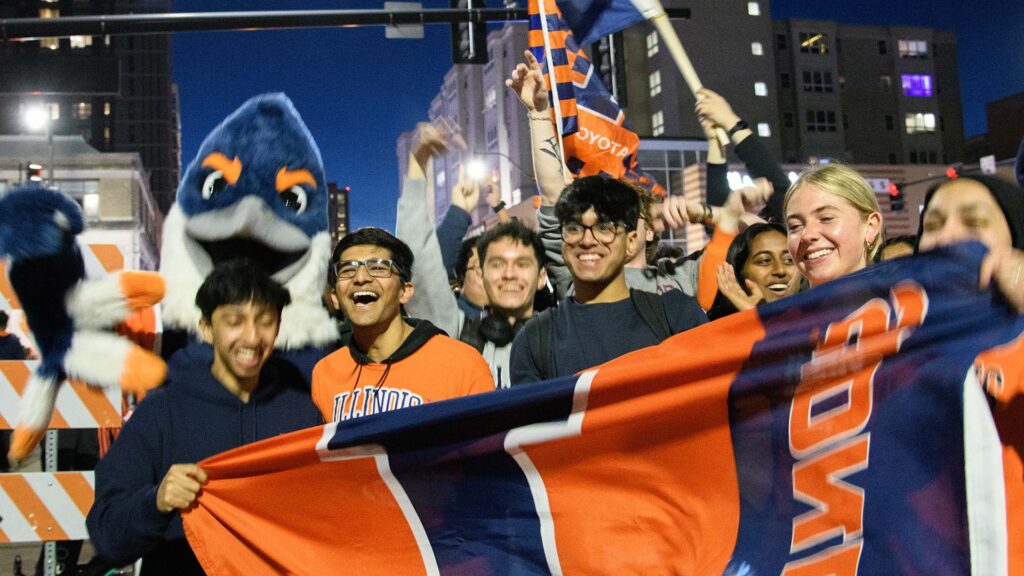
Several community members at U of I say not having a new mascot continues to harm Native Americans on campus.
Jacki Rand is an American Indian Studies professor at the school and a citizen of the Choctaw Nation in Oklahoma. She said administrators still show hostility towards Native students and faculty.
“They have letters from faculty in their offices that say, “This is very disturbing.” I can’t believe I have to work here in these conditions,” Rand said.
Rand was pushed out as Associate Vice Chancellor for Native Affairs two years ago without much explanation.
U of I spokesperson Pat Wade said student affairs and civil rights administrators are meeting now to advise the university’s new chancellor about future directions for the role.
Rand said the lingering presence of Chief Illiniwek makes it hard to hire Native American faculty.
“Instead of having a legit, real mascot, we’ve got this ghost mascot,” Rand said. “It just hovers.”
Rand is a fan of the King’s Guard and hopes the students will continue pushing for a new mascot.
Vijay Shah, a U of I PhD student and advocacy director for the King’s Guard, said the campus is coalescing behind the kingfisher.
“The amount of time that students have waited for some meaningful action, I think has really resulted in many people coming together in a way that just hasn’t happened in previous years,” he said.
UPDATE: This article has been updated to clarify that the University of Illinois is not actively searching for a new mascot, according to spokesperson Pat Wade.