

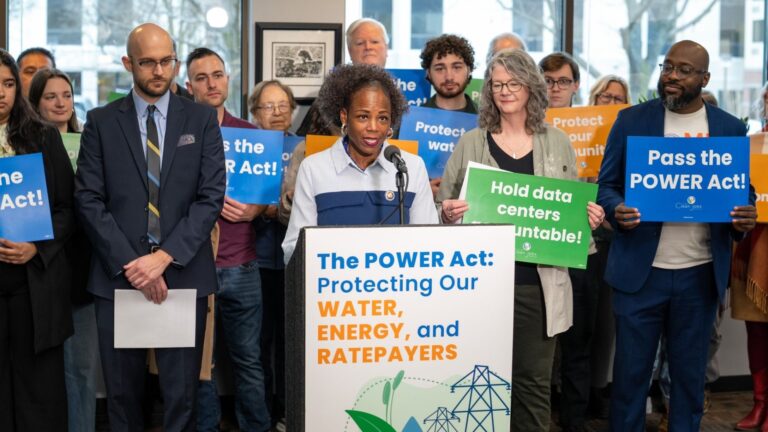
CHAMPAIGN — A new challenge has emerged on the agenda for lawmakers in Springfield: regulating the growth of high-tech data centers to shield consumers from rising electricity costs and protect Illinois’ natural resources.
Data centers hold computers and servers that are used to transmit large amounts of data. They require ample electricity to power them and water for cooling purposes.
Lawmakers from both parties argue the centers pose a significant threat to Illinois’ power grid and freshwater sources like the Mahomet Aquifer, but they are offering different visions for how to regulate the industry.
Democrats and environmental advocates introduced a broad regulatory framework under a bill called the POWER Act. A Senate Republican filed a competing package that would limit data center activity around the Mahomet Aquifer and, in an attempt to lower electricity costs, rein in a recent energy bill Gov. JB Pritzker signed into law in January.
The POWER Act: Demanding ‘Big Tech’ Pay Its Fair Share
At a press conference in Champaign, State Representative Carol Ammons (D-Urbana) joined the Illinois Clean Jobs Coalition, a group of environmental advocacy organizations, to sound the alarm on data centers.
Ammons said a city the size of Orlando requires roughly one gigawatt of power, but she said there are currently 44 gigawatts worth of data center projects awaiting approval in Illinois.
“You and I shouldn’t have to pay for that,” she said. “Nor should we be paying for the upgrades necessary to support these data centers. We deserve basic transparency and to know that data centers won’t jeopardize our water supplies.”
The POWER Act, filed as HB 5513 and SB 4016, would encourage companies to provide their own renewable energy sources to help power their centers.
Advocates said the bill also seeks to close loopholes that allow backup diesel generators to operate outside of true emergencies and create a “Water Impact Permit” administered by the Illinois Environmental Protection Agency.
Andrew Rehn, climate policy director at Prairie Rivers Network, noted 70% of the state is currently experiencing a drought, arguing the millions of gallons used by data centers for cooling should not go unmonitored.
“Our state is uniquely vulnerable,” he explained. “There’s no meaningful oversight, no permitting system, no impact analysis, and no requirement to ask whether there is enough water right now, let alone in a hotter, drier future.”
Another provision in the bill would block companies from using non-disclosure agreements to hide deals from the public.
Republican seeks protections for the Mahomet Aquifer
State Senator Chapin Rose (R-Mahomet) filed a competing bill that would also regulate data centers, though his proposal more specifically targets centers that would operate around the Mahomet Aquifer, the sole source of drinking water for nearly one million residents in Central Illinois.
Rose’s bill would ban companies from using water in the aquifer, require them to seek alternate water sources and prohibit local governments from having non-disclosure agreements with data center companies.
“It is not an infinite resource. It is a finite resource,” Rose said. “You can’t just flip a switch and turn on a spigot from somewhere else, so we got to be really cautious and protective of that.”
The senator’s approach differs from the Democrat-led legislation, which would give the Illinois State Water Survey the responsibility to assess impacts on water sources before granting companies a permit.
Rose said he had not seen the proposal Ammons was backing, though he prefers his approach taking a permanent moratorium near the aquifer.
“I think it’s great that there’s a chorus of voices on this,” he said. “I certainly have no pride of ownership if somebody’s got a better mouse trap. I’m more than interested in hearing about it.”
Republicans seek ‘common sense’ reset on energy costs
Rose’s legislative package goes a step further, arguing the state should walk back energy policies that he says are driving costs up for Illinoisans.
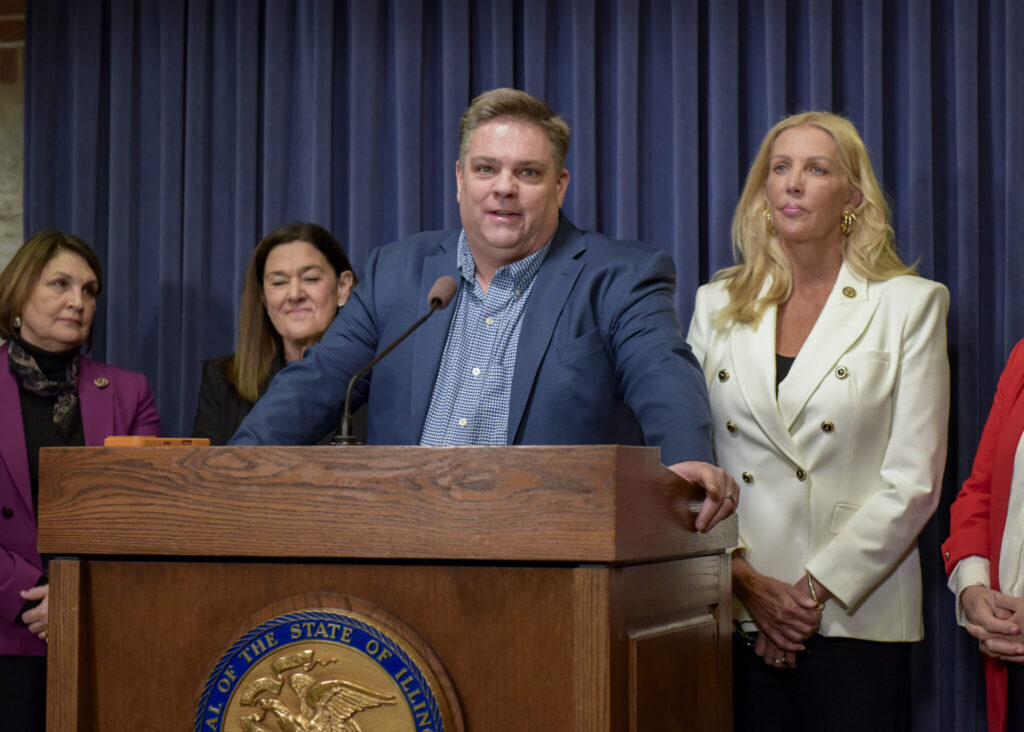
The Senator describes his proposal as a “common sense” reset following Democrats’ passage of the Clean and Reliable Grid Affordability Act, which aims to boost renewable energy and invest $8 billion to support battery storage.
Rose’s bill would repeal the battery storage requirements and institute rate caps he claims were removed. He said the approach would combat a “direct increase in everyone’s power bills” compared to neighboring states.
“What a family in Missouri is paying is substantially less than what a family in Illinois is paying,” Rose told IPM News. “When you look at that, you have to say, ‘Well, what is Illinois doing that’s so completely … screwed this up?'”
Data from the U.S. Energy Information Administration indicates Illinois consumers paid less on their average monthly electricity bills in 2024 than in surrounding states.
Both the Democratic and Republican-led bills have been referred to committees in the General Assembly.