


The film China’s College Takeover begins with a shot of tractors harvesting a golden field of crops, as the filmmaker lists the attributes he thinks the Midwest should bring to mind.
“When you think of Central Illinois in the American heartland, you probably conjure up images of abundant fertile farms, windswept plains, hardy Midwestern patriots, and perhaps even the University of Illinois Fighting Illini,” narrates former Trump campaign advisor Steve Cortes. “But unfortunately, you should also picture this.”
The film cuts to video from a previous Illini football game. A player runs for a touchdown as a sportscaster commentates in Chinese.
“Yes, that’s Illini football broadcast in Mandarin Chinese in the middle of America. Why?”
Cortes supported President Trump’s 2016 and 2020 campaigns. He is from the Chicago suburbs and has friends who went to the University of Illinois Urbana-Champaign whose kids, he said, were qualified but did not get admitted.
In his documentary, which published on Feb. 5, Cortes argues Chinese international students took their place.
“My main hope is that we stop allowing Chinese nationals to attend university in the United States. I think it’s wrong. I think that number shouldn’t be 300,000. It should be zero,” Cortes said in an interview.
Cortes said he had not heard about legislative efforts to increase funding for Illinois’ universities through a funding formula that would expand opportunities at every public institution.
‘They deserve to come here’
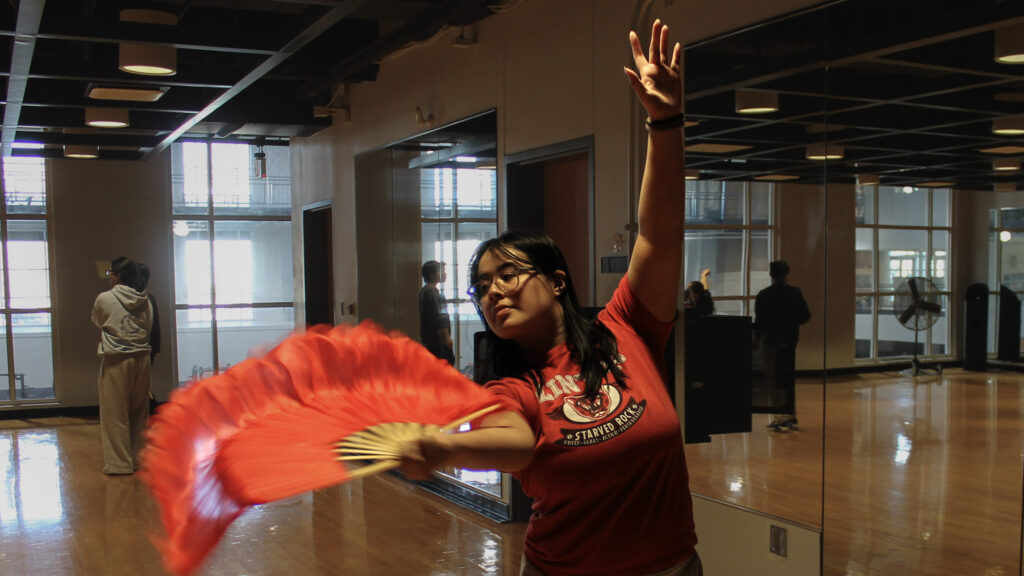
Sharon Nguyen is a sophomore at U of I and is Vietnamese American. She thinks it is sad to hear people say immigrants are “taking” opportunities away when they enrich their communities.
In Nguyen’s case, U of I’s global population is giving her the chance to research differences between international speakers of Vietnamese and those born in the United States.
“I actually had a friend that came from Vietnam down here. Those types of research will be eliminated or endangered if there’s not a lot of international students,” Nguyen said.
She opposes the idea of barring students based on their nationality.
“They deserve to come here if that’s what they feel is best for them,” she said.
Getting into the University of Illinois is hard for both international and domestic students, according to U of I spokesperson Pat Wade.
Wade said U of I ranks second among Big Ten schools in admitting in-state students. In the fall, he said, 71 percent of freshmen were from Illinois, with 6,587 in-state students and 724 from China.
“Domestic and international students with strong academics, well-written essays, and activities faced denial due to space constraints in specific majors, in addition to a larger and more competitive applicant pool,” Wade said in an email.
A presentation from the Office of Undergraduate Admissions indicates it is harder for international students to get in. Less than a third of international applicants were admitted in 2025, compared to half of the Illinois resident applicants.
Cortes argues Chinese students, in particular, are a national security threat because of documented instances of spying and cheating on admissions. Wade said there has been no data to show U of I’s Chinese students are doing either of these things.
“We recruit the brightest and most talented scholars in the world, and as far as we are aware, their contributions have only resulted in more innovation and a richer educational environment for our entire university community,” Wade said.
Similar rhetoric has harmed Asian Americans before
Experts say it can be dangerous to say there are “too many” of any group of people.
“It could lead to unintended harmful and disastrous social consequences. We saw a lot of these kinds of moments in our history books, not just here, but in many other countries too,” said U of I East Asian Studies professor Shao Dan.
Shao taught a class during the pandemic called “Yellow Peril Redux: From Coolies to Cars, Trade Wars and Coronavirus.”
“‘Yellow peril’ is a kind of shorthand for a set of similar rhetoric styles, wording choices, imaginations and arguments that perceive East Asians or Asians as invading, an economic, social, cultural or political threat to the US as well as some other countries,” Shao said.
Research by Shao and others have found “yellow peril” rhetoric has led to tragedies.
Shao’s “Yellow Peril” syllabus started with the case of Vincent Chin. He was a young Chinese American man in Detroit who was killed by autoworkers in 1982 when there were concerns about American auto jobs due to the the rising popularity of Japanese cars.
Cortes said he does not support violence against anyone. He wants the United States to ban Chinese students from attending U.S. universities, and he thinks the country should decrease its percentage of international students to about 1%.
He said the goal is to expand admissions for domestic students of all racial groups.
U of I College of Education and Asian American Studies professor Yoon Pak said racial scapegoating has long been part of American history, from excluding enslaved people from citizenship to America’s first race-based anti-immigration legislation, the 1882 Chinese Exclusion Act.
Pak said the politicians who passed the 19th century law often had not met anyone who was Chinese. They were responding to dehumanizing portrayals in the newspapers of the time.
“The sense of the ‘yellow hordes,’ the ‘yellow peril,’ the fear, the invasion. It’s really preying upon these immediate feelings of ‘attack.’ And it is the kind of rhetoric that still unfortunately continues today,” Pak said.
Pak said schooling and pop culture has the ability to overturn such stereotypes. She has helped guide teachers on Illinois’ recent Asian American history mandate. She recommends weaving the history into broader themes, like who has been excluded from American citizenship over time.
For further reading (and watching), the two professors recommend:
- The documentary Who Killed Vincent Chin?
- An exhibit with the Champaign County History Museum about Chinese scholars like Y.T. Lo, who helped theorize how to make antenna work in space
- Primary sources on “yellow peril”
- Strangers from a Different Shore by Ronald Takaki
- America for Americans by Erika Lee