

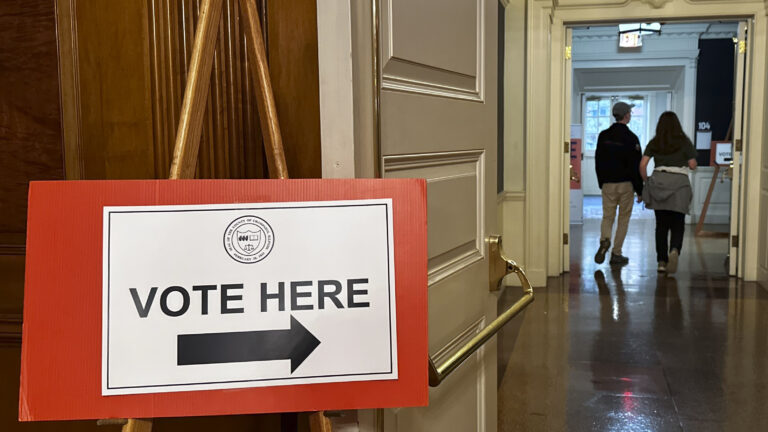
CHAMPAIGN — This election, voters in the townships of Champaign and Cunningham will be asked whether Illinois should repeal a law that prohibits the state’s pension fund from investing in companies that boycott Israel, known as the anti-Boycott, Divestment and Sanctions – or anti-BDS – law.
Voters will answer “Yes” or “No” to the following question: “Shall the State of Illinois repeal amendments to the Illinois Pension Code that penalize American businesses for boycotting the State of Israel?” The referendum is non-binding, meaning the result won’t change state law.
Illinois unanimously passed its anti-BDS law 11 years ago. It was the first state to do so, but now some policymakers hope to be the first state to reverse the policy.
Bryan Maxwell, an Urbana resident involved with Illinois for a World Beyond War and Champaign-Urbana for Palestine, has been canvassing for the past few weeks to spread awareness of the referendum question in the area.
He called the current law a restriction of the First Amendment — including the protected right of boycotting — in favor of a foreign government.
“It basically weaponizes the state’s pension system, which covers millions of workers in Illinois, in the interests of Israel,” Maxwell said.
But according to Rebecca Weininger, senior regional director for the Anti-Defamation League Midwest, the BDS movements hold American Jews responsible for the Israeli government’s actions. She said the anti-BDS law helps protect Jews in America.
“The social impact of repealing the anti-BDS law will be catastrophic to Jews,” Weininger said. “It’s about normalizing [and] justifying violence against Jews and pushing Jews out of spaces.”
Weininger also said the referendum questions serve to ostracize the Jews in Champaign and Cunningham townships since the townships have no repealing power even if the referendum is passed. She said the townships’ job is only to make their citizens’ lives better.
She also said Illinois’ anti-BDS law does not restrict individuals from boycotting. Maxwell sees it differently.
“I would say that [it] does because American businesses are owned by individuals,” Maxwell said. “It does affect the rights of Americans in this state.”
The debate over repeal
Currently, the law bars the Illinois Investment Policy Board from investing in companies attempting to penalize, economically harm or limit relations with Israel.
IIPB also restricts investments in for-profit companies that are expatriated entities or that contract to shelter migrant children, along with companies based in Belarus or Russia, among others.
Some Illinois lawmakers, including local State Rep. Carol Ammons (D-Urbana), signed onto legislation earlier this year to change the part of the law about boycotting Israel: HB 2723 and SB 2462, but those bills have not advanced.
The proposed legislation would remove companies that boycott Israel from the IIPB’s list of restricted investment companies but leave the other restricted categories alone.
The referendum question in Cunningham and Champaign townships references only the part of the current law that restricts companies boycotting Israel.
Maxwell said most people he has spoken with while canvassing have no idea the current law exists, and that, often, their “jaws drop” when they hear about it.
Illinois’ list of restricted companies that boycott Israel includes Adidas, Air Canada and 25 other companies. In 2021, the IIPB added Unilever to the list after its subsidiary, Ben & Jerry’s, ended a license for selling its ice cream in the West Bank and East Jerusalem. Unilever has since been taken off the list.
The Illinois Coalition for Human Rights, an organization that claims to defend civil liberties, supports repealing the anti-BDS law. On its website, the group says its analysis of publicly available investment data estimates the current anti-BDS law has resulted in about $150 million in lost returns for the pension fund.
“A boycott against a foreign government supersedes the actual quality of the investment portfolio,” Maxwell said. “It doesn’t matter how good of an investment you are as a company — if you’re boycotting Israel, the state won’t invest in you.”
Weininger disputes the economic loss.
“There’s a bunch of rumors out there about these big amounts of money that it cost the state — nobody has ever proven that,” Weininger said.
The results of the referendum won’t create concrete change, Maxwell said, but he hopes the result will show state lawmakers that their constituents support a repeal of Illinois’ anti-BDS law.
Six other townships in Illinois will see similar referendum questions on their ballots, according to Maxwell, including Peoria, Kickapoo, Medina, Normal, DuPage and Oak Park townships.
In Weininger’s view, the negative message to the Jews in those townships outweighs the potential impact on the state legislators. Instead, she said voters should call their local representatives to express their opinions about the law.
Both Maxwell and Weininger encouraged voters to do their own research on the issue to make an informed decision about the question.
Early voting is underway, and Election Day is Nov. 3. See your personalized ballot here.