

Updated on Wednesday, June 3 at 10:48 a.m.
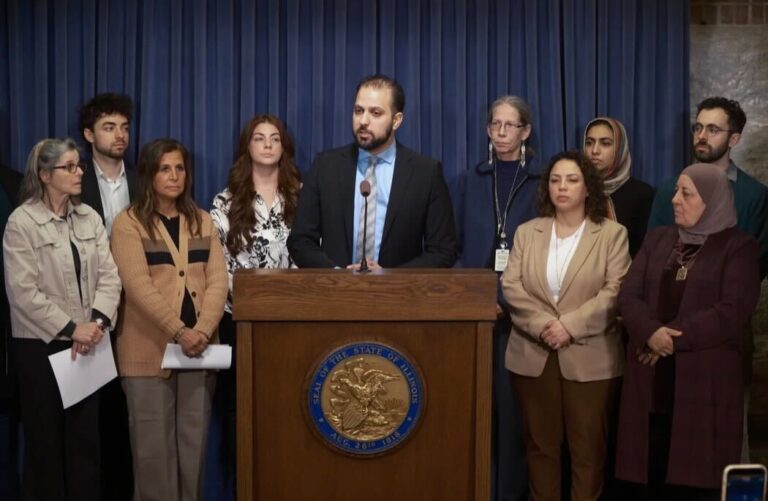
SPRINGFIELD — A decade after Illinois became the first state in the nation to restrict its public pensions from investing in companies that boycott Israel, lawmakers are debating whether to become the first to reverse the policy.
The legislative package, consisting of House Bill 2723 and Senate Bill 2462, would lift current statutory restrictions that bar state public pension funds from investing in corporations that participate in the Boycott, Divestment, and Sanctions—or BDS—movement targeting Israel.
Passed unanimously in 2015, the law made Illinois a national leader in anti-BDS pension legislation. Now, lawmakers are weighing competing concerns.
The free speech and financial arguments
Supporters of the repeal bills, known collectively as the Illinois Human Rights Advocacy Protection Act, state that the 2015 law penalizes constitutional rights and sets a dangerous precedent for state-level censorship.
Democratic State Representative Abdelnasser Rashid (D-Bridgeview), the chief sponsor of the House repeal measure, said the current law unfairly penalizes political boycotts and infringes on free speech protections.
“Israel is the only country that’s protected from peaceful boycott,” he told IPM News. “A boycott is a form of nonviolent protest.”
The democratic state representative and other supporters of repeal also argue the restrictions interfere with the fiduciary responsibilities of pension boards and could negatively affect long-term investment returns.
Rashid further argued that companies can boycott other nations — including the United States — without triggering state investment penalties.
“And our pension funds won’t say a word, but the moment that a company boycotts Israel, that company faces state retaliation,” he said. “That is wrong on multiple levels. It is an infringement on free speech.”
Advocates also point to the financial impact of investment restrictions on state retirement systems.
Amina Barhumi, the executive director of the Muslim Civic Coalition, said the law creates “a dangerous double standard on free speech,” while actively harming state taxpayers.
“We know that the law already costs Illinois pension funds about 150 million in lost returns,” she added. “Pensions should be made on the basis of merit… regardless of someone’s view, a loss of free speech that’s codified into Illinois law, is a loss for all of us.”
Barhumi connected the issue to broader concerns about political advocacy surrounding Palestine.
“We don’t want our tax dollars funding genocide, and we had a First Amendment right to peacefully express our political views through boycotts and without government punishment,” she said.
Local impact and grassroots activity
The legislative friction in Springfield is directly intersecting with grassroots campaigns at the municipal level. In April, local voters approved advisory resolutions in Cunningham and Champaign townships to place the pension divestment issue on the November ballot.
Dua Aldasouqi, an organizer with the Champaign-Urbana Muslim Action Committee, said the state law is already shaping municipal policy discussions.
“When we tried to work with Champaign City Council and discuss divestment and investment in ethical policy, what we found is that the lawyer referred to that bill, saying we can’t do this,” she explained. “It creates this overall chill effect when it comes to Palestinian advocacy.”
The broader policy environment also affects Muslim and Palestinian communities in Illinois.
“We’re seeing and have seen how federal agencies like ICE is being used to target and intimidate those picking up for human rights… and here in Illinois, we’re not setting a better example…”, Aldasouqi noted.
Opponents worry about negative impact on Illinois’ Jewish community
Opponents of the repeal say the 2015 law is narrowly tailored and does not infringe upon domestic political expression or individual First Amendment rights.
Sarah Van Loon, the Chicago regional director for the American Jewish Committee, said the statute only governs state pension investment decisions.
“A company can boycott the state of Israel and still do business with the state of Illinois,” Van Loon explained. “The current law that’s on the books just says that the state of Illinois pension funds aren’t going to invest in a foreign company that has nothing to do with their state-based contract, and again, this current bill that’s on the books does not limit free expression or political speech…”
Rebecca Weininger, Senior Regional Director for the Anti-Defamation League Midwest, warns that repealing the law would not change conditions in the Middle East, but could affect Jewish communities in Illinois.
“So, let’s say the BDS is successful here in Illinois, that measure will not have any discernible effect on Israel, but it will have a very meaningful effect on the Jews in Illinois.”
In emailed comments, Weininger responded to Rashid’s remarks about a recent committee hearing in which he said the ADL was unable to explain how the current law would enable discrimination.
She wrote that the repeal effort reflects a broader intent to open the door for boycotts targeting Israel.
“This bill is intended to pave the way for Illinois to boycott Israel,” Weininger wrote. “We don’t have to guess about what the intent of the bill is.”
Weininger noted that BDS movements single out Israel as a Jewish state.
“What BDS provisions/statutes actually do is create a pretext for the communities where they pass to boycott local Jewish and Israeli businesses and otherwise systematically exclude Jews from civic, professional, artistic, academic spaces,” she said.
House Bill 2723 and Senate Bill 2462 remain under consideration in the Illinois General Assembly.
CORRECTION: This article has been updated to correct the title of Rebecca Weininger as Senior Regional Director for Anti-Defamation League Midwest. The title was previously published as Director of State Government Affairs for the Anti-Defamation League Midwest.