

This story is part of America @ 250: The Questions Before Us, a series from IPM News and the Illinois Student Newsroom.
CHAMPAIGN — A birthday is a time for reflection: Where have we been? Where are we right now? And where are we going?
IPM is marking America’s 250th birthday by inviting people from across east-central Illinois to share what they think are the most important questions facing Americans at this historic moment.
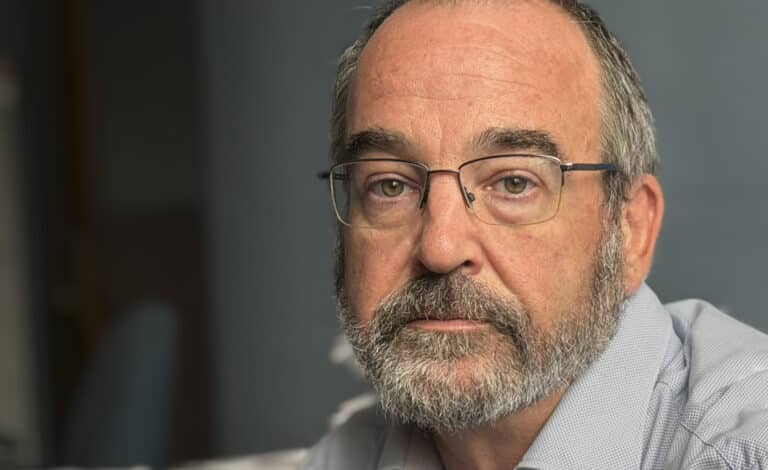
Kevin Scharp studies artificial intelligence, as a philosophy professor at the University of Illinois Urbana-Champaign. He says America—and humanity—is at an unprecedented crossroads in our relationship with AI.
The following transcript has been lightly edited for length and clarity.
We’ve pushed this technology far enough that we’re not in control of it anymore.
It seems like we’re in control. Like, I’m sure people will say, “Well, why don’t you just unplug it, you know?” Unplug it? Good. You’re going to unplug yours. Your competitors aren’t going to unplug theirs. There’s more money to be made. Your enemies aren’t unplugging theirs, you know? So, “unplug it” isn’t going to work at all. The structure of our country and our international society is set up so that this will not stop. That’s impossible.
And instead, what’s going to happen is full speed ahead to, I think, something vastly more intelligent than any person or group of people — something that would be very difficult to comprehend, maybe incomprehensible; very difficult to control, maybe uncontrollable. And so that’s the real worry. If it decides to do something that causes doom, then we can’t do anything about that.
The models that I’m using are suggesting — I’m one guy, take it with a grain of salt — but those say the following: there’s about an 89% chance of doom, where doom is defined as the worst one, which would be human extinction. 89% chance of human extinction in the next 12 to 18 months, you know. So, 10% chance of things going well with superintelligence and a 90% chance of things going poorly with superintelligence coming along.
We are creating something that poses a major existential threat to us. A few humans are in charge of doing that, and the rest of us are being taken along for the ride without anything — any choice, any vote, any of it. And now it’s already over. It’s not like we’re going to be able to go back and redo it. Those choices have already been made. We’re already along for the ride.
The safety is not there. You know, agents are communicating with each other, socializing, learning from each other. They’re better than me at every academic pursuit other than philosophy, which I’m an expert in. So, I mean… that’s my fundamental expertise, is in philosophy. And so I am still better than them at philosophy, but not by very much. And it won’t last very long.
In 2025, AIs could not do math at a professional level. Starting in early 2026, AIs started picking off extremely difficult math problems that mathematicians have been working on, in some cases, for 50 years… human mathematicians.
So now the end of 2026 and the beginning 2027 is going to be really where a lot of the action happens, and we will be able to see this technology improve itself, and improve the next generation, and improve the next generation, improve the next generation.
So an AI that’s vastly more intelligent than any person or group of people put together, working together — something that would be incredibly difficult for Homo sapiens to understand and incredibly difficult for Homo sapiens to control, because we’re not part of that loop as much anymore. You know, we’re sitting back and watching it happen.
We’ve elected folks in our country to allow billionaires to do this, for the most part, without any regulation or oversight. And the goal for them is to make trillions of dollars by essentially replacing everyone’s jobs with AIs.
So, I think that within the United States, as a group of humans, you know, trying to figure out how to live together, there’s a million questions, but none of those questions matter at all as much as our relationship to this new, massive threat. And in our relationship to this new massive threat, we don’t have questions. We have requests.
Deer don’t ask about quantum theory. They say, “Can I have food,” right? That’s how it works. So that’s where we’re going to be, as wildlife making requests of something that we don’t understand and can’t control.
This story was reported by University of Illinois Journalism Professor Charles “Stretch” Ledford. If you have an idea for the America @ 250 series or would like to be featured in an upcoming story, please contact Stretch at stretch@illinois.edu.