

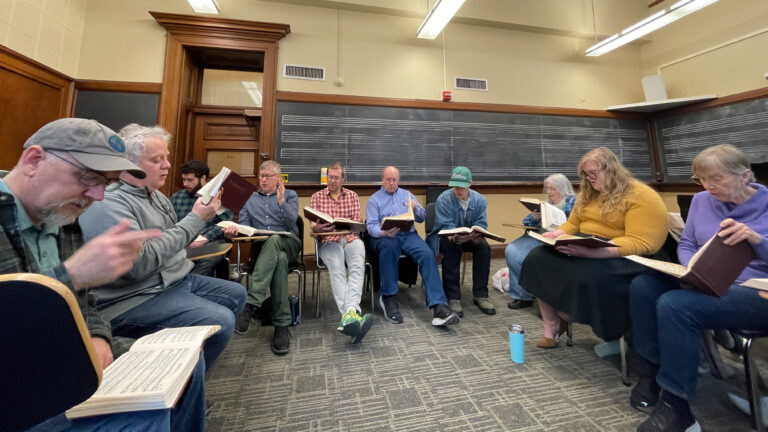
Sacred Harp is a non-denominational a cappella musical event, where everyone, regardless of experience, can come together and sing. For over 200 years, the tradition has aimed to unite communities across the country.
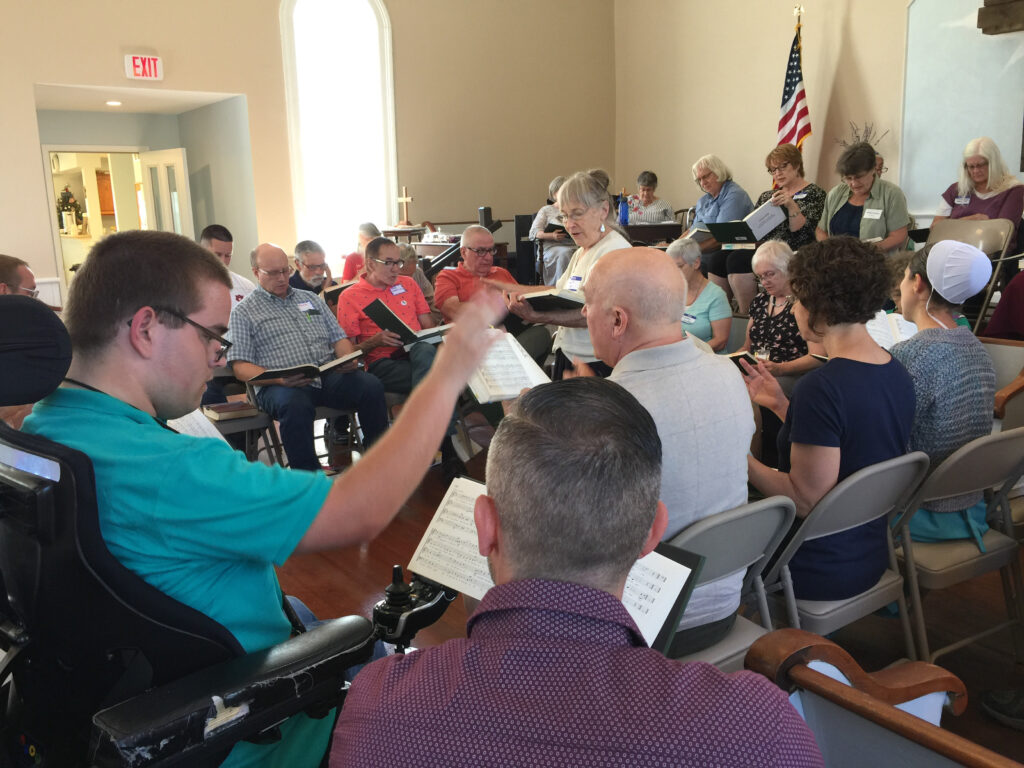
Sacred Harp singers are arranged facing forward in a hollow square with people taking turns standing in the center to lead songs from the “The Sacred Harp” book. The practice originated in colonial New England, which then spread to the rural South and gained popularity in cities during the 20th century.
Now, Sacred Harp takes place nationwide, from Alabama to New York and Illinois. This year’s Illinois State Sacred Harp Convention will be held in Urbana at the Channing Murray Foundation on Saturday, Sept. 20.
Jonathon Smith, a musicology professor at the University of Illinois Urbana-Champaign, has been attending Sacred Harp singing events for 20 years and has studied the history of the Sacred Harp tradition.
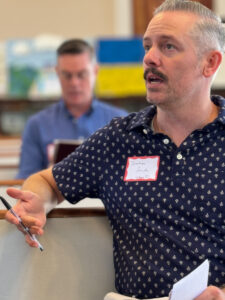
“It’s this really amazing feeling that sometimes will hit you… you’re like. ‘I don’t know these people, but I’m doing this thing with them that’s really important to us all,'” Smith said.
He said that although the songs are Christian hymns, Sacred Harp has historically welcomed all faiths.
“They were sort of meant to be for everyone to come together singing, regardless of particular religious backgrounds,” Smith said.
During divisive times, Smith said Sacred Harp provides a place to set politics aside and enjoy music together, “and that’s actually refreshing for a lot of people.”
Smith said he gets emotional during singings because of the connections he builds. “Sometimes you’ll be singing then something just you know you feel emotional because sometimes you’re with people that you really care about,” Smith said.
The history of Sacred Harp singing
Historically, Sacred Harp singing has been seen as a predominantly white tradition, according to Smith.
Despite this, Sacred Harp’s reach across the country has made the tradition more diverse. People from all walks of life attend these events, including people from different sexual orientations, religions and beliefs, said Erik Schwab, a Sacred Harp singer in Illinois.
“The appeal is broader and the community of singers is probably more diverse than it has ever been,” Schwab said.
Some singers have a deep connection with the practice. Eric Morgan, a fourth-generation Sacred Harp singer, has participated since he was a child. It’s a family tradition that traces back to Alabama on his mother’s side of the family.
“It’s very important to me and my identity because it has such a strong family connection,” Morgan said. “I really feel the weight of that, that it’s important to me that we continue this legacy.
The role of music in mourning
Morgan said he finds joy in the community Sacred Harp creates, and he also sees how the practice can help with the mourning process.
During the end of Sacred Harp conventions, people participate in “memorial lessons,” in which singers read a list of names of people who have died or are ill and sing songs to honor them.
Morgan will lead the memorial lesson at this year’s Illinois State Sacred Harp Convention. He hopes to honor his cousin’s legacy, who died this summer.
“It’s just a really good time for the community to understand that we’re a part of a larger community that has lots of experiences,” Morgan said. “We can come together and share these moments of grief together as a way of healing.”
Friendships forged through song
Schwab said when people hear the loud resonant voices of Sacred Harp singing, there is nothing quite like it. He remembered a well-loved Sacred Harp singer once said: “I would walk miles to sing Sacred Harp, but I wouldn’t cross the street to listen to it.”
Singing at an annual Sacred Harp convention lasts for about three hours, with opportunities for participants to connect with each other outside of the music.
U of I musicologist Jonathon Smith, who began practicing the tradition during college in South Carolina, said the reason why he keeps coming back to the tradition is because of the people.
“My closest friends are Sacred Harp singers,” Smith said. “The relationships that I’ve formed [are] really the most important social musical thing of my life.”
After years of attending Sacred Harp events, Smith said he sometimes gets emotional during these singings.
“We eat together, we bring food for the conventions, it’s almost like a family reunion,” Smith said. “Every time you have one, sometimes you don’t know everybody in the family, but you get to know them, which is really special.”