

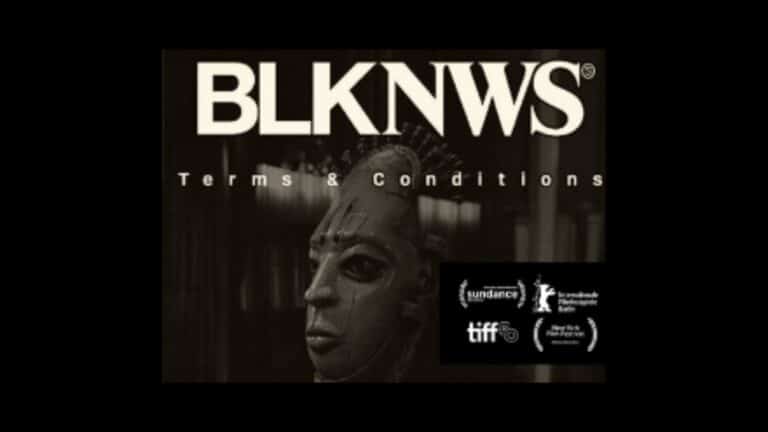
URBANA — BLKNWS: Terms & Conditions is a film directed by Kahlil Joseph that explores Black history, identity, and culture through fictional and historical characters, all through a Black point of view.
The Krannert Center for the Performing Arts is hosting an exclusive premiere of the film in the Colwell Playhouse on Wednesday, Feb. 13 at 5:00 p.m. The screening will be followed by a Q&A session with members of the production team, including Joseph and Irvin Hunt, an English professor at the University of Illinois Urbana-Champaign and one of the film’s lead screenwriters.
IPM’s Morning Edition host Kimberly Schofield and Illinois Soul Manager Jill Clements spoke with Joseph and Hunt about what audience members can see and learn from the film, with a special question by Illinois Public Media’s Illinois Soul Manager, Jill Clements.
This interview has been edited for clarity and conciseness.
JOSEPH HUNT: So they are going to see a very kind of hypnotic mélange of Black experience. They’re going to see sound, sort of made in sync with these scenes that celebrate Black freedom, scenes of this sort of ecstatic expression of Black life, and all of that is kind of held together by this figure, this historical figure and a kind of titan in African American history by the name of W.E.B. Du Bois. And also interwoven with [Kahlil Joseph]’s own family narrative of his introduction to Du Bois. There’s so many strands of the film, it’s sort of hard to trace one through thread. But I think if there is one, it would be how many different ways we can think about Du Bois, which in turn, helps us think about all the different ways we can think about Blackness across the Black diaspora.
I mean, one of the most remarkable things about this film is how diasporic it is. It doesn’t just reside in the US at all. I mean, it really is crossing the ocean. So we go from Du Bois’ young life to Du Bois’ old life to his mid-career. And he’s working on this encyclopedia project at the end of his life, and he believes that this encyclopedia is going to sort of help solve the problem of anti-Black racism — and not just the problem of anti-Black racism in the US, but the problem of anti-Black racism kind of globally. So it’s just the most ambitious project in his life that he started to undertake with the most obviously ambitious of intents. And so it was never complete. And so one of the things that this film so beautifully harnesses is what is available for us in terms of how we imagine the future, when the very projects that we are creating to imagine a better future are not complete.
You know, I feel like it sort of liberated Kahlil to pursue so many different hypothetical situations and think about so many different futures. I know that’s kind of abstract, but, you know, you got to come to see the film, to see. I mean, Saidiya Hartman, this writer and cultural critic, has this beautiful phrase where she calls a group of Black folks just “intoxicated with freedom.” And I think that that sort of intoxication with freedom is something you’re going to see on screen, and it’s also something you might experience as a viewer of the film. And I mean, I’m sure Kahlil can add more details here, but that was my take of the whole thing.
KAHLIL JOSEPH: Well, yeah, I mean, I’ve had to describe it, obviously, for a while now, and it’s really … I approached the film like an album. So it feels very much like an album, and it’s an adaptation of the artwork of the same name that I started in 2018 that it was mainly interested in, like journalism, but maybe from a conceptual POV.
SCHOFIELD: This decade, we’ve seen the release of The 1619 Project, also videos that share Black American history, which is at the same time that we have a political force that is literally banning history from schools or putting professors or teachers who teach about diversity on public databases and they get death threats. Why is a film like BLKNWS needed now?
JOSEPH: You know, it’s interesting. So the movie was green lit in 2020 when the American landscape looked very different and it was extremely, you know, progressive in its messaging and its concerns, you know, which I think is one of the reasons it got greenlit and given as much freedom as it did. And I think the studios that greenlit it were imagining it was going to come out in that type of environment, and then here we are. It came out in the exact opposite, which I kind of anticipated in an interesting … meaning, I think BLKNWS is a perennial. It’s always relevant, and especially against the backdrop of American history and culture, and that’s how I understand it.
It’s just journalism, you know, through a Black POV, in the same way CNN or BBC, we all understand it to be through a white perspective, but it doesn’t mean that it can’t cover the world. So the BBC will do stories on any, anyone, in anything, you could have Black journalists or, you know, Arab journalists for the BBC, but we all understand it ultimately to be through a white lens. And so BLKNWS is that, it’s just the world through a Black lens. We’re interested, as everybody is, in everything — in furniture and science, in biology and, you know, sports that is inherently not racialized generally, you know, we like to hope it’s not, but you know, we read everything like everybody else.
SCHOFIELD: Was there any pushback that was encountered during the process of making the film or releasing the film at all?
JOSEPH: No, remarkably, not. I mean, largely because it was based on artwork of the same — that I created in 2018 — so there was already something very robust that existed. And because there wasn’t a traditional script and actors and the way that Hollywood is, it was really difficult for them to have much jurisdiction, right, especially, like, on a cultural level, but also on an authorship level. So it was baked into the original, you know, the legality of the our collaborations with the studios that like, this is my thing, and a lot of it was predicated on me framing it as an album, you know. Like, you don’t submit lyrics to the record label before you make it. They just tell you to go make an album, you know. And so we were lucky that way.
SCHOFIELD: In some of the material that I’ve seen for BLKNWS, Afrofuturism is there. How would you define Afrofuturism for those who may be unfamiliar with it?
JOSEPH: I personally don’t, I wouldn’t, I absolutely wouldn’t describe the film that way. I don’t even like that term, to be honest. I mean, I’ve said this before, but I understand. I get it. I guess, you know, very often, a lot of stuff that Black people make and do gets collapsed into some … like we’re always defined by our race no matter what we do, it seems like. You know, from Black music to whatever, and like, they don’t call it Europeanfuturism or Asianfuturism. So I just wouldn’t. This movies literally by definition or make-believe. So there’s just fictional elements, I guess.
SCHOFIELD: Yeah, you’re right. We absolutely do not call any of the other films anything specific towards race or culture.
JOSEPH: You know, I can, I respect however people … some people feel empowered by that, those labels and those terms, and I respect that. I just, I personally don’t, I guess, you know. I’m in conversation with everyone in the history of film, in the history of literature and the history of critical thought. So you know, when people see the film, they’ll see films by Jean-Luc Godard, Jim Jarmusch. They see Agnès Varda. They see Wong Kar-wai references, you know. And very few people talk about that stuff. They kind of just latch on to the racialized elements of it more than anything.
SCHOFIELD: There’s an exclusive premiere of BLKNWS here at the University of Illinois Urbana-Champaign, which is the land of corn and soybean fields. How did that come about? Why is it happening here?
HUNT: You know, it’s happening here because Kahlil was gracious enough to allow us to screen the film. You know, we’ve been talking about it for a while, and I’m incredibly grateful for just the amount of support that brought this to fruition and ongoing support, an incredible amount of contributors and sponsors. And I will say that, this has been a collaborative effort, and I think that mirrors just how collaborative the film itself is and was in its creation.
Khalil brought me on as a screenwriter. And there’s a number of other screenwriters on there and and a number of other directors, that he worked with, cinematographers. I came on in Ghana. I was able to come and be on set in Ghana, and it was just one of the most beautiful, most creatively and enlivening experience of my life. And I think part of that was just how, you know, he sort of conducted everything, kind of like a jazz set. How many voices he was able to harness and allow to do their own thing.
SCHOFIELD: In the trailers of BLKNWS, we see the book that’s called the Africana Encyclopedia. And as you had mentioned before, the film’s trajectory kind of goes from there. Is there something specific with that that you hope people 50 years from now, hold on to or take away from?
JOSEPH: Yeah, I never really thought about that. It’s a very useful narrative device in the context of the film. It helps ground it emotionally to understanding how I came to experience the encyclopedia through my father and my brother, who are no longer here. And It also helps to, I think, personalize history, which can sometimes feel very depersonalized, you know, which is something we do throughout the film. And I know it’s not specific to me and my family — everybody’s family. I think it’s not hard to understand, in watching the film, how we’re all part of this thing. You know, it can very often, when you listen to the news, it just feels like all this stuff is happening out there.
I was also struck by how interesting and rich the Africana Encyclopedia was. It was like I was reading this incredible novel. You know, there’s so much, obviously, to learn about the world and people and things that happen that you just don’t learn in school, even if you get your degree in African American Studies. So much of it can be based on scholarship, as opposed to just like people and events and things and countries and inventions, you know, just like real basic animals. And so that was really exciting. And I’ve had people tell me they bought the book for themselves or their kids or their friends, which is kind of interesting and cool. Also, the irony for me is that I was kind of trolling the concept of an encyclopedia. Like BLKNWS is almost antithetical to the idea. I mean, it’s encyclopedic in some ways, but it’s also interested in all the things the encyclopedia can’t contain, you know, memes and, you know, dances and like all these things that aren’t static on the page. You know, the idea of an encyclopedia is very European. It’s like the epitome of the European, the canon. And a lot of stuff that happens, I feel like, in non-European context, is like, ephemeral. So it’s interesting how a lot of people … a lot of big takeaway is the encyclopedia, when I’m kind of like, yeah, you realize that the movie’s, like, none of the entries that I feature in the film are actually in the book, or they’re just random pages. So it’s been fun to engage audiences with what their takeaways are.
JILL CLEMENTS: In one of our meetings, [Irvin Hunt], you were talking about the breakthrough or impact moments when you were filming BLKNWS. So is there one or two that just stands out in your mind that you want to share with us, that you experienced?
HUNT: Yeah, I think the breakthrough moment for me was that — this was in Ghana. We were there in Ghana collectively, and it was like a majority people, or, you know, BIPOC group of folks creating this film. And we’re surrounded in Ghana by, you know, predominantly, obviously Black folks. And for me, you know, leaving the US in which I felt it was … you know, I felt pretty battered. And it almost doesn’t matter the location and time when you leave this country. It’s just like one thing after the other to sort of, if you’re plugged in, to leave you kind of tattered. And so I left this space where you know you’re made to feel marginalized, or like a minority, which is not true. And I’ve heard Kahlil talk about this a number of times. And then going to this setting in which you just felt freer to be yourselves … it was kind of a miraculous thing for all of us. There was something magical I could feel that was resonating on the set and among the creators. It was that gathering.
I felt like this wasn’t something that I was singularly authoring. It was an entirely different feeling before I got there, where I was, you know, pent up in my room, you know, doing this in a lot of solitude. But when I got there, the breakthrough for me was to experience that this was sort of like a vehicle for so many different voices, so many different empowering voices, that are letting us know we’re a part of a long tradition of, you know, artistic expression, and, you know, it was also like a clinic for me. I’d never been on a set before and this job — all of so much of this was a first experience for me. But just thinking about it in that way, thinking about the different idea of authorship, that was a breakthrough, like, on a huge level for me, just to think about producing anything creative in the future. And so I always go back to the film to check my ego, you know, and to think about work as kind of an opening and a listening to folks who have gone before and who [are] around you right now.
Krannert Center for the Performing Arts is a financial supporter of Illinois Public Media.