

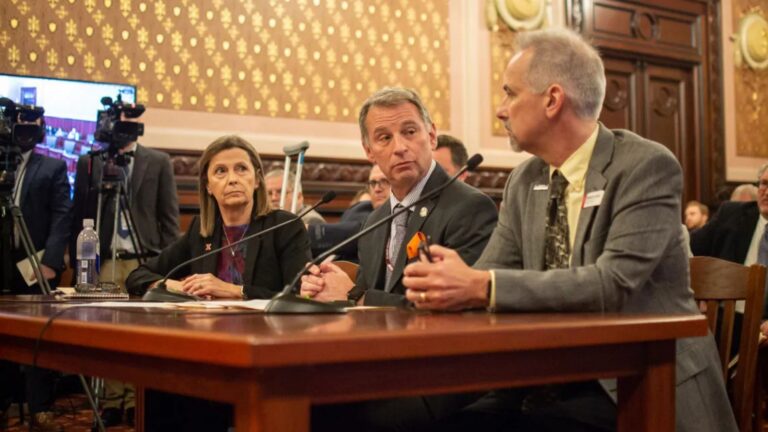
SPRINGFIELD — As the 2026 session of the Illinois General Assembly begins to take shape, advocates and policymakers say they will continue to fight to protect natural resources in Central Illinois from the potential adverse effects of carbon sequestration and pipeline projects.
Last year, Gov. JB Pritzker signed a law banning carbon sequestration directly beneath sole source aquifers. State Senators Paul Faraci (D-Champaign) and Chapin Rose (R-Mahomet) as well as State Representative Carol Ammons (D-Urbana) were part of a bipartisan coalition pushing for the bill’s passage.
The measure also charges the University of Illinois Prairie Research Institute with providing reports to a commission that will study carbon storage safety at the Mahomet Aquifer.
Faraci said he will be looking closely at the commission’s findings.
“They’re now crunching the data to better understand what’s in the aquifer, how much water is there, where is it, and how do we better protect it moving forward,” Faraci told IPM News. “So we’re going to continue to look at resources and potentially legislation to make sure that those resources are protected.”
Prairie Research Institute is expected to submit annual status reports starting on Dec. 31, 2027 through 2031.
Advocates remain concerned, highlight gaps in the law
Despite the passage of the bill, some environmental advocates, say there should be additional safeguards to protect the aquifer.
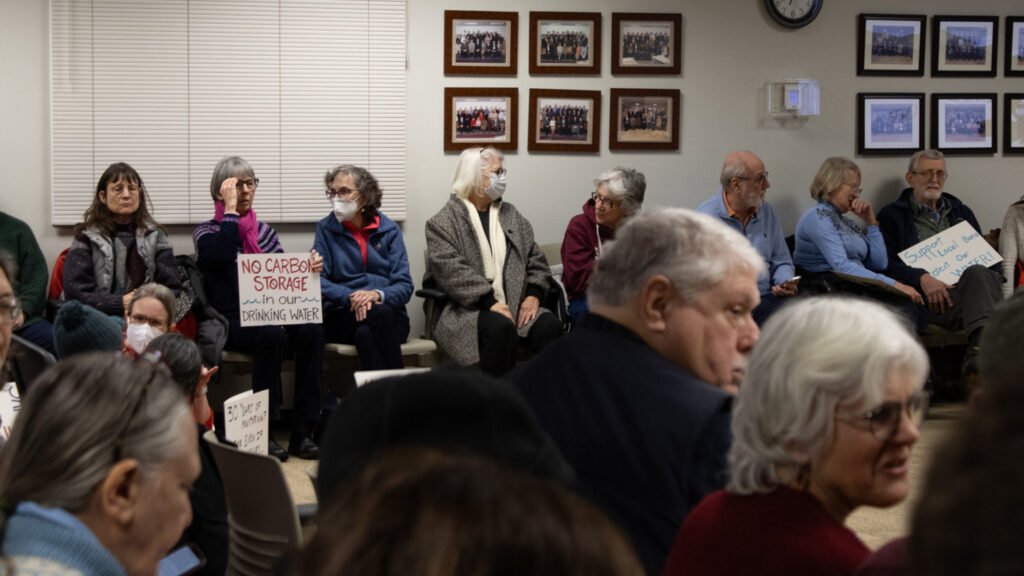
Pam Richart, co-founder of the non-profit organization Eco-Justice Collaborative, said the current law functions more as a moratorium than a permanent ban. She is worried the commission could lead the state to reverse course and allow carbon capture projects near the aquifer.
“[The commission] provides a mechanism by which to say, ‘based on our analysis, we think it can be safely done,’ and I would say then that would require another act of the General Assembly to overturn the ban,” she said. “But it could happen, right?
“So I don’t think we’re out of the woods yet.”
Richart said the risks of human error and contamination are too great to allow carbon storage near the aquifer.
Some experts have concluded carbon sequestration is safe, as storage often occurs thousands of feet below a water source with layers of rock formations separating the reservoir from the stored carbon.
Andrew Rehn, energy and climate policy director with Prairie Rivers Network, said the risk remains too great for a federally designated sole-source aquiferMahomet.
“The risk tolerance being zero is sort of a philosophical approach to how we should think about water resources, particularly water resources that are so precious,” he explained.
Rehn pointed to a recent carbon dioxide leak at an Archer Daniels Midland facility in Decatur as an example of why long-term storage raises concerns.
“We are proposing to store carbon sequestration for 1,000 plus years and not harm the resources that our communities are dependent on in that time period,” he said. “And that timeframe actually poses a lot of real challenges.”
Rehn said he would like to see some gaps in the law closed to expand aquifer protections. Those include limits on carbon storage near recharge areas, which are locations on the surface of land where rainwater can replenish the reservoir.
He added the proposed Mahomet Aquifer Advisory Study Commission is currently an “unfunded mandate” and that he does not expect that aspect of the law will move forward until additional funding is allocated.
Blocking eminent domain for carbon dioxide pipelines
Separate from the sole source aquifer legislation, Illinois farmers are pushing this General Assembly session to protect their land from construction for carbon dioxide pipelines.
A statewide pause on carbon pipeline construction is set to expire in July. The pipelines are used to transport carbon dioxide to storage sites.
Steve Hess is a fifth-generation farmer from Bushnell in West-Central Illinois. He became involved with advocacy against carbon pipelines after a land agent for a company approached him in the fall of 2022 offering to buy part of his land for a pipeline project.
“He talked about how … if you don’t sign up [for] this, and if our project gets approved by the Illinois Commerce Commission, we can just use eminent domain and take your property. That hit me kind of — that hit me wrong,” he said.
Hess says the heavy equipment used to construct these pipelines can cause permanent damage and threaten underground tile systems farmers use to manage water.
He pushed the Illinois Farm Bureau to support a Senate bill introduced in January that would stop private companies from seizing land to build pipelines.
The bill has been assigned to the Energy and Public Utilities Committee.