

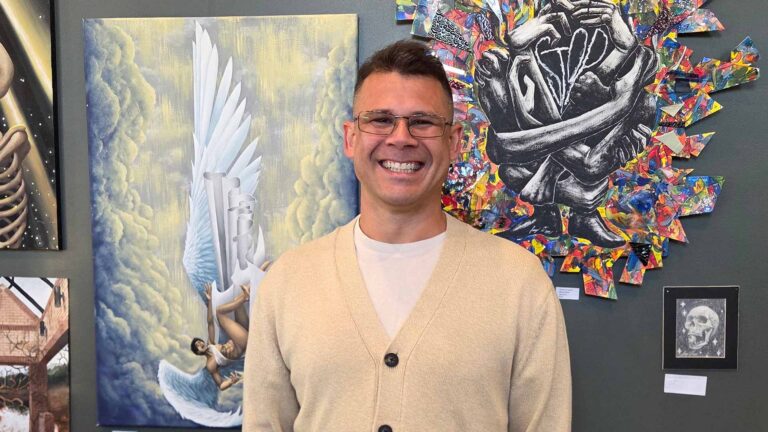
CHAMPAIGN — The spring semester started Tuesday at the University of Illinois Urbana-Champaign.
College of Education masters student Mike Pierce is particularly happy to be back in class. He said education has changed his life.
“Many of the issues of my past – my wandering youth especially – come from a space where I felt I could not communicate with the world, and I couldn’t understand it either,” he said.
Pierce spent over 20 years in prison. While inside Danville Correctional Center, he took college courses through U of I’s Education Justice Project.
Last year, Pierce became the program’s first alum to be accepted into a degree program at U of I – despite EJP’s existence at the school since 2008.
While there have long been formerly incarcerated students at U of I, getting into the school with a conviction is not easy.
EJP Policy and Research Director Ashton Klekamp said that anyone applying with a conviction to U of I’s graduate schools has to submit information to a special committee about their criminal history.
“What we’ve seen in the past is many instances of students being accepted into a program based on the merits of their application and then having that acceptance revoked,” Klekamp said.
University spokesperson Pat Wade said the chair of the special committee can clear applicants with minor, nonviolent convictions immediately. He said the committee reviews more serious cases by looking at what the person did, the number of convictions and how much time has passed since then.
“We are pleased to partner with the Education Justice Project and help provide opportunities and pathways for students who have personal experiences of incarceration,” Wade said.
Klekamp said EJP has been talking with the university about changing the conviction review process, but has not made progress yet. She pointed to a lack of evidence that screening applicants for criminal backgrounds improves campus safety.
The special committee denied Pierce’s application at first too. He appealed the committee’s decision and was able to begin the U of I College of Education Curriculum and Instruction online masters program one year ago.
Pierce is celebrating again this January. He was just admitted to the Curriculum and Instruction PhD program and will start in-person classes on campus in the fall.
IPM’s Emily Hays spoke with Pierce about his journey and what he plans to do with the degree.
This interview has been shortened and lightly edited for clarity.
EMILY HAYS: All University of Illinois students worked hard to get in, but you have overcome some unique obstacles. What does starting the spring semester mean to you?
MIKE PIERCE: Education has been life changing for me. I am very mission-driven towards furthering my own education and that of others because of it.
I always tell people that many of the issues of my past – my wandering youth especially – come from a space where I felt I could not communicate with the world and I couldn’t understand it either. When that happens, you find yourself warring with that which you don’t understand.
Education has allowed me to both understand the world and make myself understood, and that changes the way you can interact with it. I always owe that to education.
I don’t want to overlook this opportunity to say that education doesn’t happen without people. It’s those people who were very instrumental that I owe so much to – professors but also very good friends, mentors and employers.
HAYS: The article about you on the College of Education website mentions you first started taking classes in prison as a way to hang out with incarcerated family members. Have you always been interested in pursuing higher education?
PIERCE: No. That is the short answer.
I did not start my education journey from a place that was right. I will always admit that.
I was a high school dropout. I got my GED after getting in some trouble. Did a brief military stint, all because of legal issues. I only got my GED in order to get out of trouble, and then I still ended up eventually going to prison and serving close to 23 years now.
When I got to prison, my older brother was at the same institution. I call him my older brother. He’s not by blood, but I was raised by his family and we’ve always considered each other family. The only way that we could hang out was in a college classroom. We would intentionally fail classes just so that we can take them over again and be in that space together.
We coordinated where we lived, where we worked, where we went to school just so that we could spend time with one another. But it was that space that opened my eyes to some of the misplaced values that my family and the culture and community that I grew up in had instilled in me.
Being in a space where I could watch my idol, who was my older brother, be intellectually beat down day after day after day – it opens your eyes that maybe your idol is not the best person in the world, or the smartest, or the most capable, or that your values are the best to live by. It was just very eye opening to have that opportunity to sit there with him and then allow it to seep into me and influence me onto this path.
HAYS: Did your brother get influenced onto a similar path?
PIERCE: Unfortunately, no. He has been incarcerated [multiple] times. He’s currently out, has been for some years. He’s working steadily, is married and is living a good life.
But it’s not the path of education that I think he’s capable of and a lot of that has to do with systemic issues.
Poverty, mental health, drug use, all of those things that plague my community limit the opportunities that people have. In the EJP sphere, I would run across those statistics of how many people are pursuing a higher education in prison versus how many actually participate when out.
And I think it’s something like only 5 percent continue in education once they’re out of prison. So he’s unfortunately not part of that very, very tiny percentage and it’s because of the way life demands one approach the future.
HAYS: You mentioned there are some systemic things that have contributed to your life and your older brother’s life. What are some things that if they were different where you grew up would have changed your trajectory?
PIERCE: I like to tell people that I grew up poor. I don’t have an accurate judgment of poverty because what I thought was poor seems to be abject poverty and not just poor. I think that if there had been more community support, especially mental health, then there would have been a different trajectory to my life.
A lot of the drug use that I participated in as a kid had to do with self-medication, I think. There’s also a need for family and community support where I come from. It’s very isolated and the communities are very small and unsupported by anything local.
Things like domestic violence, a lack of education, the ability to go to school, or have basic resources like food and clothing. What I took to be normal I’ve found is abnormal, and I think it’s unacceptable that it can just go unnoticed.
I tell people all the time that I was the poorest family in the school, but that was only because my neighbors weren’t in school. And that says something right there. That tells you the different layers of society.
HAYS: Do you mind telling me where you grew up in Illinois, so people have a sense?
PIERCE: Southern Illinois. A little town called Walnut Hill, which is like 10 or 20 miles away from the largest town. You’re looking at a community of 50 people. The next community over is 500 people. And where I grew up, there were dirt roads, cornfields and soy bean fields.
Some of my neighbors literally lived in shacks that had tin as the walls. I grew up hunting, a little bit of farming and then a little bit of support from the community, with food banks and stuff like that. My mother worked at Walmart and supported a family of six off $13,000 a year at that time.
It was not a great life coming up. Looking back, my siblings and I talk about what we thought was normal and how hard life was and our desires to not have our kids and future generations have it the same way.
HAYS: You are working on a master’s degree in curriculum and instruction and going on to a PhD in the same subject. What do you hope to do with your degrees?
PIERCE: It has been my goal since before I got into a master’s degree program to get a degree that would help me create a higher education program for prison settings – in particular a graduate degree program.
I’ve been in college for 18 years. I have 240-ish college credits, but for the longest time I couldn’t take anything but an associate degree level course. And then when I got my associates, I was immediately kind of kicked out of college because I’d gone as far as I could at that point.
I couldn’t take another college class for seven or eight years until I relocated to Danville and I participated with the Education Justice Project, which was bringing undergrad level courses but no degree. In 2022, I think, Eastern Illinois University brought an undergrad program to Danville Correctional Center.
I was in the first cohort there and I immediately started taking undergrad classes and doing what I needed to do to get my bachelor’s. When we asked them about a graduate program, I was informed that it is very difficult to create one of those, especially for the difficulties that a prison setting brings to the classroom. And that there are certain requirements for creating one.
You have to have someone who has a PhD in curriculum and instruction and it takes three or four years to develop that even whenever you get started. So, I said, “Okay, it sounds like there’s a need that needs to be filled.”
It is also something that I very much enjoy. I became a peer educator in 2020-ish. I started mentoring and doing peer educating stuff. And I was simply self-educated on pedagogy and teaching structures and lesson planning, etc. So I decided, I have a passion here, I want to participate in it.
A lot of my friends are still inside. Some of them are refusing to graduate because they know as soon as they get their bachelors, they will no longer qualify for courses. They are just taking classes into perpetuity so that they can stay in that academic space.
My ultimate goal is to build a graduate program for inside. If I could go back in and teach, that would be just a little bow on top of it.
HAYS: Such a clear vision. You are so passionate about helping incarcerated people get access to higher education. What is one policy change in that realm you think would make a big difference?
PIERCE: That’s a great question that I haven’t thought about. I will say that I know that there are other states with colleges that are active in prisons where you have former students to those colleges teaching, earning a living wage while they’re incarcerated, educating fellow incarcerated individuals.
If we could develop programming like that, I think it would be the next step in the evolution of higher education and programming here in Illinois. To have a student get educated and then become an educator while inside is a nice dream to work towards.
At Danville Correctional Center, the peer educators are all unofficial, no one has any certification, but we do training to an extent that I don’t think any other prison in Illinois does. That’s why I think that they’re on the right track for the way that they’re trying to approach education and mental health there.
HAYS: You grew up in Southern Illinois and you have changed a lot. Tell me more about how you’ve changed since starting education.
PIERCE: Mission-driven, that keeps coming up now. I have a few values that I live by. I don’t lie. I stay disciplined in every area of my life. I’ve been sober for 13 years and that’s very important to me. And I just try to be the best human being that I can from one day to the next.
HAYS: How would you describe yourself as a student?
PIERCE: I could be a lifelong student and pursue degree after degree after degree and I would be happy. Everything else that has happened for me in life has come from being a student. Not because I planned it, not because I sought it out. I am a student and that is what I want to be.
I put in way too much work. I stress out a lot. And when the semester is over, I stress out because I’m not stressed out. If I’m not moving fast, I feel like I’m not moving at all, and that is just kind of the state of affairs for my life and I recognize it and accept it.
I love school. I love learning. I have a curiosity that can never be quenched and I am ready always for the next class and the next semester and the next turn that the world is bringing me to. That is why I’m also so ready to get back into the classroom proper, which I will do in this coming year with the PhD program.
HAYS: Do you want to talk a little bit about why you were incarcerated and your transformation since then?
PIERCE: As I mentioned before, there are a lot of systemic issues where I grew up. Drugs, violence, both domestic violence and community violence. There is a plague in Southern Illinois that’s been there since prior to my incarceration, which is methamphetamine. And mental health is a very big issue as well.
I found myself in a very bad place, and in 2003 I was incarcerated for first-degree murder because of that. I take full responsibility for my decision-making then, but there’s nothing I can do to change any of that time or what happened.
I’ve had to come to terms with that as I move forward in life. I focus now on just being the best person I can and doing what I can for my community, both inside as well as out here.
We’re all members of society. Some of them are in walls and behind bars, but we all belong to the same societal structure, which is the state of Illinois, America as a whole and the people of the world. My goal is to move forward in such a way that I can help those who are following that same path and many of whom come from the same place.
We might not all be from Southern Illinois dirt roads and cornfields. Some might be from the streets of Chicago, others imported from out of the state, but we all all have some of those same systemic barriers behind us and I want to help them traverse it moving forward, and in that way do my own little bit of good.
I cannot atone, but I can do what I can to make what life I have left worth living and beneficial to everyone around me.