

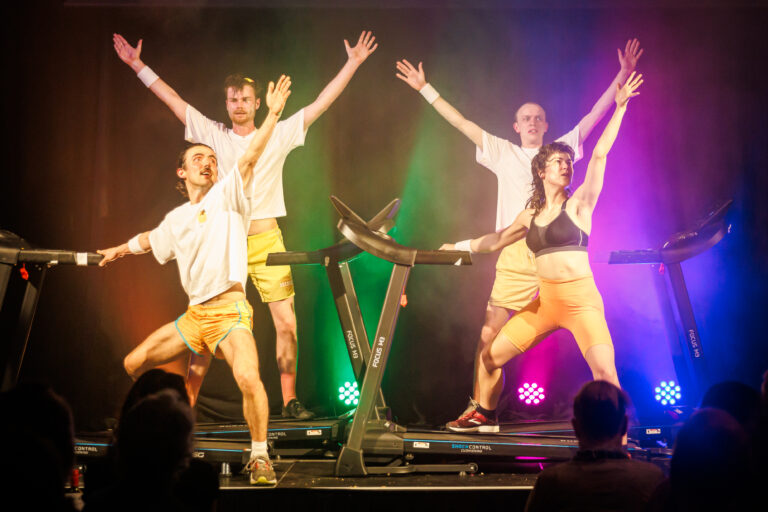
URBANA – This weekend at Krannert Center for the Performing Arts, four artists will perform a series of tasks, ranging anywhere from cooking to self-care activities to working on grant applications, all while running on treadmills. Morning Edition host Kimberly Schofield spoke with two of the creators and performers of Burnout Paradise, Dominic Weintraub and Hugo Williams, about how the award-winning show began and what it means to them and to audience members, who are also able to participate on stage.
This interview has been edited for clarity and conciseness.
KIMBERLY SCHOFIELD: Where did this idea come from…to be running on treadmills and performing tasks?
HUGO WILLIAMS: When we first started as artists making work, we didn’t get very much money, so to counterbalance that, we just made an enormous amount of shows, and we did lots of different things with community, very rarely in theaters, and the sort of effort of that over time and compacting them in…really took a massive toll on us as a collective, a toll that we had no experience in or there wasn’t much education around and what that was like. So we arrived about halfway through a year, and a festival was like, ‘We need another show from you.’ It was like two days to submit a show, which is kind. And sometimes it feels like in this industry, a lot of people are very kind in the way that they’re like, ‘We need you to get a show in. We really want you involved in this.’ And it’s like, ‘Yeah, no, I know, I know. There’s an enormous amount of labor.’
We were like, let’s just do something at the very least that we can come out of it feeling like we’ve we’re like, net positive in our bodies, than negative.
And so yeah, I think Claire was like, ‘I’d love to get fit. Like, I just want to get buff, and I want to get fit.’ And so we were like, we’ll just purchase four treadmills because if we run, then that will hopefully make us fit. And so we did.
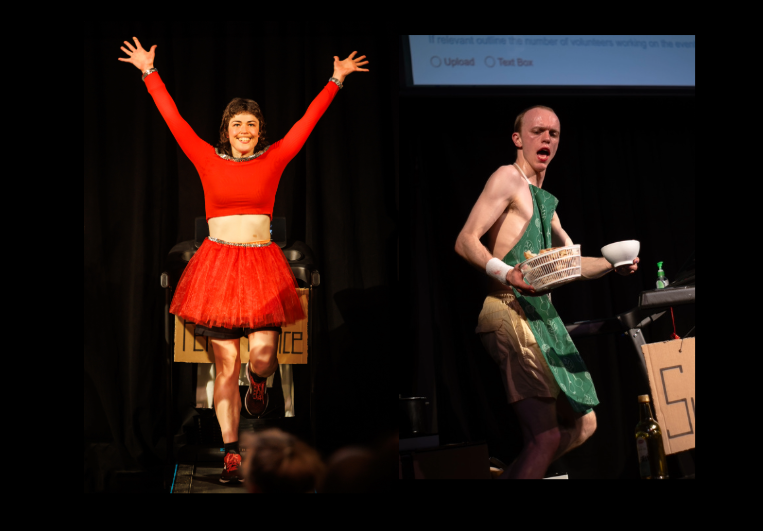
We just purchased four treadmills, we found a space. We had some friends who owned an art space that was kind of, you know, was a bit of an underground kind of vibe. And then next to it, they just bought a new place that was next to a pet store that was like a warehouse that they used to change the motors in electric bikes in? And we went in there, first ones in, and there’s oil everywhere, and the carpet is stained in lots of different places. And it’s like, it’s very smelly. It’s a beautiful space, but very…
SCHOFIELD: Needs some work.
WILLIAMS: Yeah, it needed TLC, which we didn’t provide it. Just put treadmills in there, and we just ran and that’s really how the show started. The way we make work is…what’s interesting or what’s funny, or what’s pleasurable for us to either do or watch in each other. And then when you run on treadmills, only certain things work. When you start performing too much on a treadmill, it’s kind of like, ‘what are you doing?’ You’re doing something so real, and then you’re not doing a real thing at the same time? So we kind of thought that maybe tasks on a treadmill fit nicely, and that’s kind of how the show was made.
SCHOFIELD: What was the response like? It’s a pretty unique concept.
DOMINIC WEINTRAUB: In our very first season of it, the audiences became very, I would say, gladiatorial, in their energy. At the beginning, we really had no idea what we were doing on the stage. We’d made it in such a short period of time that opening night still felt like…opening night was really the first time, I think, that we’d actually even run the show. And so there were lots and lots of things that we had not considered going into that. Many of those things being the amount of physical risk in the space we had. We had a lot of things go wrong in that first run, including Hugo trying to put on one of those rejuvenating sheet masks, and then thinking it would be a good idea to slice and cucumber and put it over his eyes while he tried to run, which naturally led to him being flung off the end of the treadmill, kind of off the stage. He landed incredibly well.
So the first show was really like…the whole audience came in to support us and also subject themselves to an incredible amount of risk. And the show almost got canceled after its…
SCHOFIELD: Oh no.
WEINTRAUB: After its opening night for a lot of those reasons, but the audiences really, really, really got into it. And I’ll never forget, like, the roar that came from the audience at the end of the first night when we when we completed all of the tasks, kind of against all of these odds. It felt a lot like we were in a sports stadium and a very big moment, and that was really fun.
SCHOFIELD: How did you pick the tasks that you have to do?
WEINTRAUB: Each of the tasks kind of came at a different time. I mean, the show now has a very tight conceptual framework around the different kinds of tasks that we all do in our day-to-day life, and the things that keep us alive and the things that keep us, I guess, happily participating in capitalism. But the tasks in this show, I suppose, primarily came about through looking for fun, looking for-like Hugo said before-looking for joy, looking for the things that were funny to watch, that both contain some element of like visual difficulty and looked like it was hard to do, and also had some kind of fun in it for the performer or some kind of playfulness.
And still, we kind of…show to show…every time we go to a new place, we throw out a bunch of the tasks that we’ve done in the past, and we go to the local shop, or we chat to local people, and we’re like, ‘what are tasks that would be fun to do in this place, here and now, and what are the things that maybe feel relevant to this community in some way?’ So there’s a real joy for us in continuing to find new tasks that still provide that difficulty. Things that we’re not yet good at or that we haven’t yet done 100 times, and things that connect what we’re doing on stage to audiences lives in the theater.
SCHOFIELD: This is kind of a weird question. Did you change-over the years-the type of treadmills that you purchased…and how do they travel?
WILLIAMS: That’s a really good question. That’s an uncommon question. We got a lot of heat on this subject. We had no money when we first made the show. It was all from our company resources that we had accrued from other projects. So we didn’t get a grant or anything like that. So we purchased, you know, what we thought were quite reasonably priced treadmills at the time. Turns out they were the best treadmills that really one could buy. And as we’ve toured we’ve tried to move them around, but moving treadmills around, even to the other side of Australia, is more expensive than just purchasing four new treadmills at that location at the other side of Australia.
It’s always a discussion. We have to have shock absorption, for example. It has to be a certain minimum length, it has to have some cup holders so we can do certain things, and it has to be able to get up to a certain speed. But even that, we’ve been in multiple places where those are just barely met. We’ve done some shows on really small treadmills…treadmills that feel like the type of treadmill you would put in a doll’s house. It feels so small. It’s like a miniature version and it looks funny on our bodies. Because usually the treadmill, at least for my body, matches the length of my body, or at least the sort of height of it. And then these smaller ones make me look so gangly because they’re so tiny.
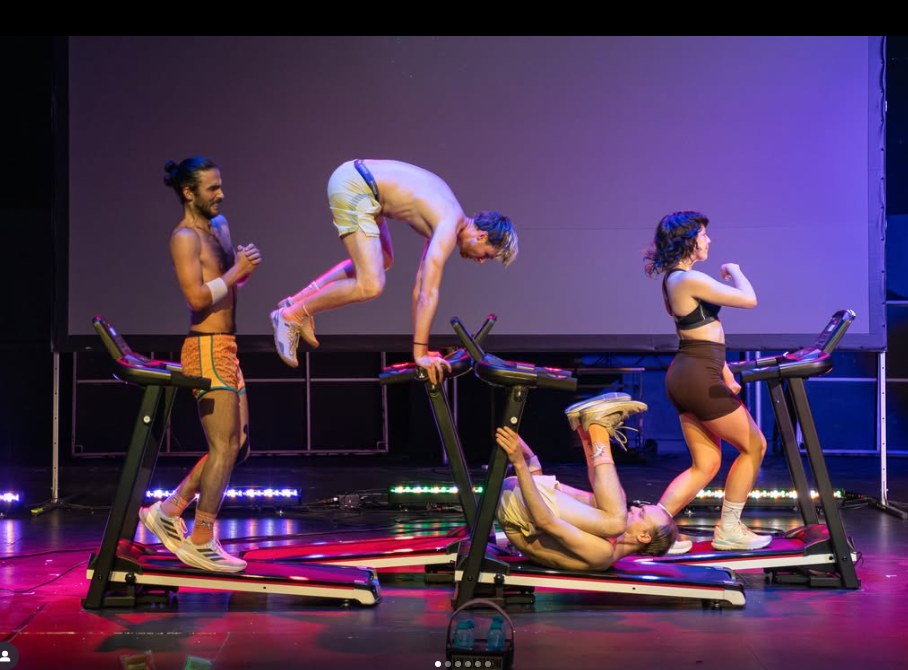
And then we did a season in Edinburgh where we purchased them from a treadmill company and they were really great. And those ones have a special place in my heart because they were very long, very thin, like enormously thin, but very, very long. But we had to do like 30 shows sort of in a row at a really intense festival in Edinburgh at The Fringe. And then we sold them the day after. People came by and picked them up. We know a treadmill when we see it. We have a good sense of it now, which I think is a thing that I never thought we would we would have any sort of knowledge on.
SCHOFIELD: Is there anything specific that you hope audiences take away from or experience?
WEINTRAUB: I think ‘community’ is something that we talk a lot about in our practice and in theater more broadly. The idea of coming into a space with other people and having an experience that binds you all. And I think for me, I’ve always struggled with that idea, because it feels like a very abstract thing. You’re sitting in silence in the dark with a bunch of people that you don’t ever really interact with, except for the people that you’ve come with, and then at the end of it all, you’re a community, which I don’t fully understand, but I like the idea of a lot.
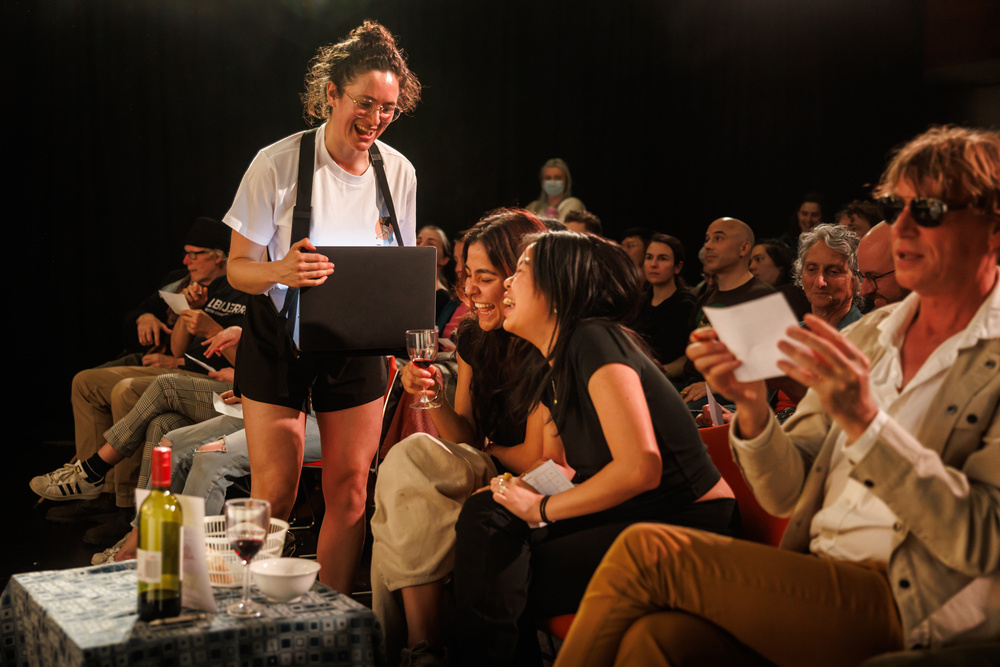
This show…the lights never turn off, you’re never in the dark, and the whole show is really about a live negotiation between the four of us, who are really struggling, and the several hundred people who are sitting in the audience. There is a sense of camaraderie and we’re in it together that this show creates that I think is pretty incredible. And whether you’re someone who wants to get up on stage and help us with a task, big or small, or whether you’re someone who just wants to sit in your seat and kind of watch it all unfold, you will end up having an experience or an interaction that surprises you through the show.
WILLIAMS: I think that’s a really well-articulated experience for the general audience member. But I think this show was originally created in line with the lifestyle of those who work contract to contract like an artist’s lifestyle in particular, or those who work in industries that are similar to that. I think that the show is really a love letter to the agony of that particular experience.
And not saying it’s harder or less hard than other people’s experiences who work, but just a particular kind of feeling of overlaying of lots of different things and lots of different types of things simultaneous, that kind of blend into almost one life, and not having clear lines between that. And I think, in what Dominic’s saying, in the way that the work unfolds, I think our suggestion or our antidote to that problem is something to do with anticipation of care for one another in a particular kind of way, and allowing yourself to be open to help and collaboration in that life. And we don’t have a fixed perspective on that. I don’t think we’re suggesting there is one type of way to do something in that way or one way that suits a person, but I think that’s an idea that’s embedded in the work.
Krannert Center for the Performing Arts is a financial supporter of Illinois Public Media.