

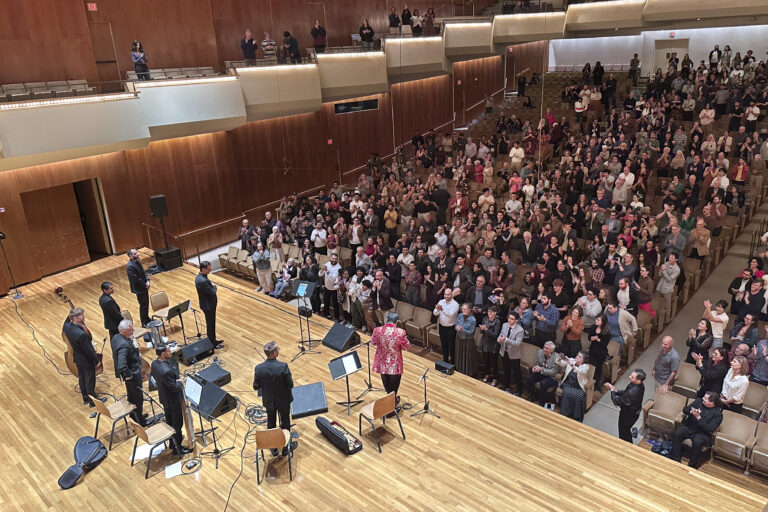
URBANA — It’s not what you’d expect from a traditional orchestra performance when the National Arab Orchestra takes the stage.
The audience whistles, dances and cheers in Arabic, while dancing dabke, a traditional Levantine folk dance shared across many Arab cultures. The space fills with the luring sound of Arabic music instruments like oud, the ancestor of the guitar, and the qanun or nay, an Arab flute. The beat of iqa’ and velvet voices sing in Arabic.
The sense of community and pride for Arab culture was in the air at the Krannert Center for the Performing Arts on Saturday, Oct. 11.
“It was so Arab,” said Lama Alrabiah, a University of Illinois Urbana-Champaign international student from Saudi Arabia. “To see people that look like me… singing music that I grew up listening to… It’s like two worlds collided.”
How it all started
The National Arab Orchestra started at the University of Michigan in 2009, where young Michael Ibrahim poured his passion for music and his culture into a student takht ensemble. Takht is a traditional Arabic music ensemble.
Over time, the ensemble has grown, and 16 years later, it is a world-renowned orchestra with over 600,000 followers on YouTube and a fan base across the globe.
“People are contacting us from overseas to do concerts there, like Saudi Arabia and Qatar, and the United Arab Emirates,” said Usama Baalbaki, co-founder of NAO and the vocalist.
Despite the fame, the mission behind NAO remains the same: to preserve Arab culture.
“Especially the musical portion of it,” said Michael Ibrahim, founder and music director of NAO. “We also wanted to be a platform for cultural expression for the Arab-American community and also a platform for non-Arabs to find out who the Arabs are, because all they know is whatever they’re told.”
To the question, why music? Ibrahim’s response is simple.
“Music is the shortest distance between people,” he said. “People are seeing the value of having a voice in terms of culture, outside of the normal social activism or religious lenses.”
Challenges persist
The orchestra’s journey to success was not an easy one. It was especially hard to find funding, according to Ibrahim.
“I think the hard part was getting the thought of the community around the idea of philanthropy,” he said. “The Arab community understands charity very well, but when it comes to philanthropy, especially with the arts, it’s normally an afterthought. So that was difficult, to really find sustainable funding, and it’s still a challenge now.”
The National Arab Orchestra is a nonprofit organization, so they apply for arts and education grants for an additional source of funding.
With the recent federal funding cuts for education and arts programs, it’s been even more challenging, according to Baalbaki.
“It’s been harder because a lot of programs have been canceled recently,” he said. “We’re hoping that some of these programs come back.”
Despite all the events happening in the Middle East, the NAO continues its mission, preserving its multi-ethnic heritage and “speaking” to people without borders or limits.
“Our presence is there, whether there’s war in the Middle East or not… We’re here,” Ibrahim said. “We’re representing our culture and our community and everything that we do… let the art speak for itself, because that is… the purest form of communication.”
Central Illinois debut
This weekend was the first time the NAO gave a concert in Central Illinois.
The performance has been in the works for over two years in partnership between Krannert Center for the Performing Arts, the U of I’s Salaam MENA Cultural Center and the U of I’s Center for South Asian & Middle Eastern Studies.
The goal is to increase representation of the Middle Eastern North African community beyond the cultural center, according to Awad Awad, director of SALAAM MENA Cultural Center.
“I’ve been on campus for almost three years, and when I came here, one of the first things I started to do was to try to get the Middle East and North Africa not just represented in the center, but represented across campus and who we are in these different spaces,” Awad said. “Just looking around me right now and how loud it is, and how much people had fun – it’s worth every single moment.”
Baalbaki said he did not think the NAO would ever play in Champaign.
“I never imagined the National Arab Orchestra would be playing in Champaign,” he said. “We get called from LA… Chicago… because those are cities with a [large] Arab community.”
Yet, when he arrived in Champaign, Baalbaki was surprised by how active and present the MENA community was.
“I haven’t seen that in cities with big Middle Eastern communities,” he said. “They just walked us here [SALAAM], and I saw this. It’s really vibrant and really beautiful.”
Foellinger Great Hall at the Krannert Center for Performing Arts was buzzing with energy. Many danced right near the stage, others were cheering and dancing in their seats.
Once the 1.5 hours of Arab joy and pride were over, the audience gave a standing ovation.
“It’s nice to see the Arab culture kind of coming together,” said Rayan Soltana, University of Illinois Urbana-Champaign student, right after the performance. “I think the most important thing we have is usually music… that’s what really brings us together… I think it’s one of the most important things when it comes to our culture.”
Awad said they are hoping NAO will come back to Urbana soon.
“They’re looking to come back and teach a course here… and to perform again and do a workshop right before the performance, so fingers crossed,” Awad said.
The Krannert Center for the Performing Arts is a financial supporter of Illinois Public Media.