

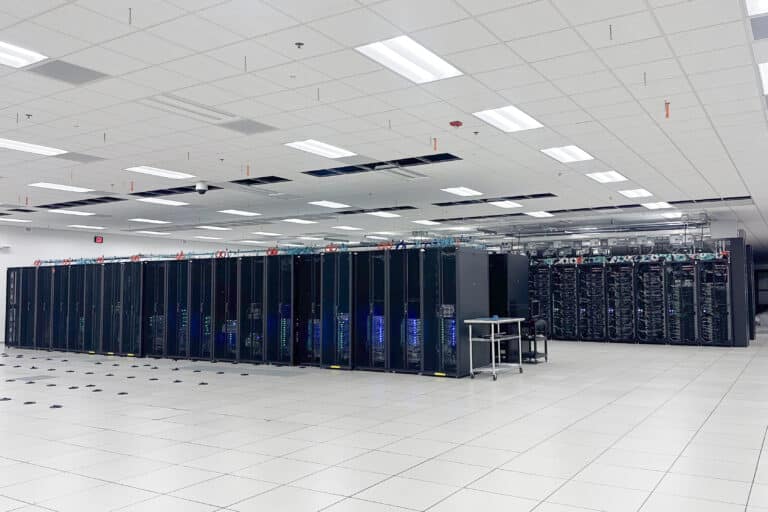
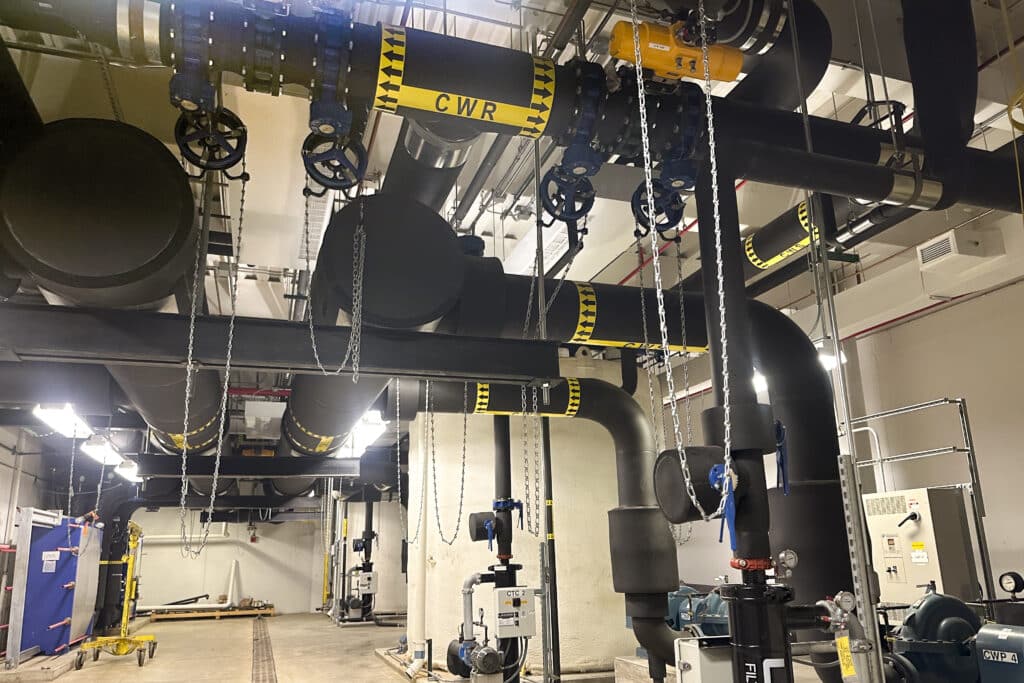
CHAMPAIGN — The steady hum inside the National Petascale Computing Facility (NPCF) is so loud that it’s hard to hear anything else inside. But beneath this noise is a hidden current of water.
“Today, it’s not much water,” said Mohammad Rantisi, the engineer monitoring NPCF operations. He pointed towards one of the pumps: “This is 575 gallons per minute.”
On that day, at least three pumps were moving water in quantities ranging from 179 to 400 gallons per minute. This is a relatively small load, according to Rantisi.
In the past, with a higher operational load, the facility has consumed water at a rate ten times greater — up to 5,000 gallons per minute, which is equivalent to filling an Olympic-sized swimming pool every two hours.
The water used at the University of Illinois Urbana-Champaign facility is recirculated back to the campus water supply after it’s used. But extensive water evaporation can occur during some server-cooling processes.
NPCF is an 88,000-square-foot complex that supports researchers and innovators on campus and beyond. It does what all data centers do: run a large number of powerful servers and generate excessive amounts of heat while doing so. The facility is small relative to other data centers, and it has LEED Gold certification, meaning it meets sustainable design and energy efficiency guidelines.
Illinois is ranked fourth in the U.S. for the number of data centers — more than 220, and this number keeps growing. It’s a national trend accompanying the rise of artificial intelligence.
Champaign County could see new data centers coming soon, bringing new jobs and investment, but with high demands on electricity and water from Mahomet Aquifer. Environmental activists and some water researchers warn that without proper legislation, AI data centers could disrupt water systems in Illinois.
Concerns about overtaxing local resources
All cooling systems use water, just in different ways, Rantisi said. NPCF uses several different cooling systems: Direct liquid cooling systems use water to cool servers, while air cooling systems cool servers with air, relying on water to cool the air.
In all cases, Rantisi said water use is inevitable: “Without water we cannot really run a data center.”
Despite the pivotal role water plays in keeping the facility cool, NPCF pays little attention to its overall water usage, Rantisi said: “It’s a significant amount actually but we don’t track it. Because… water is cheap.”
U of I spokesman Patrick Wade reached out to IPM News after this story was published to say, in part: “We’re not sure exactly what he [Rantisi] was referring to there… the water is metered and tracked” and all users are billed for their use of electricity and water.
However, information about water consumption by data centers in Illinois is not publicly reported. Less than a third of data center operators report tracking their water usage and water conservation is ranked as a low priority, according to the Uptime Institute, a data center inspection and rating firm.
Data centers bring benefits to communities, like temporary jobs and local economic growth. But their energy and water usage is getting concerning for many.
A recent report from the Alliance for the Great Lakes estimates AI data centers can consume over 365 million gallons of water a year — equivalent to what 12,000 people in the U.S. use in the same time period.
Most data centers in Illinois are scattered around Chicago and its suburbs.
But more could be coming to central Illinois. Currently, Champaign County is home to three data centers: NPCF plus two facilities in Champaign and Rantoul that belong to CollocationPlus.
Champaign County Zoning official John Hall confirmed that one company is considering Champaign as a destination for a new large data center, but no applications have been made.
In June, tech giant Meta signed a 20-year energy deal with Constellation nuclear plant in Clinton, Ill., saving the plant from danger of closure.
Tech companies are seeking new locations with existing infrastructure, lower costs and abundant land, said Ana Barros, department head of civil and environmental engineering at U of I’s Grainger College of Engineering.
“About 70% or so of the water infrastructure and energy infrastructure in Illinois is actually in small towns, in towns that have fewer than 50,000 residents,” Barros said. “There’s a lot of possibilities for the installation of centers in small communities that already have the infrastructure,” water, energy and ample land.
But data centers use municipal water and energy supply, which is not unlimited. Baros said infrastructure simply might not be ready for such hyperscale users.
“This new data center… would be a user like everybody else, the difference is that they would be three-orders-of-magnitude-higher-users than the average person,” she said. “You could pump a lot more water, but who’s going to pay for it? And what does that do to the cost of water? …How is this done in a way that recognizes the needs of everybody?”
Historical examples are not promising. During the 2021 drought in Taiwan, the government limited residential water use, prioritizing the needs of chip-making factories.
Municipal water in Champaign County comes from the Mahomet Aquifer, a relatively small source, putting it at a higher risk.
“Mahomet aquifer is actually a small aquifer that is pretty isolated…it’s not like one of the very large aquifers that crosses three or four states and if it rains in Montana, it eventually refills the aquifer,” Barros said. “It’s very local, so the implications for systems like that are even more serious… because it may not be renewable.”
The push for more regulation and greater transparency
Water law in Illinois offers very limited protections for residents who want to challenge or regulate water usage by entities like large data centers.
Illinois’ water laws were developed long before concerns about superusers, said Robert Hirschfeld, water policy director with the nonprofit Prairie Rivers Network.
Hirschfeld notes that state laws around extracting water from surface water or ground water sources are “not particularly developed.”
“Illinois largely relies on imported common law from England… That’s the system of water law that we have, laws that think about human use at that small scale,” he said.
If someone wants to advocate for their rights, Hirschfield said owning land is key.
“If you own land along a river, you have a right to reasonable use of that water,” Hirschfeld said. “‘Reasonable’ is a vague concept… I have the right to reasonably use groundwater under land that I own, as long as I’m not infringing on another landowner’s right to reasonably use that water.”
If someone wants to challenge a data center’s water usage, they’d “have to go to court and only the landowner could go to court,” Hirschfeld said.
Earlier this year, Illinois Sen. Steve Stadelman (D-34) proposed a preventive measure, Senate Bill 2181, which would require all Illinois data centers to report their water and energy usage. The measure died in committee.
Barros said a lack of transparency around water and energy usage is the biggest issue. She believes forcing companies to disclose information about resource usage could help prevent the potential crisis.
“We are basically in the dark,” Barros said. “Open data and real transparency in water use and energy use [would help] because if we have that, we can really help to solve the problem and come up with good solutions that will be robust and reliable.”
EDITOR’S NOTE: This story was updated on Friday, Oct. 10, 2025, to include additional information and context about NPCF’s water and energy usage and a quote from a U of I spokesman who disputes the statement from our NPCF source who said the facility does not track its water usage.