

Last semester, Adam Ahmed was enrolled as a junior at the University of Illinois Urbana-Champaign studying chemistry.
As a Palestinian from Gaza, Ahmed was growing frustrated with the school’s response to calls for divesting from companies supporting Israel’s military operations in the region.
“The university has ignored every call from its student body to divest, to engage with its students,” said Ahmed.
According to data from FY 2023, the university has millions of dollars invested in various companies tied to Israel’s military, and over 160,000 in the state of Israel. Officials have not answered questions from IPM News in the past about the management of its investment portfolio, referring reporters to the University of Illinois Foundation.
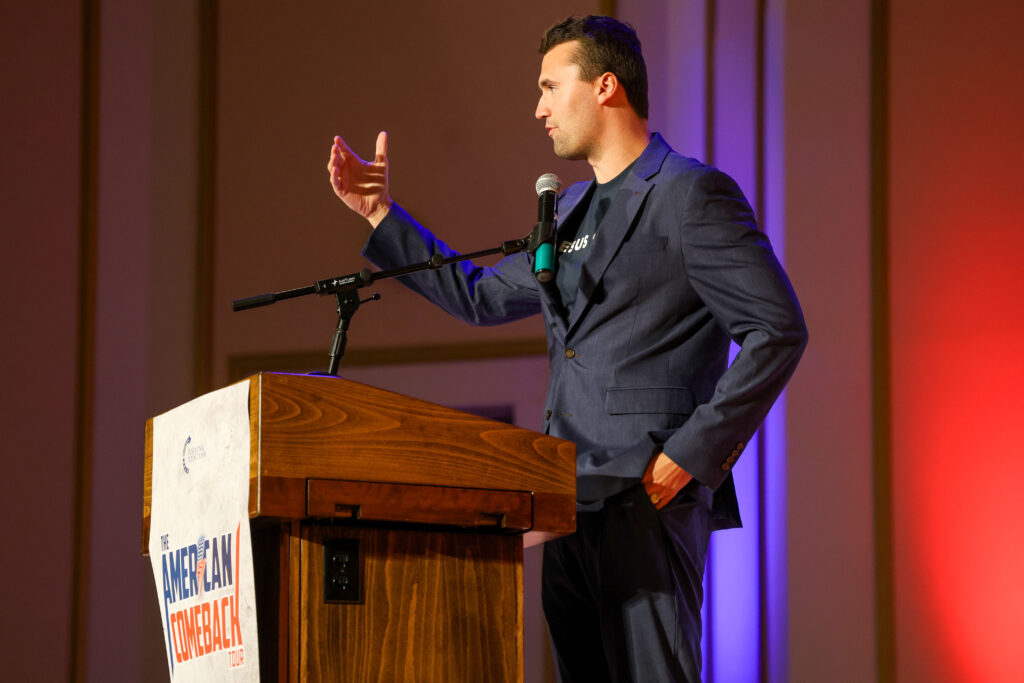
Ahmed’s frustration came to a head in April, when the late conservative activist Charlie Kirk came to campus. Ahmed was appalled that the university allowed him to come, noting his support for Israel and controversial remarks about Muslims.
“It is dehumanization of Palestinians,” said Ahmed. “It’s just completely unjustified.”
The morning before Kirk’s arrival, Ahmed said he was motivated to act.
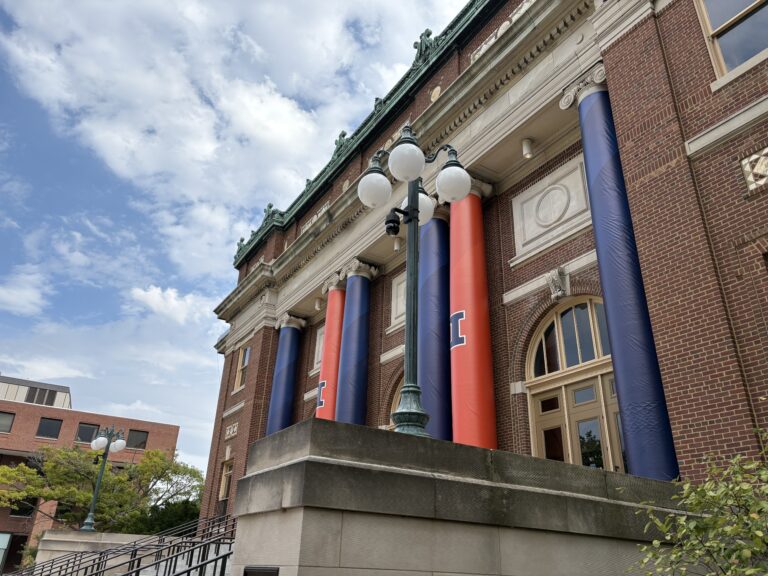
“I spray painted the word divest onto Foellinger Auditorium in protest of the university’s complicity with its investments in genocide.”
Soon after, the school’s police department arrested Ahmed. He was taken to the Champaign County Jail and faced state charges.
Towards the end of the summer break, the university notified him he was being suspended and that he could reenroll if he paid a fine for the damages he caused.
But Ahmed said he was only given two business days to complete that request. As a result, he said he is now prohibited from coming back onto campus.
Ahmed said he feels as though the university essentially expelled him, saying it was an unjust and overly harsh step for the university to take.
In a statement, a university spokesperson said students can be penalized under the policy on disciplinary procedures. She said the university does not expel students.
Pro-Palestinian activism and U of I’s position on free speech
University administrators have consistently said they support the right to free speech under the First Amendment. U of I’s new chancellor, Charles Isbell, sent an email to students this month affirming the school’s commitment to to creating safe spaces for everyone to express their views.
But the response to Ahmed’s incident is not the first time pro-Palestinian activism has come under fire at the university. News of the suspension also comes at a difficult time for public demonstrations on college campuses — even before Charlie Kirk was shot and killed at Utah Valley University earlier this month.
Several community members accuse the U of I of unfairly targeting pro-Palestinian protesters, saying the school’s actions are having a chilling effect on student voices.
In the spring, the Council on American Islamic Relations (CAIR), a national Muslim civil rights group, said the U of I is one of 28 campuses it considers hostile to voices speaking against the war in Gaza.
“We want to report these campus environments so that the public knows, parents and students and families know which campuses are hostile to free speech, free expression, protesters against genocide,” said Maryam Hassan, a research and advocacy specialist with CAIR.
Hassan said the U of I is particularly harsh on the movement compared to other schools on the list. CAIR’s list is based on a variety of factors, including how administrators react to demonstrations and what legal actions are taken to discipline students who protest.
Those concerns came into play when the U of I responded to the pro-Palestinian encampment that formed on campus in May last year. Protestors camped out on the Quad and demanded the university divest its holdings in companies involved with Israel’s siege in Gaza.
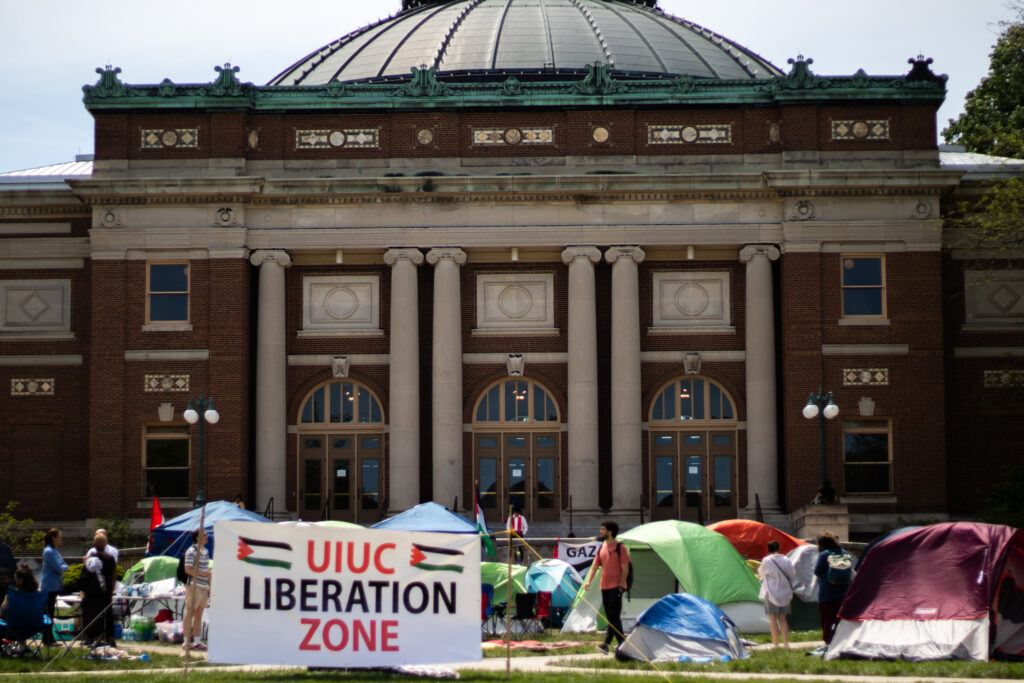
Following the encampment, university police worked with Champaign County States Attorney Julia Rietz’s office to charge eight protestors with mob action felonies. All of those cases have since been resolved, with most of the defendants taking plea deals.
Ahmed said he chose to vandalize Foellinger Auditorium because he feels the school is repressing students on campus instead of listening to their concerns.
IPM News reached out to Jewish student groups to ask whether they feel their voices are being heard on campus.
Samantha Levy with Illini Hillel declined to answer questions, instead opting to provide a statement.
“My hope as a Jewish student leader is that all Jewish students should feel free and be safe to express their Jewish identities, including their relationship to Israel,” Levy said.
Calls for revising U of I’s investments continue
Ahmed said the cause is also personal to him. He and other students have lost family members due to Israeli military strikes.
An organizer with Students for Justice in Palestine, who chose to remain anonymous for safety reasons, said she was disappointed to learn Ahmed was suspended.
“It’s clear that the university is trying to just make an example out of him, to scare us into, like, to stop talking about Palestine and just to not speak out against morally corrupt things that the university is doing,” said the organizer.
The University of Illinois declined to comment on the specifics of Ahmed’s case.
Despite his education being cut short, Ahmed said he is not worried about his future because he knows he is not alone.
“I’m reminded that this isn’t a small movement,” said Ahmed. “This is an international movement across campuses in the United States, Canada and Europe, as well as everywhere else where, where a lot of students are facing similar forms of repression and similar forms of overcriminalization.”
Ahmed now lives in Dallas. Though he is prohibited from coming onto the U of I campus, he said he’ll still continue fighting for Palestinian voices to be heard.
IPM News asked Ahmed if he regrets vandalizing Foellinger Auditorium.
“I think the real question is how can the university make sure that something like this doesn’t happen again?” he said. “The way to do that is to listen to its students and … their continued activism and pressure on the university to ensure that investments are ethical and not complicit and … to engage with their students and hear them instead of repressing and criminalizing them.”