

Corre, Corre, la Guaraca. Batakh, batakh, hans. Hankachi Otoshi. Duck Duck Goose. Different cultures, one game.
At the latest Coffee Across Cultures Hour event, students gathered in the Siebel Center for Design in Champaign to enjoy coffee, tea and pastries while exploring this month’s theme: childhood games.
Kathryn Burden, associate director of the International Student and Scholar Services Office at the University of Illinois Urbana-Champaign, said she launched this monthly program last spring after noticing a need for regular, casual programming that brings students and scholars — both international and domestic — together.
“I think it’s really important to give people the opportunity to connect and meet people who are different from themselves, because it just encourages a real sense of understanding, of empathy, and we need that, especially in these times,” Burden said. “We really want to foster that sense of belonging and inclusion in the university.”
The afternoon began with a presentation from Syed Faizaan Ahab, an art education Ph.D. student, who introduced several different games from various countries. Among them were Pilolo, a Ghanaian treasure hunt game played with pennies, and Ounch Neech, a Pakistani game similar to “The Floor is Lava.”
Ahab said the aim of this game-focused Coffee Across Cultures Hour was to combine fun with connection.
“When you’re from a culture, it’s easy to find your own people, but it can be a little intimidating for people to just walk up to someone who they don’t know who’s from another culture. You don’t know what they speak like,” Ahab said. “These kinds of [game] interactions, where it’s fun and more, ‘Oh, it’s okay, we’re making mistakes, you’re losing, I’m winning’ — this kind of an environment is very important for people to come together and connect.”
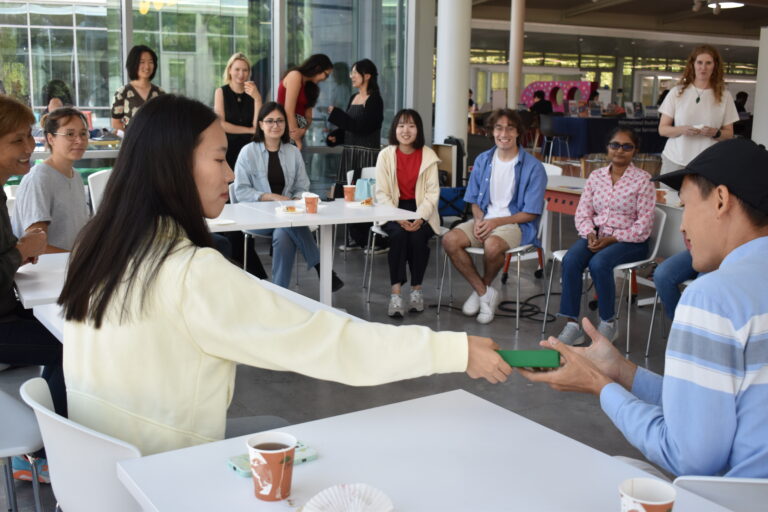
After Ahab’s presentation, attendees pushed their chairs into a circle for a game of “Pass the Parcel,” more commonly known as “Hot Potato” in the U.S. Music played as a green-wrapped box moved from hand to hand; anyone caught holding the box when the music stopped was eliminated from the game.
Every pause brought laughter as players left the circle, until only one winner remained.
That winner, Hana Kishimoto, is an exchange student from Japan who recognized the game under another name.
“In Japan, we use a ball, and we call the ball a ‘bomb,’” Kishimoto said. “It’s called ‘bakudan watashi.’”
Kishimoto had seen an event flyer and hoped to meet people and practice her English. She said she got the chance to do both, as well gain a deeper appreciation for cultural overlap.
“[Even] if the country is far from the other country, [they] share the same game or the same rules or also share some important things, like fairness or justice,” Kishimoto said. “It’s very important for us to collaborate with people from all the different countries.”
For Dylan Edwards, a recent U of I graduate from the Chicago suburbs, the event offered a new perspective.
“One of the insights that I gained today is regarding just how games can connect people,” Edwards said. “I hadn’t really thought about it, and I was more focused on strategy and those types of technical aspects — not really the culture and community behind it.”
After “Pass the Parcel” was finished, attendees lingered over more coffee and pastries and chatted with one another. Burden said she hopes everyone met someone new and made friends.
“What we’re talking about is just a simple topic,” Burden said. “We’re just talking about global games and childhood games, but it really gives people the opportunity to break down those barriers and to start to feel comfortable with others.”