

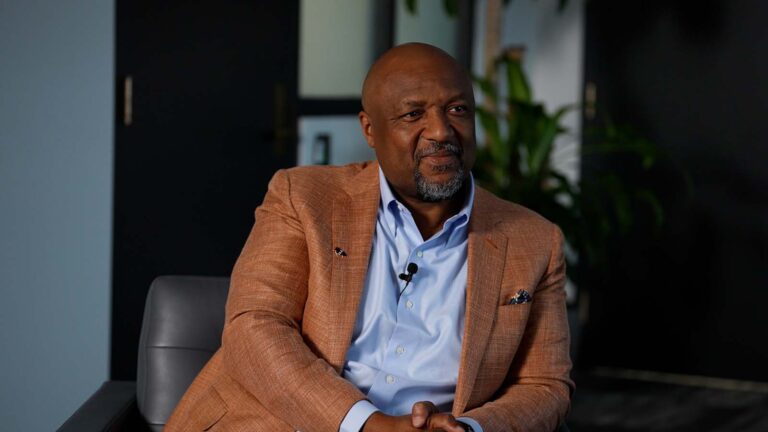
CHAMPAIGN — Class is back in session at the University of Illinois Urbana-Champaign, and a new chancellor is on campus.
Charles Isbell is still getting to know the community, but he’s also preparing for possible attacks from the federal government.
“I am assuming that we will eventually find ourselves a target, as is everyone in higher ed,” Isbell said in an interview with IPM Education Reporter Emily Hays.
Isbell is taking over after his predecessor’s nine-year term. The previous chancellor, Robert Jones, left to become president of the University of Washington.
Isbell is a computer scientist who served as provost at the University of Wisconsin-Madison. Originally from Atlanta, Isbell attended Georgia Tech for his undergraduate degree and the Massachusetts Institute of Technology for his PhD in computer science.
In this excerpt from the interview, Isbell discuss how he is settling into the new role and preparing for scrutiny from the Trump administration.
The 21st Show will air the full conversation on Monday. A full video of the interview will also air on WILL-TV and YouTube later this fall.
EMILY HAYS: It’s been a few weeks since you officially took over the leadership of the University of Illinois Urbana-Champaign on August 1. What is something you’ve learned in this time that you didn’t expect?
CHARLES ISBELL: This place is as advertised. It really does care about its mission. It really truly is interdisciplinary. The people here understand that what they’re doing is important, and they think very carefully about what they do. I think that’s what I hoped I would see. It’s what I knew from my own time visiting here over the years, but it’s been really gratifying as I’ve gotten to meet more and more folks and to understand that they care so much about this place and understand that what they do is important.
HAYS: It looks like you’ve settled into your new office. What’s something you brought with you?
ISBELL: I have over there a picture of my academic ancestry. Every single one of my advisors, my advisor’s advisors, my advisor’s advisors’ advisors, going back at least to the 1300s. Galileo is in there. Copernicus is in there. I really like the idea that I’m a part of history, that I’m a part of a story that has been going on for centuries and hopefully will go on centuries after.
And along with that picture of all of my ancestors, I have all of my descendants, all of my PhD students, the folks that I’ve worked with over the years, and I look up every day and I see the people [whose lives] I’ve been able to be a part of, and get to know that I helped them along in their journey.
HAYS: President Trump has targeted the University of Virginia and the University of Southern California, not just Ivy League schools. Have you heard from the Department of Education? Are you preparing for them to cut even more federal funds in an effort to end diversity, equity and inclusion practices here?
ISBELL: There’s a couple ways to think about that. The way that I think about it is, I am assuming that we will eventually find ourselves a target, as is everyone in higher ed. This is a concentrated and thoughtful attack on higher ed.
I use the word attack on purpose. I think that this is a conversation that the federal government is trying to force between us and everyone else about what the purpose of universities are, and particularly what the purpose of large research universities are. So we are going to be a part of that conversation, whether we are personally asked to do something or personally targeted.
We’ve already seen some effects of what’s happened over the last several months. I myself had one of my grants ended from work that I was doing before I got here. I expect that we will see more of that.
HAYS: This is a question from [Graduate Employees Organization members]. What will happen to employees if their work funded by federal grants is cut? Would U of I step in to pay their wages?
ISBELL: Well, we will do the best that we can. I can’t make promises about that, because I don’t know what the scale is going to be. I don’t know the specific mechanisms by which different students are being paid.
Hidden in there, I think, are two different questions. One is, what’s going to happen this semester, and what’s going to happen two or three years from now? This is a big transition period for all of higher ed and all the people who are affected by it. Are we talking about a fundamental restructuring of how we think about supporting graduate students, how we think about supporting faculty, how we do research, how we educate? Or are we thinking about something that is going to be very sudden and kinetic, and then change six months after that? We just do not know. So we are preparing.
We have already done work before I got here. There’s been a lot of work done in trying to build up and save funds for transitions, for people to help them get through. There’s been a lot of talk and conversation about, how do we help people move from one area of research to a different area of research?
If we think about this in the larger scheme of things, changes like this have happened always. They just normally take longer, right? There are two years of transition. People have an easier time with thinking about how to do things differently. This has been moving at unprecedented speed. That is part of what makes it difficult, is having to turn on a dime and think about how to do something on the scale of a few weeks in the middle of a semester, as opposed to, ‘We need to plan strategically about this over the next couple of years.’ It’s difficult because these things are real and immediate, but a lot of our job here is to think about how to turn this moment of very rapid change into a conversation about where we’re going to be in a couple of years.
We’re going to do the best that we can. We’ve already cut some things. We are trying not to grow, except in the areas where we absolutely have to over the short term, so that we can help buffer that through.
So again, I’m not going to sit here and say yes, we will cover everything, or say no, we’re going to cover nothing. We’re going to do the best that we can to support the work and to support the people who are a part of our mission.
HAYS: I’ve been talking with U of I’s new chancellor, Charles Isbell. I’m Emily Hays with IPM News.
This interview has been lightly edited for clarity and conciseness.