

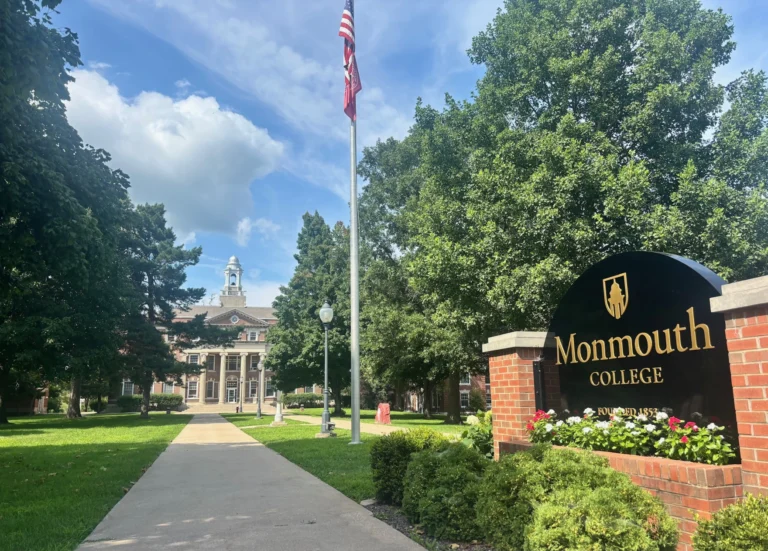
MONMOUTH — It’s quiet at Monmouth College in early August, except for the occasional buzzing of a lawnmower and birdsong ringing from towering oaks on the front lawn of Wallace Hall.
Soon there will be other sounds at the home of the Fighting Scots, a private liberal arts college founded in 1853 by Scotch-Irish Presbyterians – bagpipes, football practice, and students moving into their residence halls.
This year’s incoming class will have around 40 more students than last year’s, with a couple dozen of them coming to Monmouth for a brand-new, 3+1 nursing program in collaboration with OSF HealthCare – and more than 60% of this year’s class coming to Monmouth as Division III student athletes.
Monmouth President Patricia Draves said the college would like to see enrollment reach the high 800s in the next three or four years, with slow, controlled growth of an additional 50 students per year.
“We’re trying to be realistic, too,” Draves said. “Because it’s easy to put a number on a spreadsheet and say, okay, we can do this. But in a declining demographic, what’s realistic?”
Colleges and universities across the country are facing the combined pressures of shifting student demographics, declining enrollment, and skepticism about the value of higher education.
Against that backdrop, Monmouth is phasing out ten majors primarily in the humanities and social sciences and enhancing other programs based on student interest and market demand, following a months-long academic program prioritization process. Six faculty positions are being eliminated as part of the academic restructuring.
Draves said these changes were not implemented to eliminate a predetermined amount of money from the operating budget – and she said the changes do not mean that Monmouth College is closing.
But the academic prioritization process is meant to align expenses and revenue and to strategically allocate resources for a college’s long-term health. In Monmouth’s case, it was meant to help the college embrace its identity amid that challenging higher education landscape.
“Schools that are not doing this work are trying to kick the can down the road. It’s going to catch up to them,” Draves said.
A group of concerned alumni who say they benefitted from humanities courses at Monmouth College is circulating a petition to save those programs.
They say they’re concerned about maintaining the institution’s longstanding commitment to the liberal arts.
Changing interests
Draves is a cancer researcher who taught chemistry at Monmouth from 2002 to 2006, when enrollment was growing, reaching 1,379 students in 2009. More recently, enrollment at Monmouth has been in the lower 700s, driven in part by what Draves calls “non-consumers” of higher education.
“Over the last ten years, we have not seen anything like this, just the number of students not going to college at all,” Draves said.
Draves said students’ needs and interests are changing, too. She said millennials wanted new dorms and climbing walls and fancy food in the cafeteria. But current college students grew up in the aftermath of the 2008 recession. They are pragmatic, socially conscious, and they don’t want to go into debt.
“Gen Z-ers care about relationships. They ask about the support. They’re aware they need mental health services and development,” Draves said. “They’re asking for more of those pieces and an environment that offers that.”
When Mark Willhardt came back to Monmouth in 2000 to teach in the English department, as his father did for 35 years, the college had strongly rebounded from the early 1990s, when enrollment dropped to under 600 students.
“We were putting up buildings. We were putting up dorms. The faculty was growing. The student body was beginning to grow. We were putting on programs,” Willhardt said. “And it was not just Monmouth. You could see it across all of higher ed. I think most of us didn’t look much beyond 2010, 2012, because we figured that it would just keep going that way.”
Willhardt became Dean of the Faculty and Vice President for Academic Affairs in 2018. He said the city of Monmouth has changed and the college’s place in the community has changed over the years, too. He also sees generational differences in faculty coming on campus.
“They’re prioritizing lives in different ways. So they’re choosing a work-life balance that is different than previous generations have done,” he said. “That means the ways in which we’re conceiving of work on campus is changing. “
‘Voting with their feet’
Draves became Monmouth College’s 15th President last year, after seven years as President of Graceland University in Iowa. Prior to that, she was Dean and Vice President for Academic Affairs at Mount Union University in Ohio.
Draves was tasked by the board of trustees at the beginning of this year to undertake the academic prioritization process. Draves said she could not find evidence that Monmouth had ever previously conducted a similar process to holistically evaluate its portfolio of academic programs.
Draves led the academic prioritization task force, which also included Willhardt and faculty members in different disciplines and other administrators. Three members of the board of trustees also served as non-voting advisors to the task force.
The task force first created guiding principles for their work, then gathered data to investigate three main areas for each academic program. That included program quality – based on everything from external reviews, department narratives, and student evaluations – as well as economic sustainability and market demand.
“There was a group that looked at market, trying to think about what an external market would be for these programs, what’s the demand? Are students interested? How do we know? Looking at admissions funnels, beginning to think about that,” Willhardt said. “Then there was an economics group that was looking at the per course, per program, down to per FTE sorts of contributions to the overall.”
After months of data analysis and difficult discussions, the task force delivered its recommendations. A number of programs – including business, marketing, data science, nursing, exercise science, and elementary education – are now programs the college plans to grow and invest in.
Others – like accounting, English, math, physics, music, and theatre – are in the maintain category, though they will undergo some changes. And ten “low-demand” majors for the rural liberal arts college, primarily in the humanities and social sciences, are being phased out. That includes majors such as history, anthropology, philosophy, religious studies, environmental studies, and Spanish.