

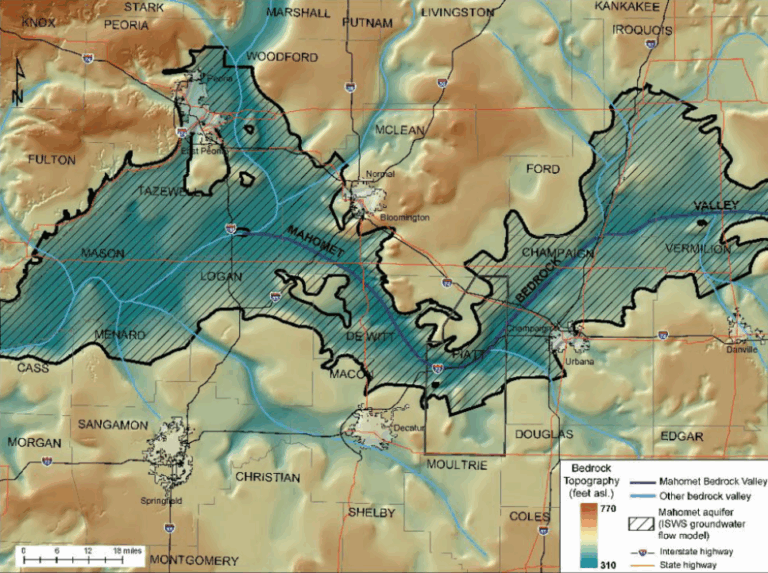
SPRINGFIELD — A bill banning carbon sequestration in the area of the Mahomet Aquifer has been signed into law and will take effect January 1, 2026.
Governor JB Pritzker signed Senate Bill 1723 last week.
The measure had dozens of co-sponsors, mostly Chicago area Democrats and lawmakers from both parties in the central and east-central Illinois region where the Mahomet Aquifer is the primary source for drinking water.
SB 1723 was passed unanimously by the Illinois Senate on April 10 and May 20 in the Illinois House with a 91-19 vote. Passage came after protections for the Mahomet Aquifer were left out of the SAFE CCS Act, a broader measure regulating carbon sequestration in Illinois that was signed into law in 2024.
That omission prompted State Senator Chapin Rose (R-Mahomet) to introduce his own legislation last summer, shielding the aquifer from CCS project.
Rose’ bill died in committee. However, a version of it resurfaced in the current General Assembly in 2025, sponsored by State Senator Paul Faraci (D-Champaign), with Rose as one of its co-sponsors.
“This is a long-overdue win for the people of central Illinois who fought tirelessly to protect our clean water,” Rose in a statement. “While I’m frustrated it took the Governor this long to do the right thing, I’m grateful he finally heard the message loud and clear – central Illinois will not be a dumping ground for risky carbon experiments.”
In his own statement issued by Illinois Senate Democrats, Faraci said too many Illinois residents rely on the Mahomet Aquifer to risk its contamination.
“While mitigating the effects of climate change should be a priority, it cannot be at the expense of the clean drinking water of nearly one million Illinoisans.”
Advocates of carbon capture and sequestration (also known as carbon capture and storage) say it can keep industrial carbon dioxide emissions out of the atmosphere by storing it underground. Critics worry that CO2 stored underground could leak into aquifers, risking the safety of drinking water sources.
Archer Daniels Midland, which operates a commercial carbon capture and sequestration site at Decatur, said CCS facilities don’t threaten aquifers because the CO2 is stored far below underground drinking water sources. ADM reported two leaks at its Decatur facilities last year, but the storage sites are not below the Mahomet Aquifer, and the company says water supplies were not threatened.
Besides banning sequestration at the Mahomet Aquifer, the legislation creates an advisory commission to study the aquifer, which underlies 15 counties from the Illinois River to the Indiana border.