

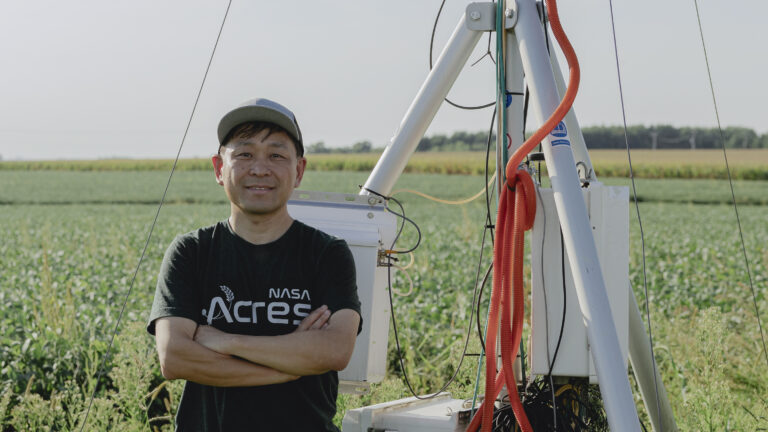
URBANA — Research on climate and the environment, fueled by mathematical modeling and artificial intelligence, could help scientists understand how climate change will impact agriculture, crop production and everyday life.
That’s according to Kaiyu Guan, an environmental scientist at the University of Illinois Urbana-Champaign, who was recently named a 2026 MacArthur fellow — one of 20 scientists who will receive $800,000 over the next five years to help fund their research.
Guan is a professor of sustainability in the U of I’s department of Natural Resources and Environmental Sciences. He works with various tools, such as remote satellite sensing data, to study water bodies, atmosphere, land and vegetation.
The ultimate goal is to help inform farmers on sustainable agriculture practices.“Data from diverse satellite sensors [helps us] understand agriculture productivity and the environment — how environmental stress affects the crop yield,” Guan said.
Guan’s research team uses mathematical models to measure plant growth and understand how plants interact with the soil and the environment.
“Satellite data can see a lot of things, but then there are things they cannot see,” he said. “If you want to holistically understand agriculture as a system, you essentially also need [to incorporate] other aspects.”
For example, Guan said he wants to measure variables such as crop yield —how much grain farmers are able to produce and harvest. Measuring crop yield can help farmers understand how soil health, water and the climate can impact production.
Guan said his research also considers the environmental impact of agriculture — such as greenhouse gas emissions, air quality and water quality.
“All these aspects are very critical because you want to use the land to generate crops, but at the same time you want this land to continue to be sustaining for many, many future generations,” Guan said.
Being named a MacArthur fellow means that he can invest in technologies to help his agricultural research.
“I really see this award is the time to really champion agriculture because agriculture is so important to our society, to human civilization,” Guan said “I see the award is really a [vote of] confidence for the work that we are doing,”
Guan is hopeful his research will help farmers cultivate “climate-smart” agricultural practices, which help reduce emissions while increasing crop productivity.
One example is the use of cover crops, which are placed after harvesting to protect the land during the winter months. Guan said cover crops could help improve soil health and boost crop productivity.
“If we start to adopt [these practices] at the right place and the right locations, it may generate benefits to the environment,” Guan said.
Guan said that the solutions he develops through his research could also help in policy making and developing new technology.
“The impact of research of agriculture does not only stay or stop as a paper,” he said. “…They will also contribute to the real-world impact.”
The award, he added, “is not the end point; It’s actually a launching pad to do something even more positive, more impactful.”