

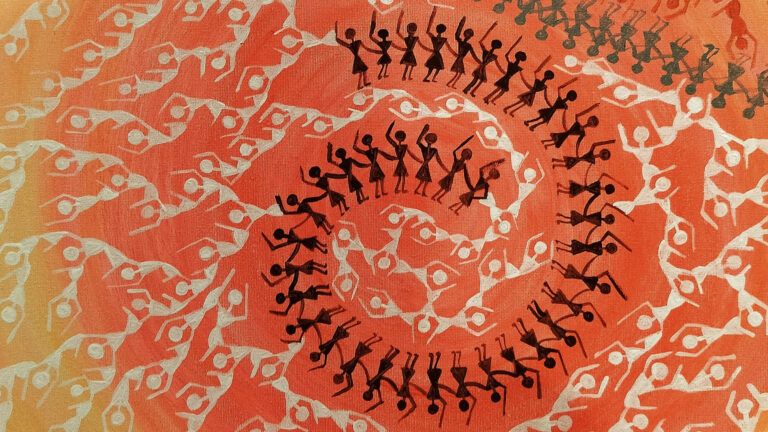
URBANA — The walls of the University of Illinois Asian American Cultural Center are lined with Warli art. It’s an art form from West India that dates back to 2500-3000 BCE, and artist Kuhu Shukla’s goal is to bring it to Champaign-Urbana.
Shukla’s exhibition, “Not Mine Only Held,” features paintings of minimalistic geometric shapes and patterns typical of Warli art.
But despite their simple nature, they work to tell more complex stories about human emotion, belonging and connections to culture.
“I think we have spent an enormous amount of time depicting things as they are on the outside, but we still struggle to talk [about] and visualize how we feel… when there’s so much chaos around us,” Shukla said. “I think Warli gives an incredibly powerful visual language that anybody can do.”
Shukla grew up in Jaipur, Rajasthan, an artistic region of Northern India. She came to the U.S. in 2013 to pursue graduate studies in computer science at North Carolina State University and moved to Champaign for work in 2015.
Shukla describes herself as a “big data engineer by day, an accidental artist on weekends.”
“In 2017, I went to the Pacific Northwest, and I connected to [Warli] in the most inadvertent kind of ways,” she said. “I never truly appreciated it until I came here.”
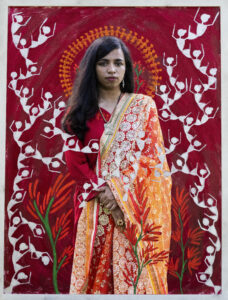
Shukla began creating Warli portraits to make sense of her emotions, particularly those she did not understand.
“When your life gets extremely chaotic, the best way to bring some feeling of control and some feeling of sanity and groundedness is to express it,” she said.
The exhibition also draws on Hindu mythology: The series, “Everyday Sati, Everyday Shakti,” Shukla retells the story of Maa Sati, the first Hindu goddess.
She says her focus is to explore how women find resilience in their everyday lives.
“It tells the story of how we can step into our fires every day. We can step into our trials and tribulations every day. And in that misery, we can find the ultimate strength, the ultimate resilience, and the ultimate freedom,” she said.
Amy Breslin, associate director of the AACC, is in charge of coordinating arts and culture programming for the center.
She says that Shukla’s work stood out to her when it came time to select the artist for the fall semester showcase.
“I really appreciated that she was very focused on utilizing her artwork, not only for her own cultural identity development and reconnection, but also [to bring] a traditional art form into the space that we’ve not previously had the opportunity to showcase before,” she said.
Breslin said that since the AACC opened the exhibit, both students and staff have shared how the art form has resonated with them, within their own lives and communities.
“You can see it on their faces… There is an immediate recognition, and they can see the work, and it reminds them of things that are just very personal to them,” she said.
And for Shukla, that’s exactly what she hoped her exhibition would do.
“[Art is] one of the most beautiful ways to connect with people around you, to truly understand what people around you are doing, feeling,” she said. “Say your friend is from a different culture. The most powerful way to connect with them is to talk about their roots, and to explore those roots through this art form.”
“Not Mine Only Held” will be on display at the Asian American Cultural Center at 1210 W. Nevada St, Urbana, until Dec. 11.
“It tells the story of how we can step into our fires every day. We can step into our trials and tribulations every day. And in that misery, we can find the ultimate strength, the ultimate resilience, and the ultimate freedom,” she said.
Amy Breslin, associate director of the AACC, is in charge of coordinating arts and culture programming for the center.
She says that Shukla’s work stood out to her when it came time to select the artist for the fall semester showcase.
“I really appreciated that she was very focused on utilizing her artwork, not only for her own cultural identity development and reconnection, but also [to bring] a traditional art form into the space that we’ve not previously had the opportunity to showcase before,” she said.
Breslin said that since the AACC opened the exhibit, both students and staff have shared how the art form has resonated with them, within their own lives and communities.
“You can see it on their faces… There is an immediate recognition, and they can see the work, and it reminds them of things that are just very personal to them,” she said.
And for Shukla, that’s exactly what she hoped her exhibition would do.
“[Art is] one of the most beautiful ways to connect with people around you, to truly understand what people around you are doing, feeling,” she said. “Say your friend is from a different culture. The most powerful way to connect with them is to talk about their roots, and to explore those roots through this art form.”
“Not Mine Only Held” will be on display at the Asian American Cultural Center at 1210 W. Nevada St, Urbana, until Dec. 11.