


SPRINGFIELD — Illinois lawmakers are considering multiple proposals to regulate the state’s rapidly expanding data center industry as concerns grow over its impact on the electrical grid, utility costs and water reservoirs.
At a press conference earlier this year, State Rep. Carol Ammons, D-Urbana, warned utility companies Commonwealth Edison and Ameren have received proposals for new data centers requiring a combined 44 gigawatts of electricity.
“That means that the data centers waiting to connect to our grid plan need much more power than 44 Orlandos put together,” Ammons said. “You and I shouldn’t have to pay.”
Ammons introduced the POWER Act, legislation that would require developers to pay for their own renewable energy generation and grid upgrades. She argued Illinois residents should not bear the financial burden of the industry’s rapid growth.
“The people of Illinois cannot afford to continue to bear the cost of this innovation,” Ammons said.
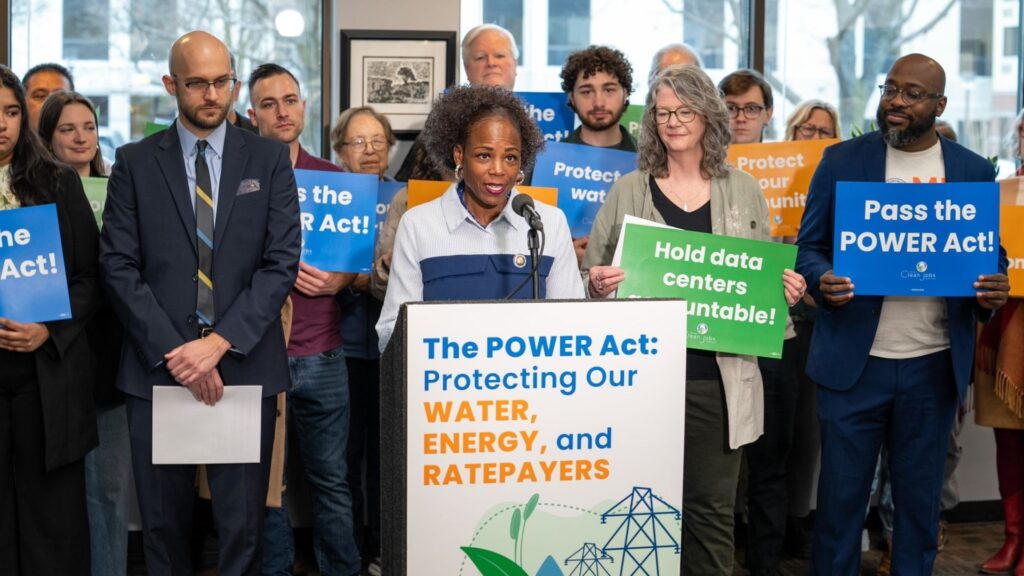
The bill would also force data centers to make their water usage public and mandate permits that require certain water-efficiency standards.
Lawmakers have held multiple hearings at the Capitol as they debate new data center regulations.
Illinois has the fourth-highest number of data centers in the U.S. Demand for the centers is only growing as companies seek out large facilities nationwide to store servers and keep them cool.
State leaders once promoted the industry as a means of economic growth. Officials now express concerns that new data centers could drive up utility costs and threaten the state’s natural resources.
Bipartisan interest in protections from data centers
Republican State Sen. Chapin Rose, R-Mahomet, has introduced a separate package of bills focused on energy costs and water protections, particularly for the Mahomet Aquifer.
Rose said the legislation is intended to “inject some common sense back into our energy policy” while protecting consumers from rising utility bills.
“These data centers need to come with their own power,” Rose said. “If they’re going to hook into the Clinton nuclear power plant … it’s just going to raise everybody else’s bills.”
He also called for a permanent moratorium on data centers using water from the Mahomet Aquifer, which supplies drinking water to nearly 1 million people in central Illinois.
“It is our sole source aquifer, meaning there’s no other place to go for a million Illinoisans,” Rose added. “You can’t just flip a switch and turn on a spigot from somewhere else.”
The Mahomet Republican contrasted his proposal with a separate one-year moratorium discussed by local officials and Democratic lawmakers, saying a temporary pause would not give the state enough time to study the long-term effects on energy infrastructure and groundwater resources.
Industry argues data centers reduce local costs
Advocates for the data center industry say the facilities already account for their impact on the energy grid — and that they can help improve infrastructure and lower costs for other customers if managed correctly.
Brad Tietz, director of state policy at the Data Center Coalition, said the industry is “100% committed to ensuring its full cost of service.” He added the projects help absorb infrastructure costs that would otherwise fall on residents.
“In most states that are seeing increased large load or data center development, they’re actually seeing a freeze or a reduction, adjusted for inflation, for other ratepayers,” Tietz said. “The cost of today’s increasing electricity prices is, in large part, due to the need to modernize our aging grid. And when data centers enter a locality, they are taking on a greater share of the fixed costs.”
Researchers studying energy systems say the issue is more complicated than simply whether data centers increase demand.
Ayse Coskun, a professor at Boston University whose research focuses on data power management and grid interactions, said AI-focused data centers create unusually concentrated electricity demand.
“AI data centers are essentially becoming some of the largest single electricity customers in the region,” Coskun explained. “Their demand is continuous and concentrated, as opposed to a city’s demand being spread out typically.”
Coskun said utilities may need to build new substations and transmission infrastructure to support hyperscale facilities, but added that some companies are exploring flexible energy strategies to reduce strain on the grid.
“If developers cover most of the infrastructure costs and facilities operate flexibly, then the pricing impact can be more limited,” she said.
Shaolei Ren, an associate professor at the University of California-Riverside who studies the environmental impacts of data centers, said many communities also lack the infrastructure needed to handle the industry’s peak water demand.
“These millions of gallons of water capacity requests from the local water infrastructure is really straining the system,” Ren said. “In many cases, the communities don’t have that much water available to support the demand.”
Ren noted water use can vary significantly depending on a facility’s cooling systems and seasonal demand. Some locations use “dry cooling” systems that reduce water consumption but increase electricity demand during hotter months.
Local governments respond to data center demand
Communities across Illinois are taking different approaches to proposed projects.
The Champaign County Board approved a one-year moratorium on large-scale data centers while officials consider potential local zoning regulations. The pause applies to facilities with at least 10,000 square feet of processing space and gives the county’s Data Center Task Force time to develop zoning and permitting standards for unincorporated areas, including regulations tied to energy use and protections for the Mahomet Aquifer.
Meanwhile, the Sangamon County Board recently approved a $500 million data center project.
Unlike data centers, which have come more scrutiny, plans for the Illinois Quantum and Microelectronics Park are moving forward with support from the state.
Illinois is providing hundreds of millions of dollars in funding for the project, which seeks to build a research and manufacturing campus on the site of a former steel plant on the city’s South Side.
The park’s director, Harley Johnson, said the facility differs significantly from AI-focused hyperscale data centers.
“The technology that we’re developing at the IQMP doesn’t use these kinds of large quantities of water that I think people are concerned about here,” Johnson said. “The amounts of water that we’re expecting to use in the project in Chicago are well within the range of what is available to any industrial customer.”
Pritzker proposes pause on tax incentives
Gov. JB Pritzker has also indicated an openness to shift course on incentives for data centers to address utility costs.
The governor signed a law in 2019 offering tax breaks to data center operators. ’ In his 2026 budget address, however, Pritzker suggested the state should pause those incentives.
“We need to think critically about our future energy usage with the needs of Illinois households at the forefront,” Pritzker said in a statement. “In the face of rising demand and surging prices, I’m proposing a two-year pause on authorization of new data center tax credits.”
“With the shifting energy landscape, it is imperative that our growth does not undermine affordability and stability for our families,” he added.
Lawmakers are expected to continue debating the proposals before the spring legislative session concludes at the end of May.