

Updated Monday at 4:10 p.m.
The war in the Middle East expanded on several fronts Monday as attacks from Iran and Iranian-backed militias struck Israel and Arab states as well as U.S. military targets.
The U.S. military said Kuwait “mistakenly shot down” three American fighter aircraft during a combat mission, though all six pilots ejected safely. Separately, six other U.S. service members have been killed in the conflict.
Israel and the United States continued to strike Iran while Israeli forces responded to attacks from the Iranian-backed Hezbollah militant group by hitting targets in southern Lebanon, killing 52 people.
The war began Saturday with the killing of Iranian Supreme Leader Ayatollah Ali Khamenei in a joint U.S.-Israeli strike. Reaction around the globe ranged from jubilation to condemnation, while the conflict has caused canceled flights, deadly protests, shipping delays and soaring oil prices.
Attacks across Iran kill hundreds, shake economy
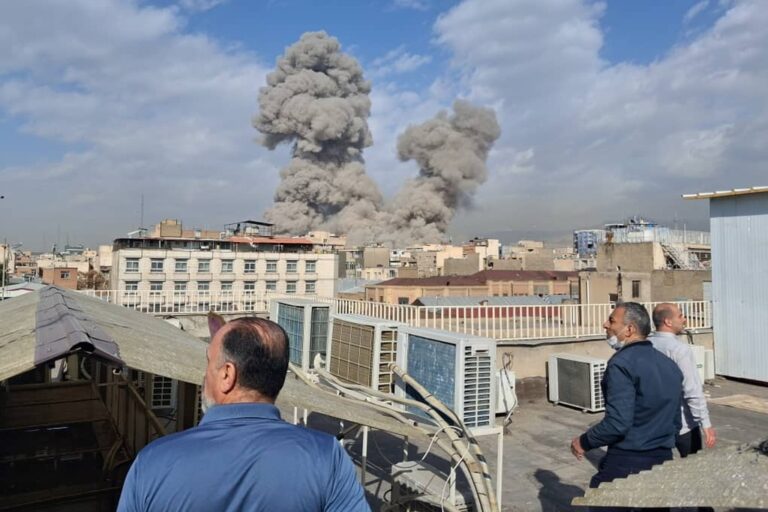
The Iranian Red Crescent Society on Monday said that attacks on scores of Iranian cities have killed at least 555 people in the Islamic Republic. Strikes in Tehran apparently took Iran’s state television off the air.
The joint U.S.-Israeli strikes on Iran stoked fears of a wider war and damage to the world economy. Meanwhile, Iran has expanded its attacks on oil infrastructure, the lifeblood of the region’s economy.
Trump lays out his objectives
President Donald Trump said the U.S. objectives were to destroy Iran’s naval and missile capabilities and stop it from obtaining a nuclear weapon. He expects the operation to take 4 to 5 weeks, but said it could take “far longer.”
”This was our last, best chance to strike — what we’re doing right now — and eliminate the intolerable threats posed by this sick and sinister regime,” Trump said Monday.
Six U.S. service members have been killed, including three killed in the Saturday attack on Iran, according to U.S. Central Command.
Secretary of State Marco Rubio said regime change is not the goal.
“We would love for there to be an Iran that’s not governed by radical Shia clerics,” Rubio said Monday. “That’s not the objective.”
Iran to name new supreme leader
In the wake of Khamenei’s death, Iran’s provisional governing council is expected to name a new supreme leader. Even before the weekend’s deadly strikes, Iran’s theocracy had struggled with growing dissent over the economy. Activists say Iran’s crackdown on protesters killed thousands.
One of the first strikes Saturday hit near the offices of the 86-year-old Khamenei, who had ruled since 1989. Israel said that it also killed dozens of other top Iranian military officials.
Iran strikes Israel and US bases in retaliation
Iran has launched retaliatory missiles and drones targeting Israel and nearby Arab Gulf countries hosting U.S. forces.
Several ships have been attacked in the Strait of Hormuz, at the mouth of the Persian Gulf, where a fifth of all traded oil passes. Shipping companies suspended their vessels’ traffic through the Suez Canal, adding to fears the strikes could rattle global markets.
Elsewhere, fire and smoke poured out of the U.S. Embassy compound in Kuwait after an Iranian attack.
Bahrain, the island kingdom that is home to the U.S. Navy’s 5th Fleet, said it has intercepted dozens of missiles and attack drones.
In Israel, 11 people have been killed, including nine in a strike on a synagogue in the central town of Beit Shemesh.
In Iraq, an Iraqi Shiite militia claimed a drone attack Monday targeting U.S. troops at the airport in Baghdad.
And at least 22 people were killed in clashes with police in northern Pakistan and in the southern port city of Karachi after hundreds of protesters stormed the U.S. Consulate there, authorities said.
Travelers across the region stranded
Disrupted air travel in the region stranded or diverted hundreds of thousands of travelers after Israel, Qatar, Syria, Iran, Iraq, Kuwait and Bahrain closed their airspace.
They include athletes heading to the Winter Paralympics in Italy, and former U.S. Open tennis champion Daniil Medvedev, one of what the ATP Tour calls “a small number of players and team members” it is trying to help leave Dubai.
___
This story has been corrected to reflect that the death toll in Israel is 11, not 20.
___
Klug reported from Tokyo, Charlton from Paris. Brian Melley in London; Sarah El Deeb in Beirut, Amir Radjy in Cairo, Matthew Lee in Washington and AP journalists around the world contributed to this report.
Updated Sunday at 11:30 p.m.
Pentagon to brief media on Iran strikes
U.S. Defense Secretary Pete Hegseth and Gen. Dan Caine, chairman of the Joint Chiefs of Staff, are planning to hold a press conference Monday morning about the military operation against Iran.
The Pentagon announced the 8 a.m. EST media briefing on social media Sunday night.
On Tuesday, Hegseth and Caine will join U.S. Secretary of State Marco Rubio and CIA Director John Ratcliffe in briefing the full membership of Congress on the strikes, the White House said.
Rubio also was slated to brief Hill leadership Monday.
Hezbollah attacks on Israel ‘expose our country to risks,’ Lebanon’s president says
In a statement Monday, President Joseph Aoun said Hezbollah’s rocket launches from Lebanon “target all the efforts and endeavors exerted by the Lebanese state to keep Lebanon away from the dangerous military confrontations taking place in the region.”
He added that while Israeli strikes on Lebanon are condemned, “persisting in using Lebanon once again as a platform for proxy wars in which we have no involvement will expose our country to risks once more.”
Cyprus says drone that hit British military base caused ‘limited damage’
Cyprus’ government spokesperson said an “incident” that happened at a British air base on the island nation’s southern coastline involved an “unmanned drone which caused limited damage.”
Spokesperson Constantinos Letymbiotis said the incident at RAF Akrotiri occurred shortly after midnight Monday.
He said “information received through various channels” indicated a drone strike.
He didn’t specify what kind of drone, where it was launched from or the extent of damage.
Letymbiotis said Cypriot authorities have enacted security protocols and are monitoring the situation in coordination with the U.K. and its two military bases in Cyprus.
The suspected drone strike occurred after British Prime Minister Keir Starmer said the U.K. would help the U.S. in the war against Iran.
Foreign minister suggests Iran’s military units acting independently
Iran’s foreign minister has suggested his country’s military units are acting independently from any central government control after being pressed about attacks on Gulf Arab nations that have served as intermediaries for Tehran in the past.
The comments came in an Al Jazeera interview on Sunday with Abbas Araghchi.
“What happened in Oman was not our choice. We have already told our, you know, army, armed forces to be careful about the targets that they choose,” Araghchi said.
“As a matter of fact, our, you know, military units are now in fact independent and somehow isolated and they are acting based on instructions — you know, general instructions — given to them in advance.”
Already, there have been attacks on Oman, which served as an intermediary in recent nuclear talks with the United States, and on Qatar, which also has negotiated with Tehran and shares a massive offshore natural gas field in the Persian Gulf with the Islamic Republic.
Militaries around the world do contingency planning for wars, including what to do if their central governments are affected.
But Iran is a special case given that its paramilitary Revolutionary Guard, which answered only to Supreme Leader Ayatollah Ali Khamenei, controls its vast ballistic missile arsenal and much of its stockpile of bomb-carrying drones.
Araghchi’s comments also could serve as an excuse for the attacks as well as to try to ease tensions with Iran’s Gulf Arab neighbors, who have grown increasingly enraged by the constant fire targeting them despite efforts at easing tensions in recent years.
Iraqi militia claims drone attack targeting US troops in Baghdad
An Iraqi Shiite militia claimed a drone attack Monday targeting U.S. troops at the airport in Iraq’s capital, Baghdad, further widening the retaliation over the killing of Iran’s Supreme Leader Ayatollah Ali Khamenei.
The group, Saraya Awliya al-Dam, is one of a group of Shiite militias operating in Iraq following the 2003 U.S.-led invasion of the country that toppled Saddam Hussein.
The U.S. and Iraq did not immediately comment on the claim.
The attack comes as Iranian-supported militias, including the Lebanese group Hezbollah, have entered the war started by the U.S. and Israel in an airstrike campaign targeting Iran’s theocracy.
Shrapnel from intercepted missile kills one person in Bahrain
The island kingdom of Bahrain said Monday that one person was killed by shrapnel from an intercepted missile.
The death of a foreign worker at Salman Industrial City, working on a boat there, marks the kingdom’s first reported fatality in the war.
Bahrain, home to the U.S. Navy’s 5th Fleet, said it intercepted 61 missiles and 34 attack drones launched against it.
Some fire has gotten through, striking buildings and the naval base.
World Central Kitchen urges Israel to reopen Gaza crossings
The World Central Kitchen, one of the major groups providing food for Gaza’s people, is warning that it would run out of supplies this week if Israel kept the strip’s crossings closed.
Israel closed off the Gaza crossings over the weekend after it joined the U.S. in striking Iran.
“We need food deliveries every single day to feed hungry families who are not part of this war,” José Andrés, the celebrity chef who founded the organization, said in a social media post.
He said WCK provides 1 million meals a day in Gaza, and that the group and others working in the war-torn Gaza need food and other supplies every day.
“We cannot wait…let the humanitarian trucks go through today!” he said.
Israeli military urges civilians in parts of Lebanon to evacuate
The Israeli military urged people in nearly 50 villages in eastern and southern Lebanon to evacuate ahead of possible retaliatory strikes after Hezbollah fired into Israel.
The Hezbollah attack came in response to the U.S.-Israeli airstrike campaign that killed Iranian Supreme Leader Ayatollah Ali Khamenei.
The Israeli military urged civilians to evacuate their homes and move at least 1,000 meters away from villages to open areas.
People flee southern Lebanon and parts of Beirut after Israeli strikes
Roads in southern Lebanon and leading out of Beirut’s southern suburbs were gridlocked early Monday with people fleeing after Israel launched strikes in retaliation for missiles launched across the border by Hezbollah.
The scenes were reminiscent of September 2024, when a monthslong low-level conflict between Israel and Hezbollah escalated into a full-fledged war.
More than one million people were displaced in Lebanon at the time.
The Israeli military said in a statement that it had carried out a “targeted attack” on senior members of Hezbollah in Beirut and southern Lebanon.
Britain says suspected drone hit its base in Cyprus
Britain’s Defense Ministry says a suspected drone has hit its military base at Akrotiri, Cyprus.
It said there were no casualties from the suspected strike which occurred at midnight in Cyprus. It did not provide further details.
RAF Akrotiri is Britain’s main air base for operations in the Middle East and is a British sovereign territory.
There was no immediate comment from the government of Cyprus.
On Sunday, U.K. Defense Secretary John Healey had said ballistic missiles were fired toward Cyprus, something rejected by its government.
Bahrain intercepts dozens of Iranian missile and drones
Bahrain’s miliary said it has intercepted 61 Iranian missiles and 34 drones since Iran started attacking the country following U.S.-Israeli strikes on Tehran over the weekend.
Bahrain, which hosts the U.S. 5th fleet, is among the Arab Gulf countries that Iran hit in response to U.S.-Israeli strikes that triggered the war.
The Bahraini military said the Iranian missile and drone targeted civilian facilities and private properties in attacks constituting a “flagrant violation of the principles of international and humanitarian law.”
Qatar urges residents to remain indoors
Qatar’s Interior Ministry has urged residents to remain indoors as the war between the U.S., Israel and Iran enters its third day on Monday.
In a social media post, the ministry called for residents not to get out only for “cases of absolute necessity,” and to stay away from windows and exposed areas.
Qatar, which hosts the U.S. largest military base in the Mideast, is one of the Arab Gulf countries that Iran hit in response to US-Israeli strikes that triggered the war.
AP journalists in Beirut jolted awake by explosions
Associated Press journalists in Beirut were jolted awake by a series of loud explosions that shook buildings and caused windows to shatter, while war planes could be heard low overhead as Israel launched a series of strikes in retaliation for missiles fired across the border by the Lebanese militant group Hezbollah.
Lebanese government officials had urged Hezbollah not to enter the fray in support of Iran, fearing another damaging war. The country has not recovered from the last Israel-Hezbollah war, which nominally ended with a U.S.-brokered ceasefire in November 2024. Israel has continued to launch near-daily strikes in Lebanon since then, which it said aim to stop Hezbollah from regrouping.
Prime Minister Nawaf Salam in a statement following the strikes said, “We will not allow the country to be dragged into new adventures, and we will take all necessary measures to apprehend those responsible and protect the Lebanese people.”
Attacks on Iran sends chill through world markets
The U.S. and Israeli attacks on Iran have sent a chill through world markets, with U.S. futures falling more than 1%. Shares opened sharply lower in Tokyo early Monday and oil prices soared. Japan’s Nikkei 225 index lost 2.3% shortly after the open and shares also fell in Australia.
Traders were betting the supply of oil from Iran and elsewhere in the Middle East would slow or grind to a halt.
Attacks throughout the region, including on two vessels transiting the Strait of Hormuz, the narrow mouth of the Persian Gulf, disrupt the region’s ability to export oil. Prolonged attacks would likely result in higher prices for crude oil and gasoline.
Israel launches airstrikes on Lebanese capital
Israel launched a barrage of strikes on Lebanon’s capital, Beirut, after the Lebanese militant group Hezbollah fired missiles across the border early Monday.
It was the first time in more than a year that Hezbollah has claimed a strike against Israel. The Israeli military said it intercepted a projectile that crossed the border, saying that several others fell in open areas. No injuries or damage were reported.
Hezbollah said in a statement that the strikes were carried out in retaliation for the killing of Iran’s Supreme Leader, Ali Khamenei, and for “repeated Israeli aggressions,” describing it as “a legitimate defensive response, and the responsible parties must put an end to the Israeli‑American aggression against Lebanon.”
Oil prices get jolt following Iran attack
Oil prices rose sharply when market trading began late Sunday, as U.S. and Israeli attacks on Iran and retaliatory strikes sent disruptions through the global energy supply chain.
A barrel of Brent crude oil, the international standard, was trading at around $79 per barrel Sunday night, according to FactSet, up about 8% from Friday.
Traders were betting the supply of oil from Iran and elsewhere in the region could slow or grind to a halt. Attacks throughout the region, including on two vessels traveling through the Strait of Hormuz, the narrow mouth of the Persian Gulf, could restrict countries’ ability to export oil to the rest of the world. Against that backdrop, countries that are part of the OPEC+ oil cartel announced they would boost production of crude oil.
Higher global energy prices could lead to consumers paying more for gasoline at the pump and shelling out more for groceries and other goods, at a time when many are already feeling the impacts of elevated inflation.
Projectile crosses from Lebanon into Israel
A projectile crossed from Lebanon into Israeli territory early Monday, the Israeli military said, triggering sirens in several areas of northern Israel. The Israeli military added that it intercepted the projectile, saying that several others reportedly fell in open areas. No injuries or damage were reported.
The incident prompted residents in southern Lebanon to move northward, fearing Israeli retaliation.
There was no official comment from Lebanese authorities or from Hezbollah, the militant group that is a key member of Iran’s Axis of Resistance and has previously fought wars with Israel. While Hezbollah has condemned U.S. and Israeli strikes on Iran and vowed to “confront aggression,” it has not yet escalated militarily.
Tensions along the Israel–Lebanon frontier remain high under the 2024 ceasefire framework, which followed months of cross‑border exchanges and a full-scale war after Hezbollah began firing rockets toward Israel on Oct. 8, 2023, in solidarity with Gaza.
Soldiers killed in Iran operation were part of logistics unit in Kuwait
The three U.S. service members killed in the operation targeting Iran were Army soldiers who were deployed to Kuwait as part of a unit that oversees supplies and logistics, according to a person familiar with the situation.
The person was not authorized to comment publicly and spoke on condition of anonymity. The development was reported earlier by NBC News and The Washington Post.
U.S. Central Command on Sunday announced that three service members were killed and five others were seriously wounded. They are the first American casualties in a major offensive that President Donald Trump said could likely lead to more losses in the coming weeks.
By Konstantin Toropin
Trump returning to Washington
U.S. President Donald Trump is making his way back in the nation’s capital after a weekend at his Mar-a-Lago estate while the U.S. and Israel launched joint strikes on Iran.
Aides said Trump held calls with leaders around the Middle East and was briefed on the mass shooting in Austin over the weekend.
He also attended a closed-door Republican fundraiser at Mar-a-Lago on Saturday night.
But the president didn’t hold a Mar-a-Lago press conference to talk about Iran, nor did he speak to reporters aboard Air Force One while flying back.
So far, Trump has only talked about Iran in video messages he posted on social media, and in short spurts after taking phone calls from individual reporters. Those calls weren’t recorded for audio or video.
Iranian minister warns Khamenei killing opens Pandora’s box
Iranian Foreign Minister Abbas Araghchi warned the United Nations that the killing of Supreme Leader Ayatollah Ali Khamenei “opens a dangerous Pandora’s box.”
Araghchi wrote in a letter to the U.N. on Sunday that the killing of Supreme Leader Ayatollah Ali Khamenei “constitutes a grave and unprecedented breach of the most fundamental norms governing relations among States.”
He once again called on the world body and the Security Council to take measure to ensure accountability from the U.S. and Israel for their role in the killing.
“Such conduct does not merely violate established principles of international law; it recklessly opens a dangerous Pandora’s box, eroding the bedrock of sovereign equality and the stability of the international system,” he added.
Australia rules out taking part in Iran strikes
Australian Foreign Minister Penny Wong has ruled out Australia taking part in military strikes against Iran.
“We didn’t participate in these strikes and we wouldn’t anticipate participating in the future,” Wong told Nine Network television on Monday.
Australia is a close ally of the United States and sent troops to join U.S. and British forces in the 2003 invasion of Iraq.
Wong said Australia supported U.S. and Israeli military action aimed at preventing Iran from acquiring a nuclear capability.
Evacuating hospital in Tehran
Iranian health ministry official said teams are evacuating a general hospital in Tehran.
The evacuation of Ghandi hospital late Sunday came shortly after strikes shook the neighborhood in northern Tehran, striking a transmitter used for Iranian state television signals and parts of a state television building, according to witnesses. The building and transmitters are located near the hospital.
The semiofficial Tasnim news agency posted videos that showed broken glass littering parts of the hospital, as well as debris that covered the street, and damaged buildings.
Health Ministry official Hossein Kermanpour said on X that Ghandi hospital was targeted and evacuated. He didn’t elaborate but posted videos of emergency teams evacuated patients.
Rubio, Hegseth, Ratcliffe will brief Congress on Iran strikes
U.S. Secretary of State Marco Rubio, Defense Secretary Pete Hegseth, CIA director John Ratcliffe and Joint Chiefs of Staff Chairman Dan Caine will brief Congress on the U.S. military operation against Iran next week, the White House said Sunday.
Spokesman Dylan Johnson said the four would speak to “the full membership of both chambers of Congress on Tuesday, March 3.”
He added that Pentagon officials had briefed congressional staffers on the conflict for more than 90 minutes on Sunday.
6 Gulf states ask Iran to halt attacks on their territories
Top diplomats of six Gulf states called on Iran to immediately halt its attacks on their territories which they said violated their sovereignty and threatened to undermine regional security and stability.
The foreign ministers of Qatar, Saudi Arabia, the United Arab Emirates, Kuwait, Oman, Bahrain had a virtual emergency meeting Sunday following the U.S-Israel strikes on Iran that triggered Iranian barrage of missiles on U.S bases and other civilian infrastructure, including airports, hotels and in some cases, residential areas. The foreign ministers condemned the attacks they said targeted their territories and Jordan.
The Gulf top diplomats said their countries retain “their legal right to respond and the right to self-defense,” according to international laws.
Starmer says UK will not join strikes on Iran
Prime Minister Keir Starmer said the U.K. will not join in strikes on Iran but has agreed to let the U.S. use British bases for attacks on Iran’s missiles and their launch sites.
Starmer said Sunday that Iran was striking at British and its allies’ interests, and “the only way to stop the threat is to destroy the missiles at source.”
Britain had previously refused to allow the United States to use U.K. bases to attack Iran.
Starmer said Sunday he was authorizing their use because of the threat from Iran’s attacks on countries across the region. He said “we are not joining these strikes but we will continue with our defensive actions in the region.”
Starmer said Royal Air Force jets have intercepted Iranian strikes as part of defensive operations in the region.
Trump says US service members killed will be avenged
U.S. President Donald Trump said of U.S. service members killed that America will ’avenge their deaths.”
The president made the comments in a roughly six minute video he posted on social media Sunday afternoon. He called the three service members “true American patriots who have made the ultimate sacrifice for our nation, even as we continue the righteous mission for which they gave their lives.”
The president went on and added: “Sadly, there will likely be more, before it ends. That’s the way it is. Likely be more.”
Near-perfect conditions for Israel-US strike, official says
An Israeli military official says a variety of factors created near-perfect conditions for Israel and the U.S. to kill much of Iran’s leadership in the opening strike of the war.
The official says that months of planning and close coordination with the U.S., combined with real-time intelligence that the targets were gathered together, allowed the two allies to strike in the joint operation on Saturday morning.
The official says the airstrikes targeted three locations, all within 60 seconds of one another, killing Iran’s supreme leader and some 40 senior officials, including the head of Iran’s Revolutionary Guard. He said that striking in broad daylight added an additional element of surprise.
The official said Israel and the U.S. agreed that striking the leadership was the best way to open the operation. Otherwise, he said they would quickly disperse and go into hiding once the attacks began. He spoke on condition of anonymity to discuss the covert operation.
“We had a great opportunity, great intel, great execution,” he said.
By Josef Federman
Israel’s top general praises military’s early gains
Israel’s top general praised his military’s early gains in fighting with Iran, while warning the public that “many more days of combat lie ahead.”
After a day marked by warning sirens, strikes and at least nine deaths from one Iranian attack, Lt. Gen. Eyal Zamir mourned fatalities in the town of Beit Shemesh and hailed “significant achievements” that he said Israel and the U.S. had made thus far. The two countries’ strikes on Iran took out high ranking security officials and Supreme Leader Supreme Leader Ayatollah Ali Khamenei.
“Patience and resilience are required now. We are operating in close cooperation with our ally. Coordination with the U.S. military is closer than ever,” Zamir, the army’s chief of the general staff, said.
Iran fight could go on for ‘4 weeks or so’
U.S. President Donald Trump has discussed a timeline for the fighting in Iran during a phone interview with a British newspaper.
“We figured it will be four weeks or so,” Trump told the Daily Mail. “It’s always been about a four-week process, so, as strong as it is — it’s a big country — it’ll take four weeks, or less.”
The U.S. military said three service members have been killed, the first known American casualties from the conflict. Trump called those killed “great people.”
“You know, we expect that to happen, unfortunately,” Trump told the newspaper. “Could happen continuous — it could happen again.”
Sound of explosions rock Jerusalem
Loud booms and explosions rocked Jerusalem on Sunday night as another batch of Iranian missiles attempted landfall.
Shelters were full and some residents concurred that the booms were the loudest they’d heard since the start of the war.
It was not immediately clear whether the booms were the sounds of missiles landing or of interceptions.
‘Door to diplomacy remains open’ — Omani minister
The diplomat who mediated indirect nuclear talks held last week in Geneva between the U.S. and Iran has called for negotiations to resume, saying that the “door to diplomacy remains open.”
Oman’s Foreign Minister Badr al-Busaidi said in a post on X that there had been a “genuine progress toward an unprecedented agreement” during the last round of talks.
“I still believe in the power of diplomacy to resolve this conflict,” he said. “The sooner talks are resumed the better it is for everyone.”
Oman’s Duqm Port earlier Sunday was struck by Iranian exploding drones, wounding one worker.
E3 nations pledge ‘proportionate defensive action’ against Iran
Britain, France and Germany — known as the E3 — said they are ready to work with the U.S. and partners to help stop Iran’s retaliatory attacks.
British Prime Minister Keir Starmer, French President Emmanuel Macron and German Chancellor Friedrich Merz said in a joint statement that they are “appalled” by Iran’s “reckless” strikes on their allies which are threatening their service members and citizens in the region.
“We will take steps to defend our interests and those of our allies in the region, potentially through enabling necessary and proportionate defensive action to destroy Iran’s capability to fire missiles and drones at their source. We have agreed to work together with the U.S. and allies in the region on this matter,” the statement said. It did not provide further details.
Filipino killed in Tel Aviv missile attack
The Philippine Embassy in Israel confirmed the death of a Filipino national in a missile attack in Tel Aviv on Saturday.
Mary Ann V. de Vera, 32, a caregiver from Basista, Pangasinan, had been working in Israel since 2019. Her identity was confirmed through biometric records at the Abu Kabir Forensic Institute, where her husband also positively identified her remains.
Ambassador Aileen Mendiola conveyed condolences to the family and assured them of the Philippine government’s full assistance, the embassy said in a statement.
France will ‘adapt’ its military posture — Macron
President Emmanuel Macron said the conflict has prompted France to reinforce its military posture and its defensive support for allies in the Middle East. He did not elaborate.
Noting that a drone hit a hangar Sunday at a French naval base, he said France needs to “be able to adapt our posture to the evolution of the last few hours.” France has military bases in the Gulf.
Chairing an emergency defense meeting in Paris, Macron said top security officials would discuss the risks the conflict creates for France, and its economic consequences. Macron spoke with the leaders of several countries around the Mideast over the weekend.
On Monday, Macron heads to a nuclear submarine base where he is expected to update France’s nuclear weapons doctrine to take into account the evolving global security context.
Trump speaks with leaders of Israel, Bahrain and UAE
White House press secretary Karoline Leavitt said in a post on X that U.S. President Donald Trump has spoken to the leaders of Israel, Bahrain and United Arab Emirates, without providing further details.
Trump has spoken to leaders throughout the region since the start of U.S.-Israeli strikes on Iran.
Israel activates extra 100,000 reservists
Israel Defense Forces spokesperson Brig. Gen. Effie Defrin told a briefing that 100 fighter jets simultaneously struck government targets in the Iranian capital on Sunday.
He said the targets included buildings belonging to Iran’s air force, its missile command and its internal security force, which violently quashed anti-government protests in January. “Our message to the Iranian regime is clear,” he said. “No one is immune.”
Defrin also said Israel has activated an additional 100,000 reservists to fortify Israel’s borders. He said there was a special focus on the Lebanese militant group Hezbollah, which so far has stayed on the sidelines of the latest war.
“We are keeping a close eye on Hezbollah,” he said.
UAE closes embassy in Iran
The United Arab Emirates has closed its embassy in Iran and announced the withdrawal of its diplomatic mission after strikes from the Islamic Republic hit the country.
The announcement from the Gulf country’s Foreign Ministry comes as Iranian retaliatory attacks targeting U.S. bases in the Mideast have hit Dubai airport and other civilian buildings, forced the closure of its airspace, and disrupted daily life.
“The Foreign Ministry as confirmed that this decision reflects its firm and unwavering position against any aggression that threatens its security and sovereignty,” the statement said.
Turkey’s Erdogan offers condolences over the death of Khamenei
Turkish President Recep Tayyip Erdogan has issued a message of condolence over the death of Iran’s Supreme Leader Ali Khamenei in U.S.–Israeli airstrikes.
In a post on X, Erdogan emphasized Turkey’s commitment to peace and stability in the region, adding that Ankara would continue working toward a “return to diplomacy” to help end the conflict.
Cuba’s president sends condolences to Iran
Cuban President Miguel Díaz-Canel said his administration extended its “deepest condolences” to Iran’s people and its government for what he called the assassination of Supreme Leader Ayatollah Ali Khamenei.
“This heinous act constitutes an unscrupulous violation of all norms of international law and human dignity,” he wrote in a post on X. “In Cuba, he will be remembered as an outstanding statesman and leader of his people who contributed to the development of friendly relations between Cuba and Iran.”
Updated Sunday at 11:45 a.m.
U.S.-Israeli strikes on Iran continued for a second day on Sunday after the killing of Iranian Supreme Leader Ayatollah Ali Khamenei threw the future of the Islamic Republic into uncertainty and raised the risk of regional instability.
There were explosions in Tehran on Sunday as Israel said it was taking its attacks to the “heart” of Iran’s capital.
Iran retaliated by firing missiles and drones at Israel and at U.S. military installations around the Gulf, and also at the Saudi capital and the global business hub of Dubai. Earlier Sunday, Iran’s paramilitary Revolutionary Guard threatened to launch its “most intense offensive operation” ever, targeting Israel and U.S. bases.
Iran also selected a 66-year-old cleric to join the three-member leadership council that will govern the country until a new supreme leader is selected.
Here is the latest:
CIA tracked Iranian leaders’ movements for months
The CIA tracked the movements of senior Iranian leaders, including Ayatollah Ali Khamenei, for months before Saturday’s airstrikes, according to a person familiar with the operation who was not authorized to comment publicly and spoke on condition of anonymity.
The intelligence was shared with Israeli officials, and the timing of the strikes was adjusted in part because of that information about the Iranian leaders’ location, the person said.
The New York Times earlier reported about the CIA’s efforts ahead of the Israeli-U.S. strikes.
Attack on Iran is an ‘illegal disastrous war’ — US senator
Sen. Chris Murphy is predicting that the air campaign against Iran will backfire and result in an even more hardline government in Tehran.
“We’re not going to get a democracy. We’re going to get an even worse leadership,” Murphy told CBS’ “Face the Nation”. “It’s no secret that our allies in the region, with the exception of the right-wing government in Israel, they begged us not to take this action.”
The Connecticut Democrat and member of the Senate Foreign Relations Committee said regime change in Iran would never succeed without troops on the ground — something that President Donald Trump has ruled out.
Barring that, Murphy said he expects the Iranian regime to hold on to power and reconstitute itself in a more hardline form.
Iran’s ballistic missile sites hit — US military
B-2 stealth bombers struck Iran’s ballistic missile facilities with 2,000-pound bombs, the U.S. military said Sunday in a post on X.
Ballistic missiles have been one of the concerns President Donald Trump has raised in the lead up to the attacks on Iran. Trump has claimed that Iran has been building ballistic missiles that could reach the U.S. homeland.
Iran hasn’t acknowledged it is building or seeking to build intercontinental ballistic missiles.
The U.S. Defense Intelligence Agency said in an unclassified report last year that Iran could develop a militarily viable intercontinental ballistic missile by 2035 “should Tehran decide to pursue the capability.”
Airstrikes to last ‘probably a few weeks’ — US senator
U.S. Sen. Tom Cotton, the chairman of the Senate Intelligence Committee, says he expects the massive airstrike campaign against Iran will continue for “probably a few weeks.”
The Arkansas Republican told CBS’ “Face the Nation” that President Donald Trump “has no plan for any kind of large-scale ground force in Iran.”
Cotton would not say how the U.S. and Israeli knew the location of slain Iranian Supreme Leader Ayatollah Ali Khamenei
“We have exquisite intelligence collection methods,” he said. “Israel and the United States once again proved that our nation have capabilities that no other nation on Earth has.”
Crowds in Paris welcome strikes on Iran
Thousands of jubilant demonstrators marched through Paris on Sunday to celebrate the U.S. and Israeli strikes and express hope for regime change in Iran.
Waving Iranian, Israeli, American and French flags, the crowd chanted ″Freedom for Iran!″
Members of the large Iranian diaspora in France and their French supporters marched from Bastille Plaza, birthplace of the French Revolution, toward a statue of Joan of Arc. One group opened a bottle of Champagne, and the atmosphere was festive.
The night before, a crowd of Iranian demonstrators danced across from the Eiffel Tower.
Paris also saw a small counter-protest Sunday by left-wing groups denouncing ″American imperialism″ and warning of broader war.
Meanwhile, France is postponing an international conference meant to bolster Lebanon’s security because of the widening conflict in the Middle East.
″Conditions are not met″ to hold the conference as scheduled in Paris on March 5, French President Emmanuel Macron’s office said Sunday. It said Macron spoke Sunday with Lebanese President Joseph Aoun and they jointly decided to delay it until April.
Tehran’s residents stay off streets
The streets were almost empty in Iran’s capital Sunday. Merchants said shoppers were buying in bulk while supplies were arriving in Tehran at a trickle.
Ali, a 42-year-old produce vendor, said trucks of potatoes and tomatoes were arriving in fewer numbers because drivers were wary of driving into the capital while strikes were ongoing.
“People are buying as much as they can out of fear of the current mess,” said Ali, who only agreed to give his first name out of fear for his own security.
Some residents expressed fear of the strikes, but also of the future.
Reza Mehrabi, 67, said celebrations of the deaths of Iranian senior leaders seem premature. He recalled similar celebrations after the 1979 revolution when the Shah was deposed, and the Islamic Republic reign began.
“I saw some people were happy about the losses, but when I remember 1979 revolution and its aftermath, I need more consideration to understand if the nation and the country is on the right path.”
‘I am leading this transition,’ says former Shah’s exiled son
Reza Pahlavi, the exiled son of Iran’s last shah overthrown during the 1979 Islamic Revolution, claims he is taking charge of the transition to a new government.
Speaking to Fox News Channel’s “Sunday Morning Futures,” he said: “This is time now for a very strong, stable transition. I am leading this transition. I have the support of millions of Iranian people. I have the people inside the country that are joining … the military will side with us. We have a plan of action and a transition plan.”
He says that process would lead ultimately “to a democratic outcome so the Iranian people get to choose their future government and system.”
Asked how long his transitional leadership would be, he said that “to be realistic from the time that we start until the day we can have the final referendum, I anticipate a period that should be longer than a couple of years at the most. But what’s critical is the first 100 days.”
Iran’s military remains in place — FM
Iran’s Foreign Minister Abbas Araghchi says that despite the attacks on his country, “nothing has changed in our … military capability.”
He tells ABC’s “This Week” that in only a few hours after Iran was struck, Tehran retaliated against Israeli targets and American bases “and we have continued to do so. So, our military is in place. They are capable enough to defend our country.”
Asked whether a diplomatic deal with the Trump administration was still possible, he said, “We negotiated with the United States twice in the past 12 months. And in both cases, they attacked us in the middle of negotiation. And that has become a very bitter experience for us.”
He said “a deal was at our reach, and we left Geneva happily with the understanding that we can reach a deal next time we meet.”
Rescuers dig through rubble of Israeli synagogue
First responders dug through rubble in a search for survivors hours after a missile struck a synagogue in a central Israeli town.
At least nine people were killed in the Beit Shemesh region, according to Israeli police. It’s the deadliest attack on Israel since it launched attacks on Iran jointly with the U.S. on Saturday.
The victims were sheltering in a safe room in the synagogue when a missile struck it, according to emergency responders, who said the number of dead could rise.
Crowds of people from the community gathered Sunday overlooking the gaping hole in the ground where the missile struck. The area was surrounded by bombed-out cars, slabs of concrete and houses with their roofs blown off.
“It’s really sad that people came to hide and actually died in a synagogue,” said Chaim Stenge, 13.
Residents said they want the war to continue. “Bibi and Trump well done,” said Hagit Ben Ezra, referring to the Israeli and American leaders. “Bibi Netanyahu has to kill Hamas and Iran so there’s quiet in the Middle East.”
Istanbul protests denounce strikes on Iran
Hundreds of protesters gathered at multiple locations in Istanbul to denounce the Israeli-U.S. attacks on Iran. A demonstration in front of Israel’s Consulate ended with protesters burning the U.S. and Israeli flags as well as posters of President Donald Trump and Israeli Prime Minister Benjamin Netanyahu.
A protest was also held near city hall, where people chanted and held up signs against Israel and the United States.
“We reject and denounce American oppression and America’s actions,” one of the protesters, Ahmet Agirakca, told The Associated Press. “We have gathered here not only to condemn but also to show that we will fight against them for the rest of our lives.”
Another protester, Ali Emre, said he was there to show solidarity with Muslims “and to protest Trump, the USA, and global imperialism.”
Doctor describes celebrating Khamenei’s death
A doctor in northern Iran said he and colleagues spent the early hours of Sunday celebrating indoors news of the death of Supreme Leader Ayatollah Ali Khamenei, because armed security forces were heavily deployed in his city.
Security forces were stopping and interrogating people celebrating in their cars, he said, but there was no gunfire.
“It was one of the best nights, if not the best night of our lives,” the doctor said in a voice message from the city of Rasht in northern Iran. He spoke on condition of anonymity for fear of reprisal. “It was actually my first time ever smoking a cigarette. … We didn’t sleep at all. And we don’t even feel tired.”
Iranian missiles did not hit carrier — US military
The U.S. military is pushing back against claims by Iran’s leadership that the USS Abraham Lincoln aircraft carrier was struck in an attack, stating that the “missiles launched didn’t even come close.”
U.S. Central Command said in a post on X that the American warship continues to launch aircraft. The Lincoln is one of two aircraft carriers that the U.S. military has deployed to the region.
Central Command posted its statement shortly after releasing another statement that three U.S. service members have been killed in the U.S. military operation against Iran.
Iranians in Berlin and Vienna celebrate Khamenei’s death
Iranians in Berlin and Vienna took to the streets to celebrate the death of Supreme Leader Ali Khamenei.
Hundreds gathered in front of the U.S. Embassy in Berlin. They held pre-1979 Iranian flags as well as Israeli and American flags, as they danced and sang near the Brandenburg Gate.
Demonstrators included supporters of Reza Pahlavi, the exiled son of Iran’s last shah overthrown during the 1979 Islamic Revolution.
More than 1,000 people also celebrated in Vienna, according to the city police quoted by the Austrian press agency.
Hezbollah supporters in Lebanon pay tribute to Khamenei
Hundreds of supporters of the Iranian-backed Hezbollah militant group gathered south of Beirut to mourn the death of Iranian Supreme Leader Ali Khamenei
They chanted anthems and slogans paying tribute to Khamenei and Iran. They waved the flags of Iran and Hezbollah, some beating their chests.
Hezbollah is Iran’s most powerful proxy in the region, but it suffered heavy losses in a monthslong war with Israel in 2024. It has not taken military action in solidarity with Tehran, as Lebanon’s political leadership tries to keep the nation out of the conflict for fears of a spillover.
3 US service members killed, 5 wounded
The U.S. military says three service members have been killed and five seriously wounded in the Iran operation.
Central Command made the announcement on social media Sunday without providing additional information.
Italy says Iran’s hard-line stance provoked attacks
Italy blamed Iran for provoking the U.S. and Israeli attack, saying its hardening position about its nuclear and long-range missile aspirations had “posed a threat to everyone.”
“The obvious issue was the atomic bomb and the increase in the production of long-range missiles that posed a threat to everyone,” Foreign Minister Antonio Tajani said Sunday.
Tajani also strongly condemned Iran’s retaliatory strikes as “senseless” and said they had only served to further isolate Tehran. He said countries hit by Iran had the right to respond.
“I hope the situation doesn’t worsen but I sensed a strong irritation of all the ministers and leaders of countries hit by Iran about the Tehran regime,” Tajani said.
Who takes shelter in Jerusalem?
Sirens ring out periodically in Jerusalem to signal incoming missiles from Iran, but the warnings are received differently in different parts of the city.
In the west of the city, where most Israelis live, the streets are relatively empty, though some kids could be seen running around in neighborhood playgrounds. It seemed Israelis are mainly staying close to home so they can get to shelters quickly if necessary.
In the east of the city, however, Palestinian residents go about their normal lives, shopping for meals during the holy month of Ramadan. There are some public shelters in east Jerusalem but they are far less common than in the west.
US senator warns US doesn’t know what follows Khamenei’s death
Sen. Mark Warner, D-Va., said that the death of Iran’s Supreme Leader Ali Khamenei is creating uncertainty about the trajectory of the conflict.
“We have had very little visibility into what happens next after the supreme leader is eliminated,” Warner told CNN on Sunday. “I think we still don’t know what is happening next.”
Warner said he hoped the Iranian people would rise up, but he didn’t believe that would be the outcome. He said the fear is that the U.S. is seeing the “opening salvos” of “what could be a sustained war in the region.”
Maersk rerouting ships from Suez to Cape of Good Hope
Maersk, the world’s biggest shipping company, said it has paused vessels’ traffic through the Ban el-Mandab Strait and the Suez Canal.
The company said in a statement Sunday it has decided to reroute the ships from the Suez Canal to the Cape of Good Hope.
Iranian-backed Houthi rebels in Yemen had targeted vessels in the Bab el-Mandeb and the Red Sea in 2024 and 2025.
Turkey’s Erdogan calls for diplomacy
Turkish President Recep Tayyip Erdogan emphasized that diplomacy remains “the most rational path forward” during a telephone call with Saudi Crown Prince Mohammed bin Salman.
According to a statement from the Turkish presidency, Erdogan also extended his well‑wishes to Saudi Arabia following recent attacks on the country and warned that, without decisive action, the conflict could escalate with “serious consequences for both regional and global security.”
Iraqis mourn the Iranian leader’s death
Hundreds of Iraqis have decried the killing of Iran Supreme Leader Ali Khamenei and expressed solidarity with the Islamic Republic.
The mourners wore black and waved flags belonging to Iran-backed Iraqi militias and red flags that symbolize vengeance in the Shiite Muslim faith as they marched across Sadr City. Some held Iran flags and portraits of Khamenei, who was killed in U.S. and Israeli strikes across the Islamic Republic.
Iraq has for years tried to balance a delicate relationship with both the U.S. and Iran, and has called for an end to the conflict and a return to dialogue.
Iran’s retaliatory strikes on U.S. bases have struck a handful of cities across the Mideast, several in the northern Iraqi city of Irbil.
US senator disagrees with Trump’s ‘gamble’ on Iran
A leading U.S. senator says he fears that President Donald Trump will cause “a more repressive, more aggressive Iranian regime” by “choosing the path of war when diplomacy was still within reach.”
Sen. Chris Coons, a Delaware Democrat and a member of the Senate Foreign Relations Committee, also says he hopes “our national security apparatus is as prepared as it can be for attacks anywhere in the world against the United States and our interests.”
Coons says he understands Trump “taking a bold gamble” given how “weak” the Iranian leadership was, “but I disagree with this gamble at this point.”
OPEC Plus will increase oil production
OPEC Plus, a group of eight oil-producing countries, says it will increase oil production by 206,000 barrels a day in April in an effort to mitigate the impact on oil prices during the latest conflict in the Middle East.
The group, which includes Arab Gulf countries and Russia, has said in a statement that its members will “closely monitor and assess market conditions, and in their continuous efforts to support market stability.”
New leadership council begins its work in Iran
Iran’s President Masoud Pezeshkian said Sunday that a new leadership council “has begun its work” after the death of Supreme Leader Ayatollah Ali Khamenei.
Pezeshkian made the comment in a prerecorded message aired on Iranian state television.
Pezeshkian is one of three officials on the council. The other two are head of judiciary cleric Gholam Hossein Mohseni Ejehei and Ayatollah Ali Reza Arafi.
Vessel attacked in Strait of Hormuz
A second vessel has come under attack in the Strait of Hormuz, according to an agency of the British military.
The U.K. Maritime Trade Operations center said that the attack happened off Mina Saqr, United Arab Emirates.
It said that the vessel had been hit by a projectile that caused a fire. The blaze was extinguished and the vessel will continue on its way.
Another vessel earlier in the Strait of Hormuz off Iran also came under attack. The attacks come as Iranian officials reportedly have been threatening vessels transiting the strait over the radio.
The Strait of Hormuz sees a fifth of the world’s traded oil pass through it.
1 killed, 20 wounded in Kuwait in latest barrage from Iran
Kuwait’s Ministry of Health says one person has been killed and 20 people have been wounded in new retaliatory attacks by Iran.
The country’s news agency reported the latest toll. None of the casualties are Kuwaiti citizens, the ministry said.
A dozen people were injured in Kuwait in previous attacks on Saturday.
The Kuwaiti army said Sunday that it has destroyed a number of ballistic missiles and drones launched against the Gulf country “since the start of the Iranian aggression.”
The spokesperson for the Kuwaiti defense ministry, Saud Abdulaziz al-Otwan, said in a statement 97 Iranian ballistic missiles launched toward the State of Kuwait were detected, along with 283. He said debris falling on facilities led to “minor material damage.”
North Korea condemns strikes on Iran
North Korea has condemned the joint U.S.-Israel strikes on Iran as an “illegal act of aggression” and “the most despicable form of violation of sovereignty.”
The North’s foreign ministry in a statement on Sunday said the attack shows how they continue to destabilize the region by pursuing hegemonic interests under the pretext of “fake peace.”
North Korea has suspended meaningful dialogue with Washington since 2019, when a summit between leader Kim Jong Un and President Donald Trump during his first term collapsed over disagreements on exchanging the release of U.S.-led sanctions and the North’s denuclearization steps.
Pyongyang and Tehran were among the few governments in the world that supported Russian President Vladimir Putin’s invasion of Ukraine, and both have been accused of providing Russia with military equipment.
US priority is Iran’s ‘vast missile arsenal’
The chairman of the U.S. Senate Intelligence Committee says a priority for its joint military campaign is Iran’s “vast missile arsenal.”
Republican Tom Cotton of Arkansas told CBS’ “Face the Nation” that those missiles threatened American troops “from bases as far flung as the Indian Ocean to Western Europe.”
“We’re stopping a lot of them from being fired before Iran can fire them. It’s much easier to kill the archer on the ground than it is to shoot his arrows out of the sky,” he said in the television interview.
3 people killed in the UAE
The United Arab Emirates’ Defense Ministry said Sunday that three people have been killed so far in Iranian attacks on the country.
The ministry said Iran had launched 165 ballistic missiles targeting the country, of which 152 were destroyed. Thirteen fell into the sea, it added.
Iran launched 541 bomb-carrying drones at the UAE, of which 506 were destroyed. Another 35 struck the country, killing three people from Pakistan, Nepal and Bangladesh, while 58 others were wounded.
Iran has launched 97 ballistic missiles at Kuwait
Iran fired 97 ballistic missiles and 283 drones at Kuwait since the start of the war between the U.S., Israel and Iran, the Gulf nation’s military said.
The military said in a statement interception operations led to shrapnel falling in parts of the county, causing “limited damage.”
On Saturday, the military said three Kuwaiti troops were wounded when shrapnel landed in the Ali Al Salem air base.
At least 6 killed in Israel
Israel’s police said at least five people were killed and 23 others wounded in a strike that hit central Israel on Sunday.
A spokesperson for the rescue services said searches were ongoing for additional victims.
Iran has so far launched dozens of rockets at Israel.
Saudi Arabia summons Iranian ambassador
This follows repeated Iranian attacks on the kingdom.
The state-run Saudi Press Agency said the country expressed “dismay, condemnation and denunciation of the Iranian attacks on the kingdom and the Gulf states.”
It added that the kingdom “will take all necessary measures to defend its security and protect its territory.”
South Korea prepares plans to ensure safety of nationals in Mideast
South Korea says it’s preparing emergency evacuation plans and considering the deployment of response teams to the Middle East to guarantee the safety of South Korean nationals.
The Foreign Ministry said Second Vice Foreign Minister Kim Jina chaired back-to-back meetings over the weekend with officials from the country’s embassies in Iran and Israel, as well as other Middle East missions, to assess the conflict’s impact on the safety of Korean nationals.
There are about 60 South Koreans in Iran and about 600 in Israel, including about 100 short-term visitors, according to the ministry. No casualties among South Koreans had been reported as of Sunday, but Kim warned that uncertainty in the region could intensify.
Updated Saturday at 11:30 p.m.
Iranian Supreme Leader Ayatollah Ali Khamenei was killed in a major attack on Iran launched by Israel and the United States, throwing the future of the Islamic Republic into doubt and raising the risk of regional instability.
Iranian state television and the state-run IRNA news announced the 86-year-old’s death early Sunday. President Donald Trump had announced his death hours earlier, saying it gave Iranians their “greatest chance” to “take back” their country.
The announcements came after a joint U.S. and Israeli aerial bombardment that targeted Iranian military and governmental sites. Trump said the “heavy and pinpoint bombing” was to continue through the week or as long as necessary.
The strikes opened a stunning new chapter in U.S. intervention in Iran, marking the second time in eight months that the Trump administration has attacked the country during talks over its nuclear program. The reported killing of Khamenei after decades in power appeared certain to create a significant leadership vacuum given the absence of a known successor and because the Supreme Leader had final say on all major policies.
On Sunday, Iran’s paramilitary Revolutionary Guard threatened to launch its “most-intense offensive operation” ever targeting Israel and U.S. bases.
Here’s the latest:
Argentina’s president lauds joint operation that lead to Iranian leader’s death
President Javier Milei praised the joint operation carried out by the United States and Israel that resulted in the death of Iran’s Supreme Leader Ayatollah Ali Khamenei, whom he described as “one of the most evil, violent, and cruel individuals in modern history.”
In his statement, Milei also recalled the 1994 attack on the Argentine Jewish community center, known as AMIA, in Buenos Aires. The bombing killed 85 people and injured hundreds, marking one of the deadliest attacks in the country’s history.
The president reaffirmed that pursuing justice for the victims of the AMIA bombing remains a state policy. “We will continue until the last person responsible pays with his freedom or his life for this horrific crime,” Milei said.
China organizing evacuations from Iran
A Chinese organization is registering Chinese citizens in Iran for evacuation to neighboring countries, according to a media report.
More than 200 Chinese are scattered across Iran, Tan Kai, the president of the Iran Federation of Chinese Organizations, told the Global Times newspaper. The group is making evacuation preparations at the instruction of the Chinese Embassy, Tan said.
An embassy statement said the land borders with Azerbaijan, Armenia and Turkey were open for individuals wishing to depart on their own.
In Israel, the Chinese embassy advised citizens to move to safe areas away from the centers of Tel Aviv, Haifa and Jerusalem and airports, power stations and similar sites. It said it would begin registering citizens on Sunday who wish to evacuate to Egypt and cannot do so on their own.
Head of Iran’s Revolutionary Guard and top security adviser killed in US-Israeli strikes
The head of Iran’s Revolutionary Guard and a top security adviser to the late Supreme Leader Ayatollah Ali Khamenei were killed in American-Israel airstrikes on the country, state media reported Sunday.
The state-run IRNA news agency announced the death of Maj. Gen. Mohammad Pakpour, who took over as the Guard’s top commander after Israel killed its past commander in the 12-day June war.
Also killed was Ali Shamkhani, long a figurehead within Iran’s security establishment, IRNA said. Shamkhani was wounded in the June war.
Council formed to govern Iran after Khamenei’s killing
A council has formed to govern Iran after the killing of Iran’s Supreme Leader Ayatollah Ali Khamenei.
That council is enshrined in law in the Islamic Republic. It is made up of Iran’s sitting president, the head of the country’s judiciary and a member of the Guardian Council chosen by Iran’s Expediency Council, which advises the supreme leader and settles disputes with parliament.
Iran’s reformist President Masoud Pezeshkian and hard-line judiciary chief Gholamhossein Mohseni Ejei are on it.
Iranian law says the Assembly of Experts “must, as soon as possible,” pick a new supreme leader.
Debris from aerial interception spark fire at Dubai’s Jebel Ali Port
Dubai authorities say that debris from an aerial interception sparked a fire at Dubai’s Jebel Ali Port, the city’s main sea terminal and a major global transshipment hub.
The Dubai Media Office says emergency crews responded immediately to the blaze on one of the port’s berths and were working to contain it.
The sprawling Jebel Ali, which sits between Dubai’s two man-made palm-shaped islands, is the world’s busiest port outside of East Asia. The best known of those islands, the Palm Jumeirah, was also struck.
Dubai officials earlier reported that debris from an intercepted drone also caused a fire on the facade of the city’s iconic Burj Al Arab hotel.
The media office also said Dubai International Airport was damaged and that four employees were injured.
Iran’s Revolutionary Guard threatens ‘most-intense offensive operation’ ever
Iran’s paramilitary Revolutionary Guard threatened Sunday to launch its “most-intense offensive operation” ever after the killing of Supreme Leader Ayatollah Ali Khamenei.
“The most-intense offensive operation in the history of the armed forces of the Islamic Republic of Iran will begin in moments, targeting (Israel) and American terrorist bases,” it said.
Mourners raised a black flag over the Imam Reza shrine in Mashhad, Iran’s second-largest city and a major pilgrimage site for Shiite Muslims.
Global shipping firm tells its vessels in the Persian Gulf to shelter
A global shipping firm has instructed its vessels inside the Persian Gulf, and bound to the Persian Gulf, to shelter, citing the rapid military escalation between the U.S., Israel and Iran, and restrictions on traffic through the strategic Strait of Hormuz.
The company, CMA CGM, said on its website that it has suspended the passage of its vessels through the Suez Canal, a crucial waterway connecting the Red and Mediterranean seas.
“Vessels will be rerouted via the Cape of Good Hope,” it said.
Iran’s Revolutionary Guard says ‘regret-inducing punishment’ coming
Iran’s paramilitary Revolutionary Guard warned Sunday that a “severe, decisive and regret-inducing punishment” would be coming over Supreme Leader Ayatollah Ali Khamenei’s killing.
The Guard, which answered only to Khamenei, issued the statement after state media acknowledged the 86-year-old leader’s killing.
The Islamic Revolutionary Guard Corps, the Armed Forces of the Islamic Republic of Iran, and what it called the vast popular Basij forces will powerfully continue the path of their leader in defending his legacy, standing firm against internal and external plots and delivering what it described as a lesson-giving punishment to aggressors against the Islamic homeland, it added.
Iran’s Cabinet warns that ‘great crime’ will not go unanswered
Iran’s Cabinet warned early Sunday that this “great crime will never go unanswered” after a U.S.-Israeli campaign killed Supreme Leader Ayatollah Ali Khamenei.
The statement came after Iranian state media reported Khamenei, 86, had been killed in an airstrike targeting his compound in downtown Tehran.
On Iranian state television, an anchor broke in to read the announcement of Khamenei’s death.
“To the noble and proud people of Iran: With the ultimate grief and sorrow this is to inform you that following the barbaric attack by the criminal governments of America and the evil Zionist regime, the true example of faith, jihad and resistance, the Supreme Leader of the Revolution Grand Ayatollah Khamenei achieved the blessing of martyrdom,” the anchor said.
Daughter, son-in-law of Khamenei killed in US-Israeli attacks in Iran
The daughter and son-in-law of Iranian Supreme Leader Ali Khamenei were killed in the U.S.-Israeli attacks in Iran, according to semi-official news agency.
Also killed in Saturday’s attacks were a grandchild and a daughter-in-law, Fars News Agency, citing unidentified sources. The agency didn’t provide further details.
Iran’s government declared 40 days of public mourning and a seven-day nationwide public holiday to commemorate Khamenei’s death.
Iran state TV says Khamenei was at his Tehran compound when attack began
Iranian state television described Ayatollah Ali Khamenei as being at his compound in downtown Tehran when the initial attack began. Satellite photos from Airbus showed the site heavily bombed.
The death of Iran’s Supreme Leader at his office “showed that he consistently stood among the people and at the forefront of his responsibilities, confronting what officials call global arrogance,” state TV said.
Iranian state media announces Ayatollah Ali Khamenei’s death
Iran’s Supreme Leader Ayatollah Ali Khamenei, 86, is dead, Iranian state media reported.
State television and the state-run IRNA news agency reported his death, without elaborating on a cause of death.
U.S. President Donald Trump had said he’d been killed in a joint American-Israeli operation targeting Iran.
Australia’s prime minister says he supports US actions
Australian Prime Minister Anthony Albanese said he supports U.S. actions to prevent Iran threatening international peace and security.
“We support the United States acting to prevent Iran from obtaining a nuclear weapon and to prevent Iran continuing to threaten international peace and security,” Albanese posted on social media on Saturday.
Arab League says Arab-Israeli conflict has expanded into ‘full-scale regional war’
The Arab League said the Israeli-US airstrikes on Iran are “a moment when the Arab-Israeli conflict has expanded into a full-scale regional war.”
Maged Abdelaziz, the 22-nation league’s U.N. observer, accused Israel of using the Iran war to evade ending its occupation of Palestinian territories and prevent the establishment of an independent Palestinian state – and to impose its “hegemony on the Middle East by using military means.”
Despite the announcement of some progress in U.S.-Iranian talks in Geneva two days ago, he told an emergency meeting of the U.N. Security Council Saturday that Israel launched “a wanton military attack” claiming it “was intended to prevent Iran from acquiring nuclear weapons.”
“At the same time, Israel itself refuses to join the Nuclear Non-Proliferation Treaty,” he said., and it refuses to subject its nuclear facilities to the International Atomic Energy Agency’s nuclear safeguards regime.
International Atomic Energy Agency to hold special session on Monday
The Board of Governors of the International Atomic Energy Agency will convene a special session at its headquarters in Vienna on Monday morning following a request from the Russian Federation, the U.N. nuclear watchdog said in a press release.
In a diplomatic note dated Feb. 28 and seen by the Associated Press, Russia’s Permanent Mission to the International Organizations in Vienna requested the convening of the special session “on matters related to military strikes of the United States and Israel against the territory of the Islamic Republic of Iran that started in the morning of 28 February 2026, preceded by repeated open threats of such action, including against nuclear facilities under the IAEA safeguards.”
The special session of the Board of Governors will take place before the already scheduled regular session of the Board on Monday, the IAEA said.
Iranian, US ambassador have tense back-and-forth in UN Security Council session
In a rare and colorful exchange, the representatives of the United States and Iran exchanged warnings and direct rebuffs toward the end of the emergency session on Iran as military aggression between their countries risked spilling into a regional war.
After U.S. Ambassador Mike Waltz responded to Iranian claims that America had violated international law, Tehran’s diplomat to the U.N. asked to speak again to issue a warning: “I advise to the representative of the United States to be polite. It will be better for yourself and the country you represent.”
Waltz responded immediately, saying, “This representative sits here, in this body, representing a regime that has killed tens of thousands of its own people, and imprisoned many more, simply for wanting freedom from your entire tyranny.”
Israel says it acted against an `existential threat’
Israel’s U.N. Ambassador Danny Danon told an emergency meeting of the Security Council that Iranian chants of “Death to Israel, Death to America” and the burning of both countries’ flags were acts of “state-sanctioned hatred” and preparation for action.
“But today, alongside our ally the United States, we acted to stop … an existential threat before it became irreversible,” he said, stressing that Israel didn’t act on impulse or for aggression. “We acted out of necessity,” he said.
Danon said “diplomacy was exhausted.”
Addressing the Iranian people, he said the operation is directed “at a regime that has silenced you” and Israel stands “with you.”
Syria condemns Iranian attacks on Gulf monarchies
Syria’s Foreign Ministry said in a statement that it “strongly condemns the Iranian attacks that targeted the sovereignty and security” of Gulf monarchies hit by barrages of Iranian missiles.
Under Bashar Assad, Syria was among Iran’s closest regional allies and a staunch critic of Israel, yet the statement made no mention of the Israeli or U.S. strikes that began the day, reflecting the new government’s efforts to rebuild ties with regional economic heavyweights and the United States.
Iranian diplomat says hundreds of civilians killed or wounded
Amir Saeid Iravani, Iranian ambassador to the U.N., said hundreds of civilians have been killed or injured on the first day of the United States and Israel’s “unprovoked and premeditated aggression against Iran.”
“The aggression and atrocious crimes of the United States regime and the Israeli regime, and their deliberate and persistent targeting of civilian infrastructure, are ongoing,” he said during the emergency Security Council session. “This is not only an act of aggression; it is a war crime and a crime against humanity.”
Israel says woman in the Tel Aviv area died from Iranian missile attack
Israel’s rescue services, Magen David Adom, said Saturday night that a woman in the Tel Aviv area had died after being injured in an Iranian missile attack.
It was the first death announced in Israel since the exchange of missiles began Saturday morning. It came after a heavy barrage of Iranian missiles targeted central Israel, damaging buildings and setting fires.
The service did not immediately identify the woman or give more details on what happened.
Magen David Adom says it has so far treated at least 90 people lightly injured in Israel and one man who was seriously injured.
Iranian official says Israel and US will ‘regret their actions’
Ali Larijani, the secretary of Iran’s National Security Council, said Saturday that Israel and America will “regret their actions.”
“The brave soldiers and the great nation of Iran will deliver an unforgettable lesson to the hellish international oppressors,” Larijani posted on X.
Rubio cancels planned visit to Israel next week after Iran attacks
U.S. Secretary of State Marco Rubio has canceled a planned trip to Israel early next week following US and Israeli military strikes on Iran.
The State Department said the trip that had been set for Monday and Tuesday was now off. There was no indication if it would be rescheduled.
“Due to current circumstances, Secretary Rubio will no longer travel to Israel on March 2,” said Dylan Johnson, the assistant Secretary of State for public affairs.
Dubai airport says 4 injured in ballistic missile attack
Dubai International Airport — the largest in the United Arab Emirates and one of the busiest in the world — said Saturday that four people were injured as the Emirates condemned what it called a “blatant attack involving Iranian ballistic missiles.”
Strikes were also reported at other commercial airports in the region, including Kuwait International. Other airports closed and canceled flights.
Trump says bombing of Iran will continue through week or longer
U.S. President Donald Trump in his social media post said the death of Iran’s Supreme Leader Ali Khamenei would not bring an end to the joint airstrikes by the U.S. and Israel.
“The heavy and pinpoint bombing, however, will continue, uninterrupted throughout the week or as long as necessary to achieve our objective of PEACE THROUGHOUT THE MIDDLE EAST AND, INDEED, THE WORLD!” Trump said.
The president stresses that his hope was for the Iranian government to join with the opposition.
Trump says Iran’s supreme leader is dead
U.S. President Donald Trump said on social media that Iran’s Supreme Leader Ali Khamenei is dead, saying his passing is “the single greatest chance for the Iranian people to take back their Country.”
The death occurred after a joint U.S. and Israeli aerial bombardment that targeted Iranian military and governmental sites.
Trump in his post called Khamenei “one of the most evil people in history.”
Trump said that Khamenei “was unable to avoid our Intelligence and Highly Sophisticated Tracking Systems and, working closely with Israel, there was not a thing he, or the other leaders that have been killed along with him, could do.”
Trump says he believes Iran’s supreme leader is dead
U.S. President Donald Trump said in an interview with ABC News he believes Iran’s supreme leader is dead.
The president was asked if Iranian Supreme Leader Ali Khamenei was killed in the Isreal-U.S. attack and he said, “We believe so.” But he also said: “I don’t want to say anything definitively until I see things but we believe he is. And much of their leaders are gone.”
Trump said the U.S. had “great intelligence” and that it believes much of the Iranian leadership “is gone.”
ABC News did not release audio of the interview.
UN chief calls for end to hostilities, return to US-Iran talks
Secretary-General Antonio Guterres told an emergency meeting of the U.N. Security Council on the U.S. and Israeli airstrikes that “everything must be done to prevent a further escalation.”
“The alternative,” he warned, “is a potential wider conflict with grave consequences for civilians and regional stability.”
Guterres reiterated his earlier condemnation of the U.S. and Israeli airstrikes for violating Iran’s sovereignty and territorial integrity and international law, including the U.N. Charter – and he also condemned Iran’s retaliatory attacks for violating the sovereignty and territorial integrity of Bahrain, Iraq, Jordan, Kuwait, Qatar, Saudi Arabia, and the United Arab Emirates.
Shrapnel from Iranian missile attack injures man in Tel Aviv area
Israel’s Magen David Adom rescue service says rocket shrapnel from the latest Iranian missile attack has seriously injured a man in the Tel Aviv area. It marks the first serious injury to be reported in Israel since the exchange of missiles began. Magen David Adom says it has also treated 90 casualties, all in mild condition.
No one has been killed in Israel.
Israel’s U.N. ambassador calls condemnation of airstrikes ‘hypocrisy’
Danny Danon told reporters ahead of an emergency meeting of the U.N. Security Council that Iran is responsible for escalating actions by its proxies and its nuclear and missile programs, and “now Israel and the U.S. act to prevent an irreversible and immediate threat.”
He did not respond to a question asking whether he could confirm the death of Iran’s supreme leader. But he said: “We will continue to target the leadership of the radical regime and we will do whatever necessary to enable the right conditions for the people of Iran and stability for the region.”
How long will it take? “As long as it will take to achieve the goals,” Danon replied.
Everyone is watching the situation on the ground, he said, and “the time for the Iranian people to take control of the future is very soon.
Most of Iran’s senior leadership is ‘gone’ — Trump
Asked about reports that Iranian Supreme Leader Ali Khamenei was killed in airstrikes on Saturday, President Donald Trump said: “We feel that that is a correct story.”
In a brief phone interview with NBC News, Trump said “a large amount of leadership” of Iran had been killed, adding: “I don’t mean like two people.”
He also said “most” of Iran’s senior leadership is “gone,” including many people who make decisions.
Asked who might now become Iran’s new supreme leader, Trump joked, “I don’t know. But at some point they’ll be calling me to ask who I’d like” before noting he was being “only being a little sarcastic” in suggesting that.
Iran’s defense minister and Revolutionary Guard commander killed, says Israel
Israel’s military has named some of the top members of Iran’s leadership it says were killed in its first round of Saturday strikes on Iran. Neither Iran nor the U.S. commented on or confirmed the claims.
Israel said the strikes killed Mohammad Pakpour, the commander of the Iranian Revolutionary Guard Corps and Iran’s Defense Minister Aziz Nasirzadeh.
The military also said its strikes took out Ali Shamkhani, the secretary of the Iranian Security Council and a close adviser to Supreme Leader Ali Khamenei, and Mohammad Shirazi, the head of Khamenei’s military bureau.
Khamenei is dead, Israeli officials tell AP
Israeli officials told The Associated Press Saturday that Supreme Leader Ayatollah Ali Khamenei is dead. There was no immediate comment from the U.S. or Iran on his status.
The killing of the second leader of the Islamic Republic, who had no designated successor, would throw its future into doubt.
In a nationally televised address, Israeli Prime Minister Benjamin Netanyahu said there were “growing signs” that Khamenei had been killed when Israel struck his compound early Saturday.
Shortly after the address, two Israeli officials said Israel had confirmed his death. The officials both spoke on condition of anonymity pending a formal announcement and gave no further details.
Iraqi group claims drone attack on U.S. base in Irbil
A group calling itself the Islamic Resistance in Iraq-Brigades of the Guardians of Blood in a statement claimed that it launched a drone attack on a U.S. base in Irbil, the capital of Iraq’s semi-autonomous northern Kurdish region.
Earlier Saturday, a number of missiles and drones were intercepted over Irbil.
The Islamic Resistance in Iraq is an umbrella group of Iran-backed militias that has previously launched attacks on U.S. bases in Iraq and Syria.
Iran’s conventional missile capability was an ‘intolerable’ risk, says US official
A senior Trump administration official says Iran’s conventional missile capability presented an “intolerable” risk to the U.S., and that that reality has since been demonstrated by Tehran’s strikes around the region after the U.S.-Israeli attack.
On a call with reporters, the official said Secretary of State Marco Rubio had briefed top leaders in Congress. Rubio made it clear then that Iran was ready to use conventional missiles against U.S. forces in the Middle East, the official said.
The official — who spoke on condition of anonymity to discuss details about Trump’s decision-making process that have not been publicly disclosed — added that Iran’s unwillingness to discuss ballistic missiles in previous negotiations left Trump no option but to proceed militarily.
Separately, Trump administration officials said on a phone call with reporters that they offered Iran many ways to have a peaceful nuclear program that could be used for civilian purposes.
But the officials said it was clear to them that Iran wanted enriched uranium for a nuclear weapon. The Trump administration officials said that Iran met their offers with “games, tricks, stall tactics.”
The officials requested anonymity to describe the rationale behind the joint military strikes on Iranian targets by the U.S. and Israel.
Pro-Iran protests in Baghdad
Hundreds of people demonstrated in Baghdad in support of Iran and against the attacks launched by Israel and the U.S.
Demonstrators carried posters of Iran’s Supreme Leader Ayatollah Ali Khamenei, slain Iranian Gen. Qassem Soleimani, former Hezbollah leader Hassan Nasrallah, and the high Shia cleric Grand Ayatollah Ali al-Sistani.
Demonstrators clashed with anti-riot police several times in the demonstration that was held near the heavily fortified Green Zone in the Iraqi capital.
US posts aerial footage showing strikes on variety of targets
Aerial footage posted to social media by U.S. Central Command showed U.S. munitions striking what appeared to be a variety of targets from drones to buildings.
The video montage was released Saturday afternoon. It showed black and white aerial footage of what appeared to be a drone on a runway, a radar tower, a missile battery, and a compound of buildings. They were all being struck by what seemed to be bombs or missiles and followed by large explosions.
The footage features the words “unclassified” at the top of the screen and a targeting reticle in the middle.
U.S. Central Command did not provide more details about the video.
EU foreign ministers to hold virtual meeting on Sunday
European Union foreign ministers will meet virtually on Sunday to discuss the unfurling conflict in the Middle East, the bloc’s top diplomat said.
EU foreign policy chief Kaja Kallas said in a social media post that she would hold a meet of the Foreign Affairs Council to work toward a de-escalation.
“It is essential that the war does not spread any further. The Iranian regime has choices to make,” Kallas said. “The Iranian regime’s indiscriminate attacks against its neighbors carry the risk of dragging the region into a broader war and we condemn this.”
Growing signs that Khamenei ‘is no longer alive’ — Netanyahu
Israeli Prime Minister Benjamin Netanyahu says there is growing evidence that Iran’s Supreme Leader Ayatollah Ali Khamenei was killed in the U.S.-Israeli operation.
Speaking in a nationally televised address, Netanyahu said the strikes had targeted Khamenei’s compound. “There are growing signs that the tyrant is no longer alive,” he said.
Khamenei has not been seen in public since the operation began.