

3I/ATLAS, the third known interstellar object to pass through our solar system, is on its way out, yet speculation that it is alien technology persists.
The alien talk is partially fueled by Harvard professor Avi Loeb, who continues to speculate about 3I/ATLAS potentially being alien technology — long after space agencies like NASA have classified it as a comet.
“It’s acting just like a piece of rock and ice would,” said Leslie Looney, professor of astronomy and director of the Laboratory for Astronomical Imaging at the University of Illinois Urbana-Champaign.
Comets are essentially giant, dusty snowballs. Their signature tails of dust and gas can be millions of miles long, created by solar wind as they approach the sun. Interstellar comets, like 3I/ATLAS, come from beyond our solar system.
“We are seeing material from another solar system come swinging through our solar system,” Looney said. “That by itself is amazing.”
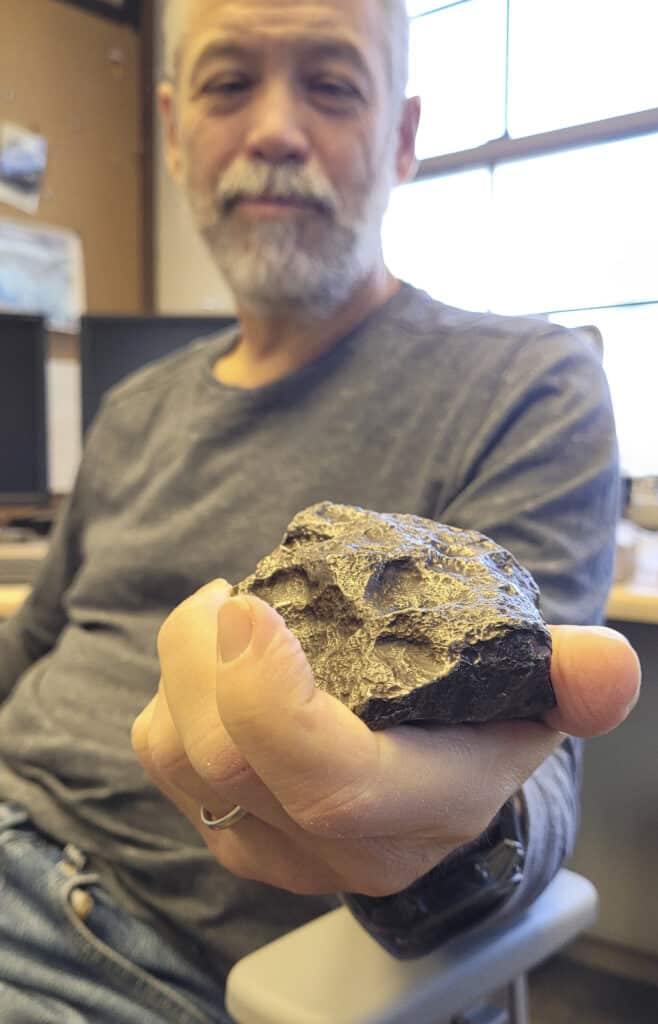
Looney is not opposed to the idea that extraterrestrial intelligent life exists, though.
“I think aliens are out there,” Looney said. “Our galaxy is huge — 100 to 400 billion other stars. That’s a lot of possibilities out there for life.”
To go about the search for extraterrestrial intelligence, or SETI, in a scientific manner, Looney brings up a phrase popularized by the late astronomer Carl Sagan: “Extraordinary claims require extraordinary evidence.”
“That is still true and should always be true in any science endeavor. You have to make sure you have the data,” Looney said.
How scientists search for extraterrestrial life
One example of an organization searching for that extraordinary evidence is the SETI Institute, a nonprofit based in Silicon Valley, which “is one of the only places in the world that supports the research that I do,” said Sofia Sheikh, a technosignature research scientist at the SETI Institute.
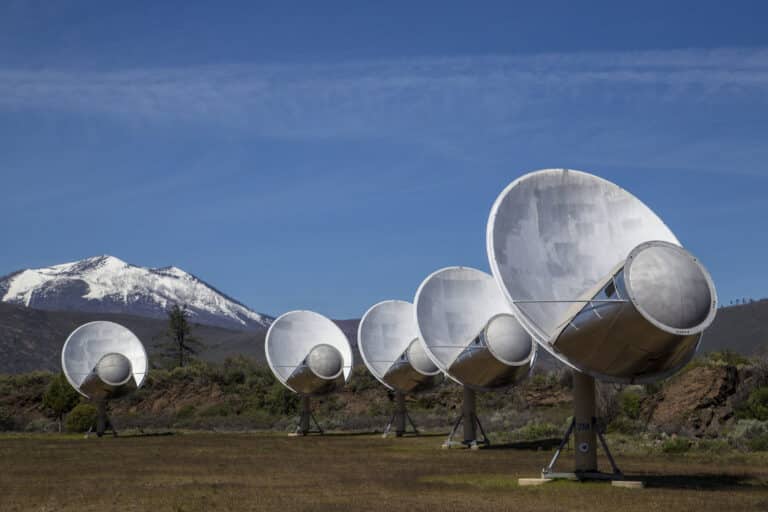
Sheikh works with the Allen Telescope Array, which is comprised of 42 dish antennas that listen for radio signals that could indicate a presence of technology beyond Earth. While radio waves are the product of many natural things, Sheikh said radio waves produced by technology are distinct.
“Human technological signals often are really concentrated in their width,” Sheikh said, referring to the types of signals that are called narrowband. “If we were ever to see that and prove that it’s coming from beyond Earth, then that would be a really good sign that technology is making that signal and not the natural universe.”
To listen to space, Sheikh has to listen through “all of the chaos and cacophony that is human technology on the Earth,” as she puts it.
“I get millions of technological signals in a night, and I have not found millions of aliens, unfortunately,” Sheikh said. “What I’ve found is millions of instances of human technology.”
She said a significant portion of her work is figuring out how to better filter out that Earthen technology interference.
Big questions for curious minds
When asked why the search for aliens is important, Sheikh said, “I think that SETI is very much a human endeavor. … It’s a question. Are we alone in the universe? Is there life out there? It’s sort of a higher pursuit in a way that it makes people excited and inspired and inspires creativity. I think that has worth of its own.”
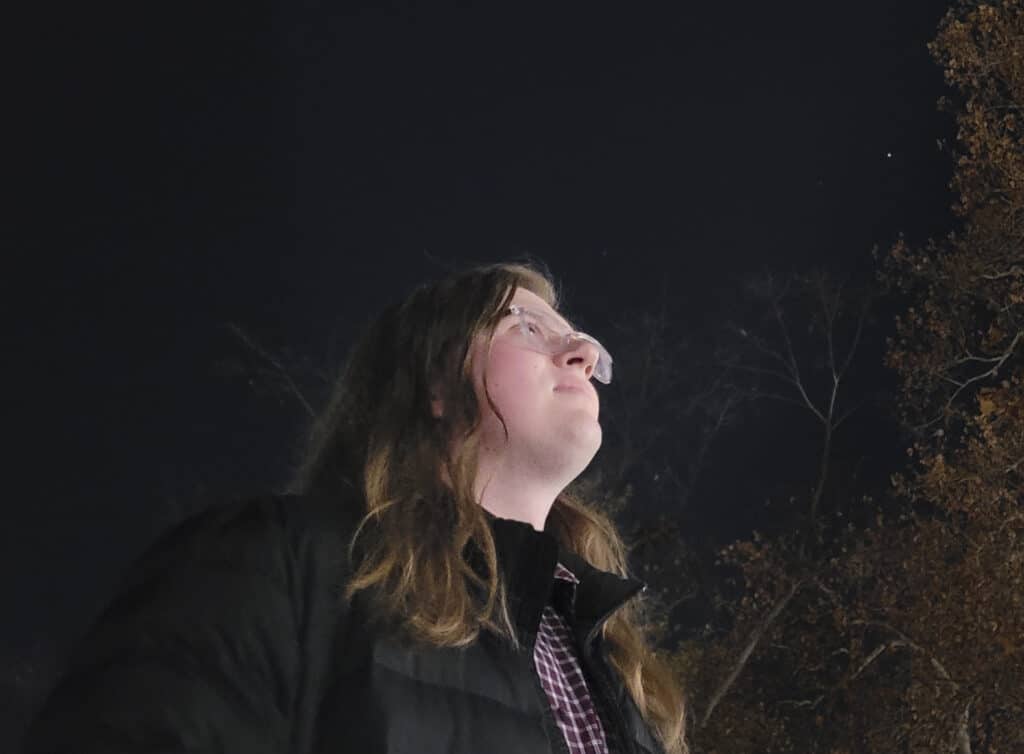
The big questions of the universe bring in curious minds and inspire learning, like with U of I’s Astrobiology Club.
Astrobiology is the study of hypothetical life beyond Earth, explained Jack Pallotto, a U of I undergrad and president of the Astrobiology Club. The field deals with alien life, but also how humans would fare in conditions outside Earth.
“Astrobiologists are incredibly important for figuring out how to safely allow people to live in space for extended periods of time, like on the International Space Station,” Pallotto said. “Or if we ever colonize Mars, you need people to figure out what are some risks involved with living in these environments for a long time.”
Since it’s unknown what alien intelligent life would look like, Sheikh said experts from other fields of study, like history, anthropology and linguistics, are also brought in.
Part of the SETI Institute’s mission is to “understand the origins and prevalence of life and intelligence in the universe.”
In other words, researching hypothetical extraterrestrial life isn’t just about aliens. It may teach us more about ourselves.
That’s what has been said about 3I/ATLAS as well. Through analyzing the comet’s makeup, scientists may be able to learn more about how our galaxy formed. It may not be as exciting as an alien spaceship, but an interstellar comet is nevertheless interesting.
And the search for life beyond Earth continues, with emphasis on science over baseless speculation.
Science communicator Hank Green discussed the alien speculation surrounding 3I/ATLAS in an October video where he countered the X-Files tagline “I want to believe” with “I want to know.” Looney said he agrees with that mindset.
“I don’t know, so I want to know,” he said. “I want to know more than I want to believe.”
Sheikh said the search is only beginning, with the most progress being made in the past five years or so, thanks to improvements in computers and telescopes that allow Sheikh and other technosignature researchers to examine more frequencies and larger areas of space at once.
“People will say, ‘Hey, haven’t you guys been looking for decades and you haven’t found anything? Doesn’t that mean there’s nothing out there to find?’…
“In reality, the space we have to search is so vast that even though these searches have been going on since the ‘60s, we have barely scratched the surface of the amount of searching that’s yet to be done,” Sheikh said.