

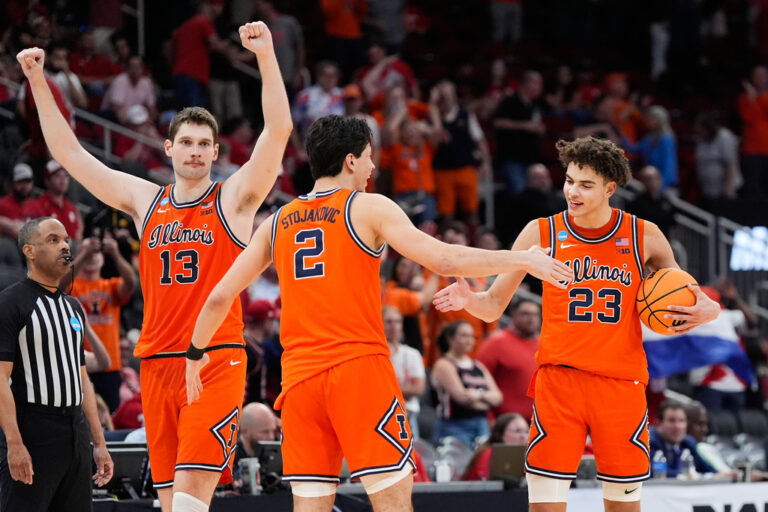
The Fighting Illini men’s basketball team has been propelled to the Final Four for the first time since 2005 — with help from a group of players from Southeast Europe.
The team’s roster has six members from countries such as Serbia, Croatia and Montenegro, often referred to as “The Balkan Bloc.”
Head Coach Brad Underwood recruited them from a region that was formerly part of Yugoslavia under the Soviet Union.
That approach has paid dividends, according to Peter Wright, an associate professor in the Slavic Languages and Literature department at the University of Illinois Urbana-Champaign.
“Coach Underwood’s strategy is really smart. It’s capitalizing on a place where there are, where the sport is just unbelievably popular,” Wright said. “There’s just a really large pool to draw from.”
The impact of Yugoslavia’s basketball culture
A basketball fan himself and historian who studies Yugoslavia, Wright said the game is like a national sport in the region.
In the late 20th century, Yugoslavia was seeking a way to stand out from the competitive environment in football — known as soccer in the U.S. Wright said the region worked to cultivate its skills in basketball as a means of being visible across the globe.
Wright said as early as the 1960’s, Balkan players would travel to the U.S. to play for college teams or compete in the NBA. He said one reason many of these players have been successful is they learn to play the sport without specializing in a specific role.
“A lot of players in Yugoslavia specifically are trained in that system that is now the dominant system in the NBA,” he said. “Yugoslavia pioneered this, the positionless basketball.”
Members of Illinois’ “Balkan Bloc” are often among the most visible and highest-scoring players on the court, perhaps in part because, as Wright noted, people from the Balkans are exceptionally tall.
The team’s roster includes Andrej Stojakovic, David Mirkovic, Mihailo Petrovic, Toni Bilic and twins Tomislav and Zvonimir Ivisic.
Wright said he estimates there are hundreds of Eastern Europeans on U.S. college basketball teams.
“The NBA is really wealthy, and it’s becoming more lucrative, more appealing,” Wright said. “Players from Europe want to improve their chances of reaching the NBA, so they want to get more exposure by coming to college, so they’re closer to NBA scouts … so they they’re more frequently starting at colleges to get exposure.”
Wright said new rules also allow athletes to be directly paid for playing on a college team, creating additional financial incentives for European players.
Over time, many of these players with roots in Southeast Europe have made a name for themselves to become leading players in the NBA.
Nikola Jokic, a Serbian center for the Denver Nuggets, was named MVP in the NBA for the 2021-2022 season. And Luka Doncic, a Slovenian Guard for the Los Angeles Lakers, has also earned accolades on the team.
“It’s really sort of … a Balkan takeover of American basketball, in a way,” Wright said. “The fact that Illinois has these six players is sort of representative of a larger trend.”