
If you or someone you know is in crisis, call or text the 988 Suicide and Crisis Lifeline to connect with a counselor.
URBANA — The City of Urbana will launch a new initiative aimed at helping people experiencing mental health crises — without police involvement.
At the Oct. 6 City Council meeting, stakeholders from law enforcement, health care and advocacy groups will begin discussions on building an alternative crisis response model. The discussions will be facilitated by a nonprofit organization, Law Enforcement Action Partnership (LEAP), that has worked with communities across the U.S. to establish similar models.
Several on the frontlines of mental health care in Champaign County are eager to see what results from the Alternative Response Task Force, which will convene multiple times over the next nine months.
Among them is Karee Voges, Champaign County jail captain. She says the jail has been overwhelmed with people who are in need of mental health services that the jail isn’t best-suited to provide.
“The biggest issue for jails around Illinois is the fact that we don’t have any say in who comes to jail,” Voges said, “We have to sit here and just wait for people to come and then our job is to care for them all.”
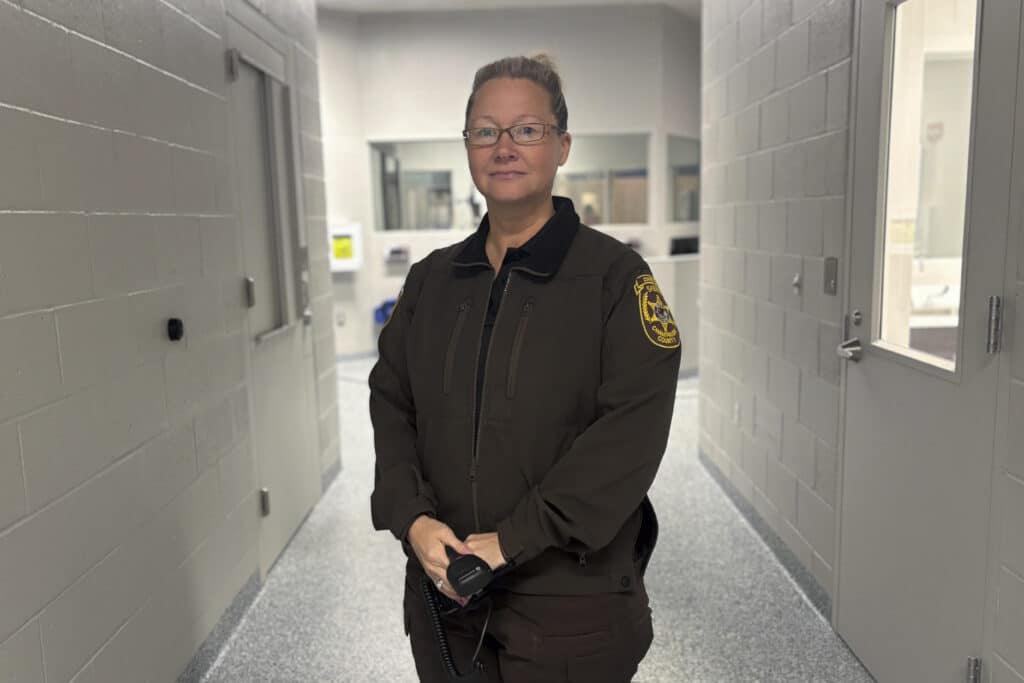
People with mental health challenges can struggle in the jail environment, she said. Epecially in first 24 hours, people tend to struggle with suicidal thoughts and react to staff with violence.
Voges said chronic detainment also puts pressure on jail staff. She said it will be beneficial if people with mental health needs avoid jail altogether – and she hopes Urbana’s Alternative Task Force can help with that.
“If it’s minor, let’s get them the help they need from that moment,” Voges said.
Jail is not the right place for mental health care
Although the jail provides some medical care, it has only one psychiatrist on staff, Voges said, working 12-hour shifts. Pretrial inmates also have the right to reject treatment, and the jail is not authorized to force people to receive medical care.
“Urbana is trying to get this thing [alternative response model] off the ground. And I think it can only do good,” she said.
Voges said Champaign County Jail’s housing unit for inmates with mental health needs currently houses 11 people unfit to stand trial. She said they’re waiting to be transported to a state psychiatric facility in Chester.
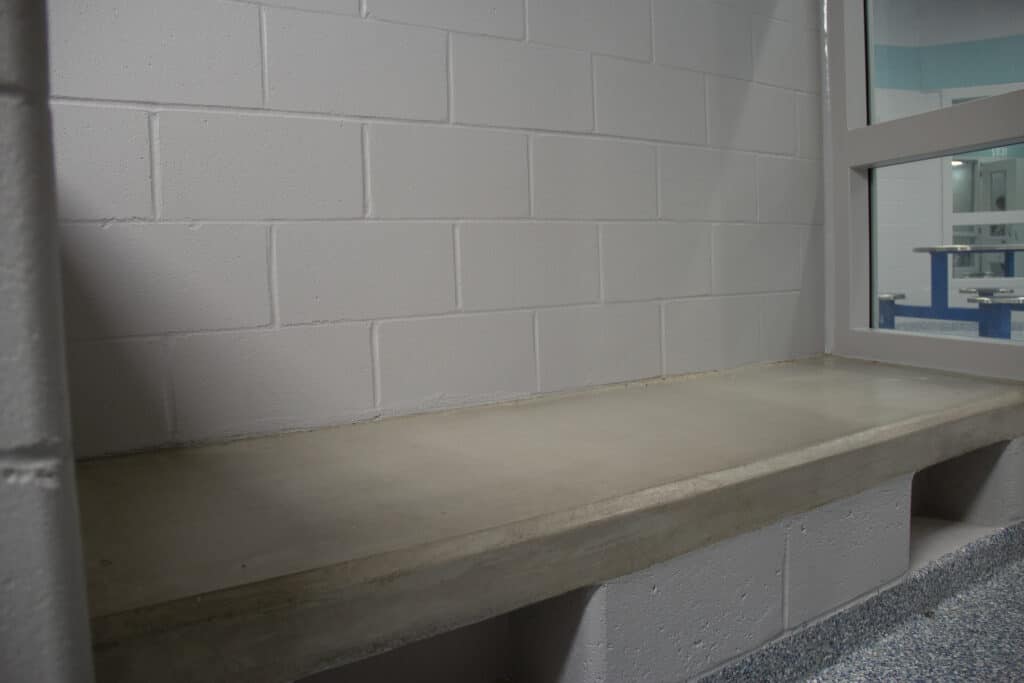
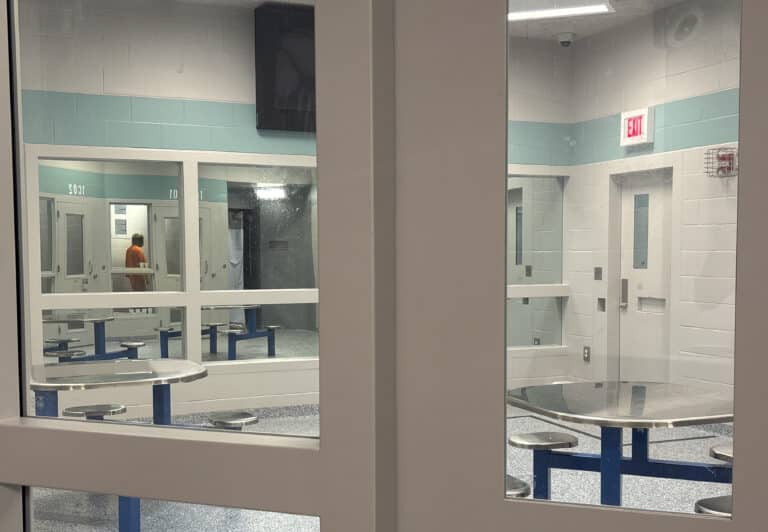
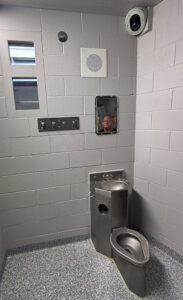
Each person is housed in a room with a concrete bed, aimed at preventing people from hiding needles or drugs. The room has a door made of one-way glass, to allow monitoring by staff, and small skylights designed to reduce suicidal tendencies.
Voges said for years, the Illinois Department of Human Services (IDHS) has caused delays in moving inmates to state mental health beds. Some people wait up to five months in these conditions before the state transfers them to a psychiatric facility.
IPM News reached out to IDHS for comment. In an email, a spokesperson said as of the end of September, 151 forensic patients were waiting to be admitted to state facilities — with an average wait time of 74 days.
Illinois law requires inmates who are unfit to stand trial be transferred to a psychiatric facility within 20 days.
All 822 forensic beds across the state’s six hospitals are currently filled, according to IDHS.
“The Department admits forensic referrals as soon as capacity is available, and prioritizes consumers based on their clinical needs and the length of time they have been waiting,” the IDHS statement reads.
Voges said she often has to explain to attorneys that the jail has no authority to decide when inmates can be transferred to state psychiatric beds, as the decision rests entirely with the state.
People in the mental health unit are allowed out of their isolated cells to spend two hours a day in a small common area, Voges said, but they’re not allowed to communicate with others. In some empty cells amid the lingering smell, the walls show deep marks and scratches left by previous inmates displaying repetitive behaviors.
Many inmates are too ill to manage even basic needs such as eating regularly or taking showers, she said.
Alternative response model: A reform, not a replacement
The City of Urbana has been expecting an alternative response model for years. In August, City Council approved funding up to $52,130 for the Alternative Response Task Force to develop the model with assistance from the organization Law Enforcement Action Partnership (LEAP).
There’s growing interest in cities nationwide to minimize law enforcement involvement in mental health crisis situations. The movement gained momentum after the murder of George Floyd in 2020 sparked nationwide calls for police reform.
Since then, more than 80 community responder programs have been created. Three of those programs are in Illinois, in the Chicagoland area; there are currently no community responder programs downstate.

The idea is to dispatch unarmed community responders to the scene to handle non-risk crises, said Tom Thompson, a retired police officer and executive board member with LEAP, who will attend Urbana’s Oct. 6 meeting.
“This allows police officers to engage more in building their relationships with their community and investigating criminal activity and keeping their community safe,” he said.
The City of Urbana already has a co-responder model for mental health crisis intervention. Since 2021, the Urbana Police Department has partnered with local mental health provider Rosecrance to respond to crisis calls.
Urbana police say the goal of the co-responder model is to provide services with dignity and safety while reducing involuntary hospitalizations and arrests.
The law enforcement–based Crisis Intervention Team (CIT) program originated in 1988 in Memphis. It connects police officers with community resources and provides training to help them respond to individuals experiencing mental health crises.
In Illinois, the Law Enforcement Training and Standards Board offers a voluntary 40-hour Crisis Intervention Team (CIT) training for officers. Officers involved in Urbana’s co-responder initiative receive this training.
The alternative response model does not conflict with the current system, as cities like Denver, Colorado, and Durham, North Carolina, have implemented both models, according to Thompson.
“You know, there are times where we [police] can show up to the scene and make it a lot better, and then there are times where people have had experiences where we can show up and it doesn’t make it a lot better,” Thompson said.
The case for alternative response
Karen Simms, executive director of the Trauma & Resilience Initiative, said CIT training does not guarantee officers will have a full understanding of how to handle mental health crises.
“You can’t just pull this one thing off the shelf,” Simms said.
She said mental health crisis responders need to understand the psychological mechanism of trauma and have cultural sensitivity when working to deescalate a situation.
“And I also think that if a social worker accompanies a law enforcement officer, if a social worker is embedded in a police department, they tend to adopt the culture, climate and mores of law enforcement,” Simms said.
Lynn Canfield, executive director of the Champaign County Mental Health Board, also pointed out that while the number of people experiencing mental health crises is growing, community resources to support them remain limited.
“The emergency room visits are potentially unproductive and certainly visits to the jail are unproductive,” Canfield said. “And it’s very hard on the jail staff, too.”
Canfield said it has been a struggle to build a stable network of community resources and connect those resources with law enforcement.
“Police don’t have a lot of time. They want to know one phone number that they can call to get the help that a person needs,” she said.
An open conversation
Thompson said he and his colleagues at LEAP do not have a preset agenda for the discussions about Urbana’s alternative response model.
“Urbana is unique,” he said, “[We have] no agenda on our end to coerce anybody from Urbana into doing anything, it’s more of: How can we serve you?”
As for mental health advocates like Simms, she hopes the conversation will reveal the necessity to fix structural issues.
“The problem that we’re having in our county jail is a reflection of us not doing prevention well and early intervention well,” Simms said. “We could worry about fixing here, but if you fix downstream, you won’t have what they’re experiencing.”