

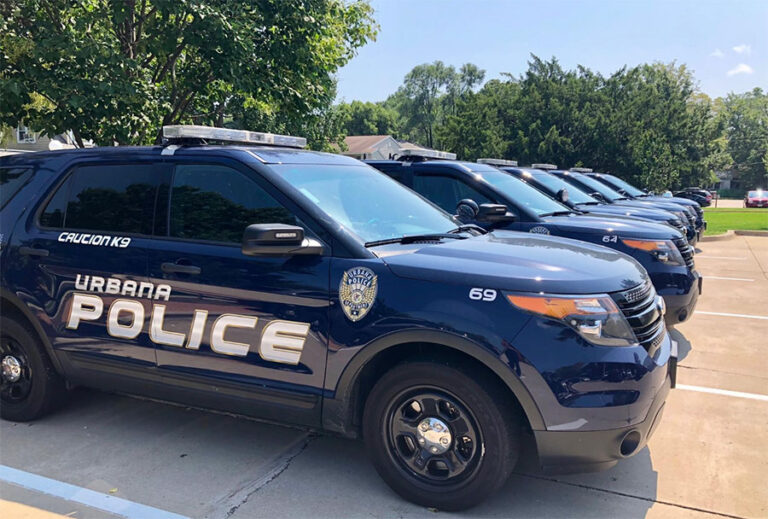
URBANA — After years of discussion over how Urbana and its police department should use surveillance technology, officials approved an ordinance requiring city departments to seek approval before obtaining or using tools like license plate readers, facial recognition software and other monitoring devices.
The measure represents a new step in the city’s long-running conversation over reforming public safety and increasing transparency around surveillance technology.
Community members have long pushed the city to make the adoption of surveillance technology more transparent … and track whether tools violate civil rights or discriminate against specific groups.
Jane McClintock, president of the Champaign County chapter of the American Civil Liberties Union, thanked the city council for getting the policy across the finish line.
“The ordinance will ensure that despite the rapid evolution of technology, Urbana will retain its identity as a community that values privacy and protects civil rights and civil liberties, as well as a community that listens to the voices of its residents and gives them a say in the important decisions that affect their daily lives,” she said.
What is in the ordinance
Under the ordinance, city departments that intend to use a new surveillance tool will need prior support from a Urbana City Council vote. This includes GPS trackers, biometric technology, aerial drones and tools used to gain access to someone’s computer or mobile device.
New requests will be disclosed through public reports for community members to give feedback.
The city will also be required to publish an annual report detailing the surveillance tools being used, what data is being collected, and any concerns with the technology.
The ordinance cites a need for these guidelines “because of the likelihood that federal law enforcement agencies will access any data stored by surveillance technologies.”
Urbana resident Ben Joselyn said he worries footage from surveillance cameras could be used by other authorities to violate a person’s privacy, such as jeopardizing a woman’s choice to seek an abortion or disclosing a person is living in the U.S. without legal status.
“Even if we trust our own local officials, these forms of surveillance are so much more powerful and the forces we’re trying to deal with are so much bigger than we are,” he said.
Council voted 7-1 on the ordinance
Ward 3 Councilmember Shirese Hursey was the lone vote against the measure.
Hursey said she “cannot in good conscience vote for such an ordinance,” arguing the new restrictions on surveillance technology would have consequences for Black residents, people of color and lower-income residents who may suffer from crime.
She said Urbana has already held back its police department and referenced the council’s past opposition to hiring additional officers. Hursey said the new rules could slow the city’s ability to address safety concerns for its most vulnerable residents.
“I’m sure that some may be thinking that you’re saving black and poor folk from the systematic racism and terror that has endured for generations in these communities, but from my perspective and those of some of my constituents, you’re just updating it.”
“I believe I’m just as convicted in my belief of how this might cause more harm, especially in the communities that most need that kind of help, than it would anybody else in the city,” she later added.
The ordinance has exceptions to omit certain routine or required surveillance tools from the approval process, including body-worn cameras for police officers under state law.
It also creates a process where city departments can temporarily use devices for 30 days without seeking approval if there are emergency circumstances.