

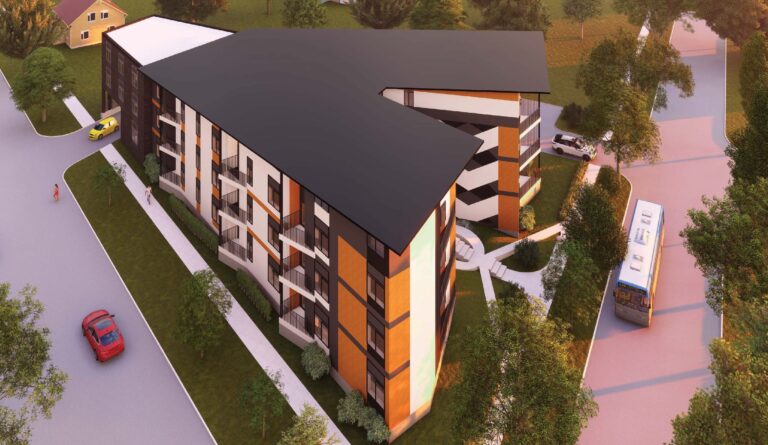
URBANA — The Urbana City Council is expected to hear from project developers next Monday, July 13 on the 32-unit proposed housing development on West Main street.
Discussion around the development has been contentious.
The project would add 32 new housing units in the Downtown Urbana district, which supporters said would help address a costly housing shortage.
“We can no longer ignore the housing shortage,” said Adani Sanchez, a Champaign resident and member of the CUrbanism Club. “And saying no to new homes is not the way to start making the steep steep steps that we have to make, to make sure that everyone has what they need.”
The development would include 27 units of parking and would need to be elevated on stilts to prevent flooding issues due to being adjacent to Boneyard Creek.
Opponents of the project cite the Imagine Urbana comprehensive plan and say these design details are inconsistent with the neighborhood’s character.
Mark Nigles lives next to where the project would be built. He said his family decided to live in Urbana for its quiet neighborhoods — but is now questioning whether that was the right decision.
“It’s not clear how long it will be until we are pushed out,” he said. “It’s also a question of whether or not fixing up our house was a complete waste of time, or whether we should’ve never bought a house in Urbana to begin with.”
Council motioned to defer the vote until the following Monday, making it the third time this vote has been pushed back.
Officials expect to hear more project details from the developer of the project.
People Over Parking Act
The Urbana City Council also voted Monday night to amend their minimum requirements for vehicle parking to be in compliance with state law.
The state of Illinois People over Parking Act went into effect June 1. As defined in the act, a public transportation hub is an intersection with two or more bus routes with a combined frequency of 15 minutes or less during peak commuting periods.
According to the state law, minimum parking cannot be imposed on a development if it is within a half of a mile of a public transportation hub.
Developers can still voluntarily include parking, but will no longer be required to.