

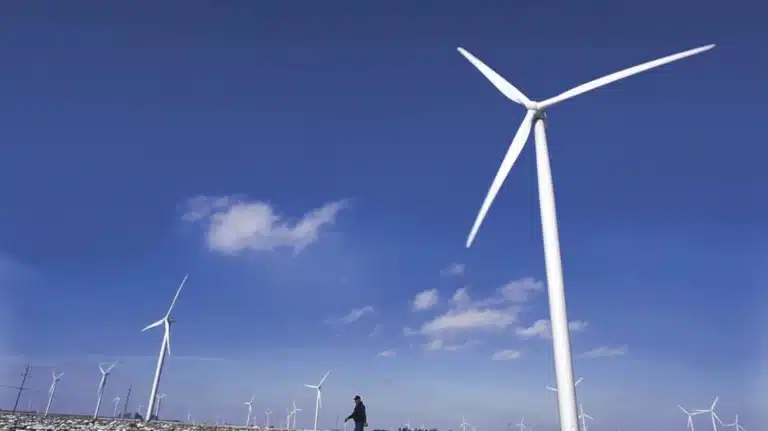
Billions of dollars in wind farm projects all over Illinois are on hold, including two projects in McLean County, two in Peoria County, and one in Tazewell County.
It’s well known that President Trump doesn’t like wind-based renewable energy.
“You can talk about windmills. They litter our country. They’re littered all over our country like dropping paper, like dropping garbage in a field,” Trump said a year ago.
The Trump administration now has what amounts to a moratorium on new wind farm projects, according to renewable energy advocates.
“We’re going to try and have a policy where no windmills are being built,” Trump said in 2025. He also repeated the sentiment in January during a widely reported White House meeting with oil and gas industry executives.
Dane Simpson directs the Great Plains Laborers-Employers Cooperation and Education Trust [GPLECET]. It’s a partnership between employers and the Laborers International Union that lines up and trains workers for large-scale construction projects that can require long lead times, sometimes years.
Simpson’s territory is Central Illinois.
“In total, we’re seeing a delay of $2 billion in private development, 2,849 megawatts, 800 turbines, which would generate enough energy for 400,000-plus houses, 2,000 construction jobs, an estimate of $160 million to landowners,” said Simpson.
He said the impact also includes $536 million in property tax revenues. Counties affected include McLean, Peoria, Tazewell, McDonough, Knox, Bureau, and Iroquois. Simpson said he’s also aware of several wind farm projects in southern Illinois that are delayed, though he did not have details of those.
Central Illinois projects by county
- McLean — Apex Renewables, 300 MW, 100 turbines, 200-250 jobs, near Heyworth: Delayed
- McLean — EDPR Bright Stalk II, 150 MW, 240 jobs, $49 million in local government payments, near Chenoa: Might go forward in 2027
- Peoria — Repsol Renewables, 650 MW, up to 120 turbines, 250-300 jobs, $80-$100 million in lifetime landowner payments, $100 million tax revenue: Delayed
- Peoria [also Stark and Putnam] — Apex Clean Energy, 900 MW, up to 250 turbines, 300+ jobs, $232 million in tax revenue, $189 million in school funding: Delayed
- Tazewell — EDPR, 205 MW, up to 89 turbines, 200-250 jobs: Delayed
- Bureau — Leeward Renewable Energy, 147 MW, up to 52 turbines, $35 million in landowner payments, $48.8 million tax revenue: Delayed
- Iroquois — Apex, 300 MW, up to 52 turbines, 250-300 jobs: Delayed
- Knox — NextEra Energy Resources, 147 MW, up to 52 turbines, 250-300 jobs, $35 million landowner payments, $40 million tax revenue: Cancelled
- McDonough — RWE Clean Energy, 200 MW, 45 turbines, 200 jobs, $63 million in property taxes: Delayed
How the freeze works
The roadblock comes at the federal level, with Simpson saying, “250 projects nationally, impacting 30 different states that would have generated 30 megawatts and tens of thousands of construction jobs.”
The American Clean Power Association said not only are 40,000 direct jobs at stake, but there also are 110,000 supported jobs stimulated by the $54 billion in capital investment.
Counties are a cog in the state process of approving wind turbine towers and they [pardon] … get wind of projects late in the game.
“By the time applications come to us, they will have met a whole litany of requirements. One of those requirements has to do with FAA [Federal Aviation Administration] compliance. We usually have a certificate as part of a packet that indicates they have met federal compliance in that way,” said Lea Cline, chair of the McLean County Board’s Land Use and Development Committee.
Until last August, getting these certificates was routine. The FAA automatically kicks applications to the Department of Defense to see if there is a risk to military readiness, said a source knowledgeable about the process.
Nearly half the projects pose no risk at all and go directly back to the FAA for a “no hazard determination,” and the developer proceeds to state and local filings and construction.
The Department of Defense used to take just a day or two to decide the easy cases, sometimes just by looking at a map.
In cases where there could be an impact on a military installation, there’s a clearinghouse that works on what’s called mitigation. That had been straightforward as well. In 90% of those cases, the developer paid roughly $80,000 to have the military recalibrate radar to filter out the new tall objects on the horizon. A source said there’s only one documented instance of a wind farm that could not go forward at all because it was simply too close to a military installation.
Mitigation cases stopped getting approved starting last August, said a background source. In late April, even the easy cases stopped receiving certificates. Now, no wind farm project in the nation that didn’t already have permit approval is moving forward, said multiple sources.
The Defense department did not respond to a request for information for this story. Joel Valdez, the acting Pentagon press secretary, has told other media outlets the agency “is actively evaluating land-based wind energy projects to ensure they do not impair national security or military operations, in accordance with statutory and regulatory requirements.”
Despite the straightforward procedure description from renewable energy advocates, Valdez said the process “involves complex, time-consuming inter-agency coordination” to “balance renewable energy development with the protection and preservation of testing, training, and operational readiness.”
Congressional reaction
“He is screwing with working people by taking this offline,” said Democratic U.S. Rep Eric Sorensen, whose congressional district includes much of Central Illinois. “I also look at our farmers. They’re looking at that little postage stamp on their thousand-acre field and saying OK where that wind turbine is, I’m going to be able to get some income because what if mother nature doesn’t give us a good crop this year.”
The economic implications go well beyond jobs, property tax revenue, and turbine rent payments to farmers.
The American Clean Power Association estimated not allowing the U.S. to construct new wind projects would cost the national electricity grid an extra $361 billion over the next 25 years because of higher prices based on demand.
U.S. Sen. Dick Durbin, D-Ill., said the president’s moratorium is “short sighted” and reflects Trump’s disbelief in climate change.
“He calls it a hoax, he’s one of the few people in the world that says that with a straight face, and he’s pushing through that policy in Washington, slowing down and stopping renewable and sustainable sources of energy. It makes no sense,” said Durbin.
Energy experts said most wind projects are in red states or red rural areas and supply chains run through red states as well. Even some Republicans are uneasy.
“Well, I have concerns,” said GOP U.S. Rep. Darin LaHood, who has has one of the largest wind power districts in the country. Union figures indicate LaHood has $4 billion in wind farm projects in his Central Illinois district at various stages of permitting.
Like Sorensen, LaHood said he favors an “all of the above” energy policy. But bucking Trump is not lightly done, even though LaHood said he has met with wind farm developers about the holdup.
“They have not asked my office to do anything as of yet. They have not asked us to introduce any legislation or weigh in with the administration,” said LaHood, adding he and some other colleagues are “prepared and ready to weigh in at the appropriate time.”
But time already is running out.
Freedom Caucus
A congressional observer said the origin of the apparent freeze goes back to Trump’s One Big Beautiful Bill. The source said the president made a deal with the conservative Freedom Caucus that opposes wind energy, to get their votes on the measure.
If the Freedom Caucus would sign onto a measured sunset of tax credits for wind and solar, which more moderate Republicans wanted, he would find a way to not let wind projects move forward. The off ramp pushed by moderates was that existing projects could still qualify for the tax credits if they began construction by July of this year and are in operation within four years.
“Construction” is a flexible term in this context. It can include purchasing turbine components from a manufacturer.