

Updated on Thursday, Sept 18 at 1:30 p.m. CT
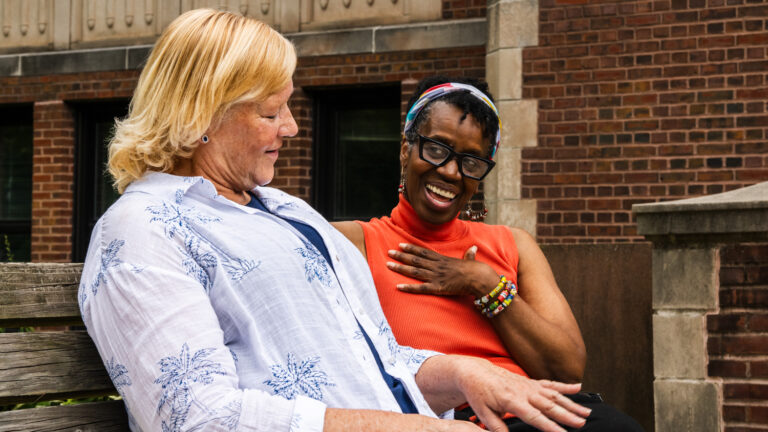
Angela Patterson and Laura Hastings greeted each other with chants from their childhood as soon as they joined a video call.
“I’m Angie Burnett and I got a big boot,” Angela sang.
“I’m Laura Lollipop, yeah man,” Laura responded.
Then, unprompted, they go off reminiscing about how they came up with the introductions at a camp.
Both were kindergarteners in 1966, when a group of parents known as the Ellis Drive Six pushed Urbana to integrate its elementary schools.
Few schools budged in the decade after the U.S. Supreme Court overturned racial segregation in public schools with the Brown v. Board of Education decision in 1954. It took years for new laws, court cases and federal funding incentives to push districts to change.
In Urbana, a group of determined parents convinced the district to voluntarily desegregate. Six decades later, many students from that first integrated class are still friends — including Laura and Angela.
Urbana only had one middle and high school each, and they remained integrated as Black families moved to the area. But as white families moved out of neighborhoods near the new Black families, the city’s elementary schools became segregated.
The Ellis Drive Six saw almost no Black students were graduating from high school. They thought their children were not being prepared adequately in their neighborhood elementary school.
Angela’s mom is Rev. Evelyn Burnett Underwood, one of the Ellis Drive Six. Underwood later became Urbana’s first African American school board member and earned doctoral degrees in education and law.
Angela and her brothers were among the first Black students to desegregate Yankee Ridge Elementary.
Laura transferred to Yankee Ridge in fifth grade and recalled meeting Angela on the playground.
“Angie, I just remember that you were fast and you talked a lot. I’m like, ‘I’m going to like her because she talks a lot like I do,’” Laura said.
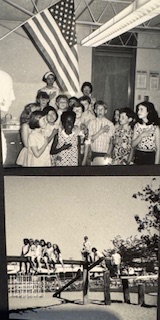
Their friendship strengthened over time as they went to camp together, did cheerleading and grew up as teenagers.
“Remember we would go up on campus and we weren’t supposed to do that? Somebody would see my parents’ blue station wagon and say, ‘Did you go to a movie?’ And then they knew, I was busted,” Laura remembered.
The painful sides of integration
While Laura and Angela had a somewhat rosy experience with integration, others were not so lucky.
Angela stayed at her neighborhood elementary for kindergarten for an extra year while her brothers transferred. She learned later that delay shielded her.
Her brother remembers white parents at Yankee Ridge screaming at him. Angela learned about it later, when she heard him describing his experiences on a radio show.
“He was talking about how they were screamed at, and I told him, I don’t remember that. He said, ‘You didn’t go the first year,’” Angela said.
Angela only remembers good things at the school – except for one teacher. At the time, she loved her.
“I adored my teacher. I knew her daughter was a cheerleader. I knew she was from Texas,” Angela remembered.
But for Angela, first grade was too easy. She was bored and acting out in class. Her parents told the school she needed to be put in a more advanced class.
When the school finally did assess her, she breezed through all the test books. But her teacher was unhappy to see her join the upper level track.
“I thought the sun rose and set on on her, but she threw my books at me. She threw them at a first grader,” Angela said.
She still thinks about it when she interviews teachers for her church’s Sunday school.
“Not everybody is everybody’s cup of tea, but a child should never know … that you don’t favor them,” Angela said.
Schools are segregated again. Should districts try to fix that?
Data shows schools across the country have become as segregated as they were in the late 1960s, especially for low-income Black and Hispanic students.
Laura said school districts should try again. She said in order to grow, you need to be around people who are different from you.
“You can’t learn it from a book. You have to have the exposure and have the opportunities, kind of like we had, socially outside of school and inside school,” Laura said.
After college, Laura and Angela’s families kept running into each other. Laura became a teacher in town and ended up teaching Angela’s niece.
“My brother was a little circumspect about it because I think she was in [Special Education] class or something. He was a little circumspect about the school until he saw Laura. And he was like, ‘All right, we’re going to be okay because we got Laura,’” Angela remembered.
Angela lives in Georgia now, but the two are still close. For her part, she is not sure whether the integration effort did all it set out to do. Many districts across the country fired or demoted Black teachers, and Black students’ average math and reading scores don’t reflect the dreams the civil rights parents had.
“There was an initial plan and then there were compromises that had to be made,” she said. “The initial plan of integration was that they wanted Black teachers to go first, but the kids went first.”
But, Angela said, her experience gave her the confidence to walk into every room as an equal. And it gave her great friends.
UPDATED: This story has been updated to include more information about Rev. Evelyn Burnett Underwood, including her doctorates in law and education.