

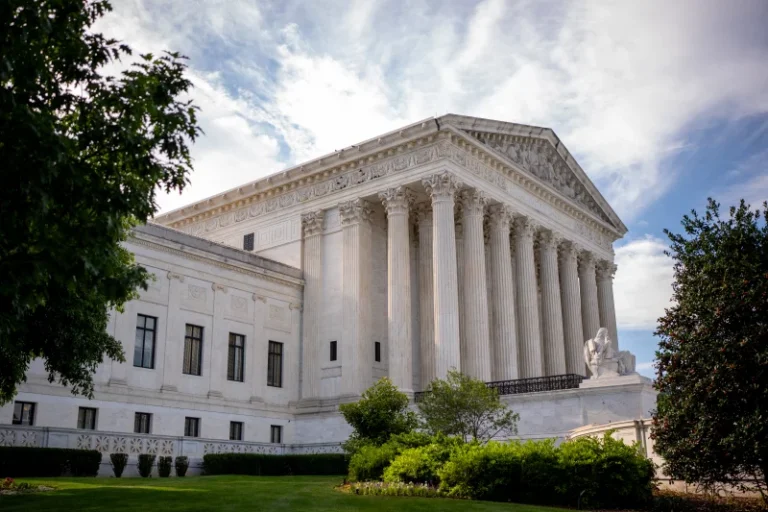
The Supreme Court on Tuesday lifted a lower court order that had blocked President Trump’s executive order requiring government agencies to lay off hundreds of thousands of federal employees.
The order was unsigned. Justice Ketanji Brown Jackson, who was appointed to the court by President Biden, dissented. Justice Sonia Sotomayor, a fellow liberal, concurred with the court’s decision. The order did not make clear how the other justices voted, but they did say, “we express no view on the legality of any” plans to shrink the federal workforce, and it left open the possibility that the issue could return to the Supreme Court.
The executive order and memorandum included explicit tools for staff reduction including a general standard that no more than one employee should be hired for every four employees that depart, removing underperforming employees, and allowing term or temporary positions to expire without renewal.
Groups challenging the layoffs in court contend that the RIFs could result in “hundreds of thousands of federal employees los[ing] their jobs.” They argued that without the temporary restraint “there w[ould] be no way to unscramble the egg” if they eventually won the larger case in the lower court. They contended that without the temporary block to the federal layoffs, “critical government services would be lost … there [would] be no way to go back in time to restore those agencies, functions, and services.”
Labor unions, advocacy groups and local governments sued the president and 21 federal agencies over the RIFs, contending that the president exceeded his authority in mandating the federal layoffs. They argued that the president avoided the congressional approval needed to restructure federal agencies.
During his first term, Trump sought congressional approval to mandate similar layoffs. But, Congress rejected his plan. This time Trump didn’t bother going to Congress, and objectors sued, arguing that to implement the RIF plan legally, the administration should have sought congressional approval or “cooperate[d] with Congress through the regular legislative or budgetary process.”
The administration contends that the president has the authority to conduct mass layoffs on his own. As the executive, they argue, “the President does not need additional statutory authorization to direct agencies to conduct RIFs to further reorganizations.”
U.S. District Judge Susan Illston, a federal district court judge in California, disagreed, temporarily blocking the administration from mandating mass agency-wide layoffs while lower court proceedings continue.
Illston, a Clinton appointee, also blocked a subsequent OMB and OPM memo telling agencies how to carry out Trump’s executive order.
Illston’s decision stopped most of the government’s largest agencies from issuing new reorganization plans and layoff notices. It also prevented those agencies from formally separating those who have already received such notices and are currently on administrative leave.
The 9th Circuit Court of Appeals has since agreed with the lower court, concluding that because the order is temporary, it isn’t too heavy a burden on the administration’s actions.