


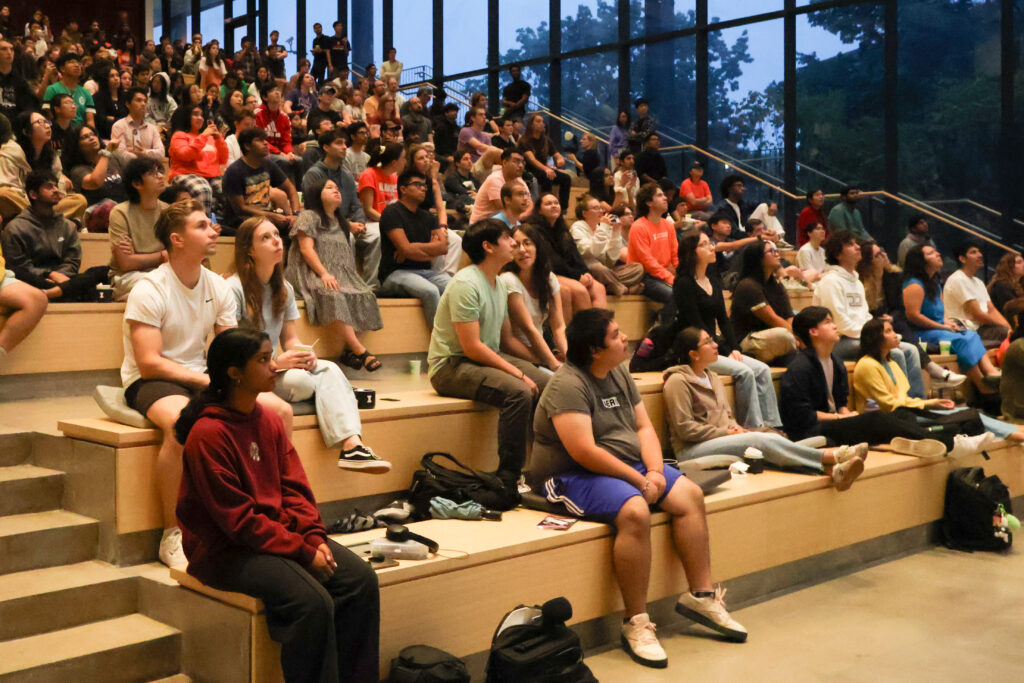
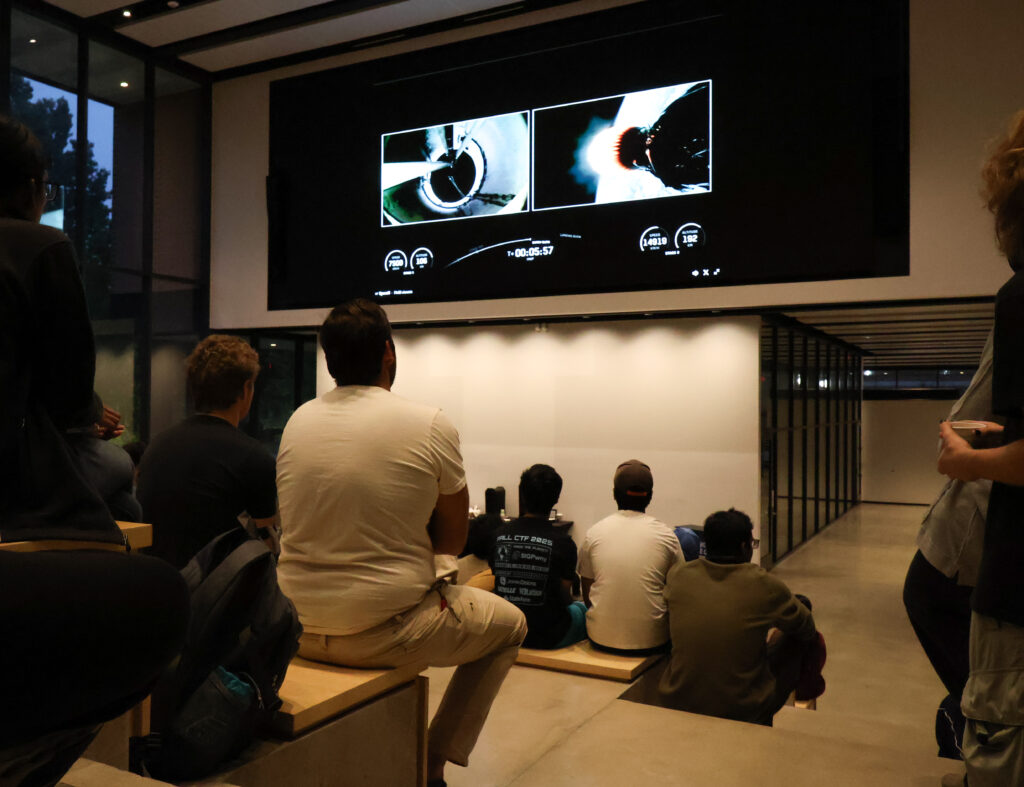
URBANA — Well over 100 people gathered at the University of Illinois Urbana-Champaign’s Campus Instructional Facility early Wednesday morning to witness the launch of NASA’s Carruthers Geocorona Observatory — one of three space weather satellites launched from the Kennedy Space Center in Florida.
The Grainger College of Engineering hosted a watch party for NASA’s livestream, since the Carruthers mission is led by Lara Waldrop, associate professor of electrical and computer engineering at the U of I.
Ray Luo, a U of I freshman studying physics, said he woke up before 5 a.m. to witness the event.
“It’s a unique experience to have, just to witness something like this,” Luo said. “[I feel] a little bit of school pride. It certainly helps to build the enthusiasm for this launch.”
The Carruthers Geocorona Observatory is named after the late George Carruthers, a U of I alum and pioneer astrophysicist whose list of accomplishments includes developing the first Moon-based observatory.
Luo attended the watch party with his friend, Uma Rahardja. Neither of them had seen a rocket launch live before.
“You don’t get these at all in Indonesia, where I’m from,” said Rahardja, a U of I freshman studying mechanical engineering.
Rahardja said she is interested in all of the mechanisms that go into the launch and satellites. The Sept. 24 launch used a SpaceX Falcon 9 rocket carrying three satellites, each with a different mission related to space weather.
A quest to understand Earth’s exosphere
The Carruthers Geocorona Observatory will study Earth’s exosphere — the outermost layer of the atmosphere.

The Carruthers Geocorona Observatory will travel about one million miles from Earth to orbit a spot known as the Sun-Earth L1 Lagrange Point — one of five positions in space where the gravity of the sun and Earth help lock spacecraft into place, enabling them to stay in orbit with less fuel.
At L1, the Carruthers Geocorona Observatory stays between the sun and Earth. It is the first mission with the primary objective of studying the exosphere, of which we currently know little about. A better understanding on the size, shape and density would allow us to prepare better for solar storms.
Airplane routes are one example of how this can impact daily life. Airplanes have to avoid polar regions during solar storms because the intense solar activity can be harmful to humans and technology, said Waldrop in an interview with IPM’s Weather Realness podcast.
“Having a better understanding of how long a storm might last will help humans and their technological systems be able to know: How long do we need to be protecting ourselves?” Waldrop said.