

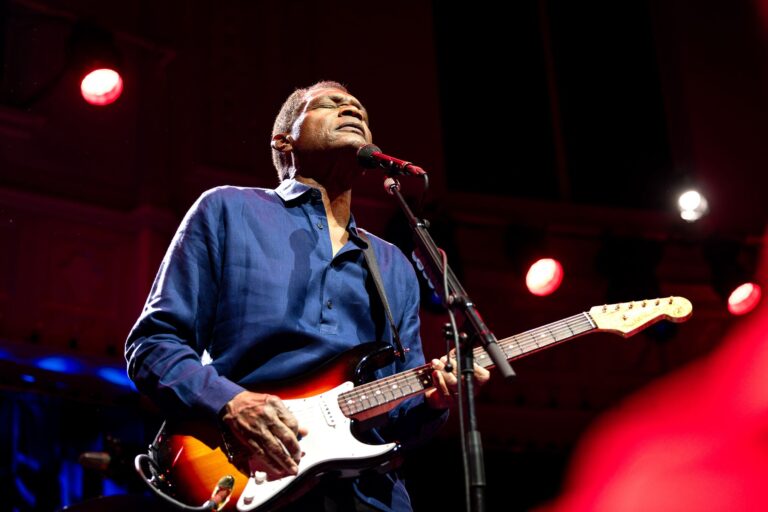
CHAMPAIGN — Robert Cray, a five-time Grammy Award winning artist, is coming to the Virginia Theatre with The Robert Cray Band on Tuesday, March 31. Cray and the Robert Cray Band are staples in blues, with over five decades of playing and touring across multiple genres.
IPM Morning Edition host Kimberly Schofield spoke with Cray, who was born in Georgia, about the upcoming performance and his life and career.
This interview has been edited for clarity and conciseness.
ROBERT CRAY: Well, when I grew up, my father was in the Army. We were at an army base there, and then we moved to the West Coast, just outside of Tacoma, Washington. And we were there for the first five years, and then we were off to Germany, and then back to Washington State again, which is where I attended high school. But prior to going back to Washington, while we were in Germany, my father and my mother, they bought this great Grundig stereo console, and they bought 45 and albums of people like, you know, Sarah Vaughan and John Lee Hooker and Sam Cooke and Bobby ‘Blue’ Bland and all kinds of stuff. And I was, you know, a pre-teen, and, you know, we were told to go to bed at 7:30 but we could hear the stereo going and my mom and dad out there dancing and whatever. On Sunday there was gospel music, and so that’s where I got my first taste of music. When I got back to the states, it was in the early 60s, and the Beatles just came out, and at that particular time, everybody wanted to get a guitar, and I fell in with that crowd.
KIMBERLY SCHOFIELD: Other than your parents listening to the stereo, was anybody in your family musical at all?
CRAY: You know, I found out later, after we started the band, that my father liked to sing gospel music, so he started a group with some friends of his, but basically it was just playing the stereo.
SCHOFIELD: How would you define the blues?
CRAY: Well, basically blues, if you’re not talking about the music so much, is about your way of life, and you know how you’re dealing with your personal relationships, or you know, your way of life, basically. Musically, it can include those two topics that I just mentioned, but it can also, kind of, try to describe a genre of music that not only includes the blues, but rock, because it comes out of blues. And jazz that grew out of blues, and just about everything else that’s American.
SCHOFIELD: It sounds like you had a lot of influence on how you started to actually find your own sound. Are there any musicians who you give credit to that influence, or is it a huge array of people?
CRAY: There’s a large array of people, but I think the most influential, right before I got out of high school was Albert Collins. I was in high school in Tacoma, Washington. Albert Collins played our high school graduation party. And it was our class that voted for him, and the reason being is that Albert had played a lot around western Washington. And this is the late 60s, and I graduated in ’71, so I know that it wasn’t just me who saw Albert because the class voted for him. I got an opportunity to say hi to him after he played our graduation party, and I’ll always remember what he said. He says, “Young man, you play guitar?” I said, “Yes, sir.” He says, “Well, keep it up.” After I graduated in ’71, we became his backup band in like ’76, whenever he was on the West Coast and so we were a little band that, you know, wanted to play blues, and there was our mentor right in front of us.
SCHOFIELD: Do you think that there’s been a significant change in the style of blues, or the people who play blues, over the years, as your career has progressed?
CRAY: It’s changed in a natural progression, I think. When I look back, and what’s really great is you can see videos of people like Muddy Waters and Howlin’ Wolf and whatnot, and you understand that the way that they play music is a reflection of their time and the music that was around them. And so it is for somebody like myself or somebody else that’s coming up nowadays, they’ve had all kinds of influences that affect the way that they play the music. So it’s a natural progression, and it’s supposed to change, and whether it’s good or bad, it depends on what you like.
SCHOFIELD: You’ve put out nearly 20 albums. Of all of them, is there one that you would consider your master, or one that you just have a favorite of?
CRAY: Yeah, I can’t, I can’t really, there’s … it’s kind of funny because you go back and you listen to stuff and you go, ‘Ooh, I can do that a lot different now, or a lot better.’ So it’s, it’s kind of hard to really pick out an album and say that you know that one’s your favorite, but I do look at the albums as a time and place for the personnel in the band because there’s been a lot of personnel changes over the years. Our bass player, Richard Cousins, he’s pretty good at describing what unit it was of the Robert Cray band at a particular time, because there was an album that was called Strong Persuader, and Richard calls that band the Strong Persuaders. And then we had the Midnight Stroll Band, and we had the Bad Influence Band. And, you know, there’s all these different bands within the Robert Cray Band.
SCHOFIELD: What was it like when you found out that you were nominated for a Grammy the first time?
CRAY: The first Grammy Award was with an album that we did with Albert Collins and Johnny Copeland called Showdown! And we went to the award ceremony, all three of us, they called our name, and we walked up to the front of the stage and walked up the stairs. And I don’t know who was in front first, but that person stopped, and we kind of all slammed into one another like the Three Stooges, which was kind of how the album was made, too.
SCHOFIELD: You’ve collaborated with tons of artists. What was it like collaborating with Tina Turner?
CRAY: Working with Tina Turner was great. We did some 40 shows with her in the UK and Europe, and a lot of outdoor shows and hockey rinks and stuff all over Europe and whatnot. And it was great because the crowds were fantastic. And some of those shows were big festivals as well. And so it was right after Strong Persuader came out and we had a pretty big following. So these shows were tremendous and it was just great to be on stage with her. She would have me on stage for a song or two. It was just tremendous, a whole different thing than what we do. I mean, you know, it’s a big production and all that. So it was really great to to be a part of that. And she was kind and she worked hard. She was super dynamic.
SCHOFIELD: Black people started the blues. Is there ever any concern that you have or that you see from other people that the authentic connection with the community could be lost? There are some people who say that that happens with R&B or hip-hop, with people kind of adopting the culture or the style.
CRAY: Other communities adapting the blues or hip-hop or whatnot is a reflection of how strong the music is. I think that it’s something that can’t be denied. I mean, when you think about blues and rock and roll and even country, everything that we see that’s played outside of America just proves how strong and dynamic the music is. I mean, you know, there’s all these British players that played blues in the 60s and turned around and brought it back to America, you know? And when we go down to Brazil or something like that, there’s all these blues bands down there. Go to Japan. There’s blues bands in Japan, you know, there’s hip-hop in Japan … it’s everywhere. The music, you know, it can’t be denied. And jazz, same thing, everywhere. We play jazz festivals in Europe every summer.
SCHOFIELD: When you come to the Virginia Theatre here in central Illinois, what can people expect with the performance?
CRAY: Our book is big, so we play a little bit of everything from all the different, like Richard says, different bands, the Persuaders or the Bad Influencers and all that. We play a lot of the favorites, basically, on every night, but we also, every night, change the list dramatically. Or even if somebody yells out something, we just might do that on the spot. But it’s always going to be a lot of fun. You’re going to hear some ballads, you’re going to hear some up-tempo things. You’re going to hear some blues. It’s just what we do.