

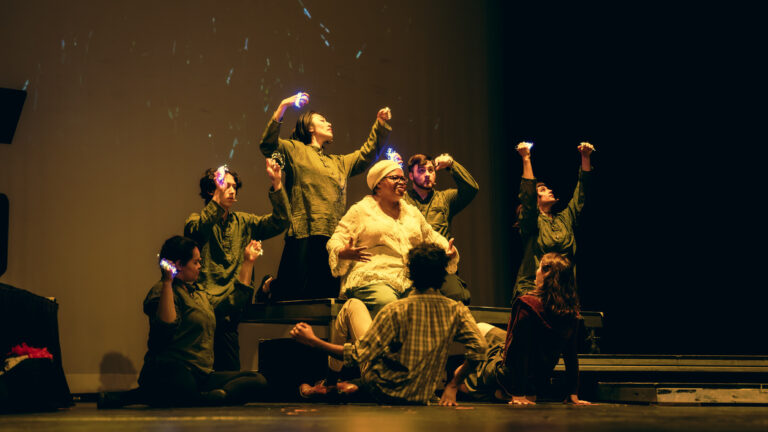
URBANA — Atoms, electrons and other particles too small for the eye to see will come to life on stage through movement and music at the Krannert Center for the Performing Arts in Urbana.
“Quantum Voyages,” a play that was created by scientists and artists at the University of Illinois Urbana-Champaign, returns on Saturday night with a brand-new musical score to celebrate the International Year of Quantum Science and Technology.
The interdisciplinary piece premiered in 2018 and was co-written by two U of I faculty members: Smitha Vishveswara, a physics professor, and Latrelle Bright, a theatre studies teaching professor.
The piece follows the journey of two voyagers, Terra and Akash, as they explore the quantum realm. Sapienza, the spirit of knowledge, serves as their guide. Throughout the play, the voyagers face a series of challenges and receive help from physicists, or quantum sages.
“It’s almost like an opera where you have this deus ex machina that just comes and saves the day,” Vishveswara said. “Except these are real-life physicists in all their unique voices, sharing their wisdom and saving the day.”
The voyagers are also joined by a quantum ensemble. The group of performers represents atoms, electrons and other quantum particles that make up the atomic landscape.
The new iteration of the piece, which will take the stage at Krannert Center’s Colwell Playhouse this weekend, features music by U of I music professor Stephen Taylor.
Taylor first met Vishveshwara during the pandemic when they collaborated on another interdisciplinary project. Soon after, Bright says Taylor was introduced to “Quantum Voyages.”
“I think as much as we wanted music early on, I don’t think we had an idea of who it would be,” Bright said. “Stephen just kind of emerged.”
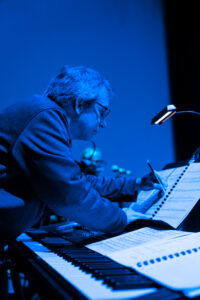
To compose music for the project, Taylor brought together a band of U of I faculty, students and other musicians. He said it was important to bring people with different levels of expertise together.
“One thing that I’m really happy about with the band is that it’s following Latrelle’s idea that we should involve people from all aspects of our community,” Taylor said.
To bring the quantum themes to life, the band used a combination of traditional and new instruments, like the spinductor, which makes sounds as a performer holds magnets and gestures in or around the instrument.
Taylor said he hopes audience members develop a curiosity to learn more about the potential of music.
“Musically, one of my friends said once that he’s convinced that we’ve only discovered about 5% of what’s possible with sound and music,” he said. “And so I hope that people come out and maybe start thinking about some of that other 95% that we can do.”
Bright also contributed to the music in the performance. She took fragments of text from the script, added rhythm and rearranged it all to make a spoken word piece.
She says working with experts across disciplines can help create unique experiences for people.
“I really appreciate that aspect of a whole bunch of people gathering together — from folks who know physics or study a particular part but don’t know this other part, or community people who are just happy to be in the room and learn how we can all shape something that is meaningful for an audience,” Bright said.
There’s sometimes friction when you’re working with others to push creative boundaries, she said, but underneath it all is love and respect, which helps them work through it.
“Ultimately, everyone’s goal is to tell as much truth as we can in the most beautiful way that we can,” Bright said.
While it’s the performers and people behind the scenes who help create Quantum Voyages, Bright and her collaborators say they hope everyone who sees the piece will come away feeling like it’s theirs, too.