

SPRINGFIELD — Illinois lawmakers and advocates for passenger rail are seeking support for a new bill that could ease sold-out trains, chronic delays and long travel times for riders from Champaign-Urbana and across the state.
The Passenger Rail Planning Act would require the Illinois Department of Transportation to include specific train frequency targets in the state’s rail and long-range transportation plans. Supporters argue the shift would force planners to design rail infrastructure around how often people want to travel, rather than around limited, incremental upgrades.
“This is about planning for the service people actually need,” said Rick Harnish, executive director of the High Speed Rail Alliance. “If trains only run a few times a day, people don’t have freedom. Frequency is what makes rail usable.”
A new approach to passenger rail planning
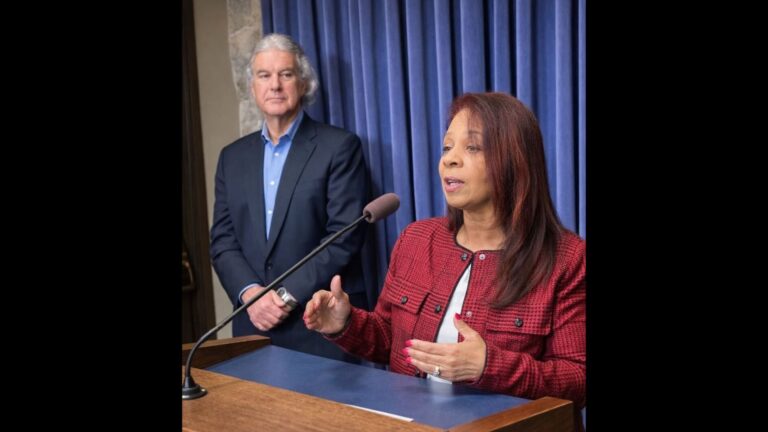
The bill has been introduced in the House as HB 4279 by Representative Rita Mayfield (D-Waukegan) and in the Senate as SB 4285 by Senator Ram Villivalam (D-Chicago). Both measures were assigned Tuesday to the Illinois General Assembly’s transportation committees.
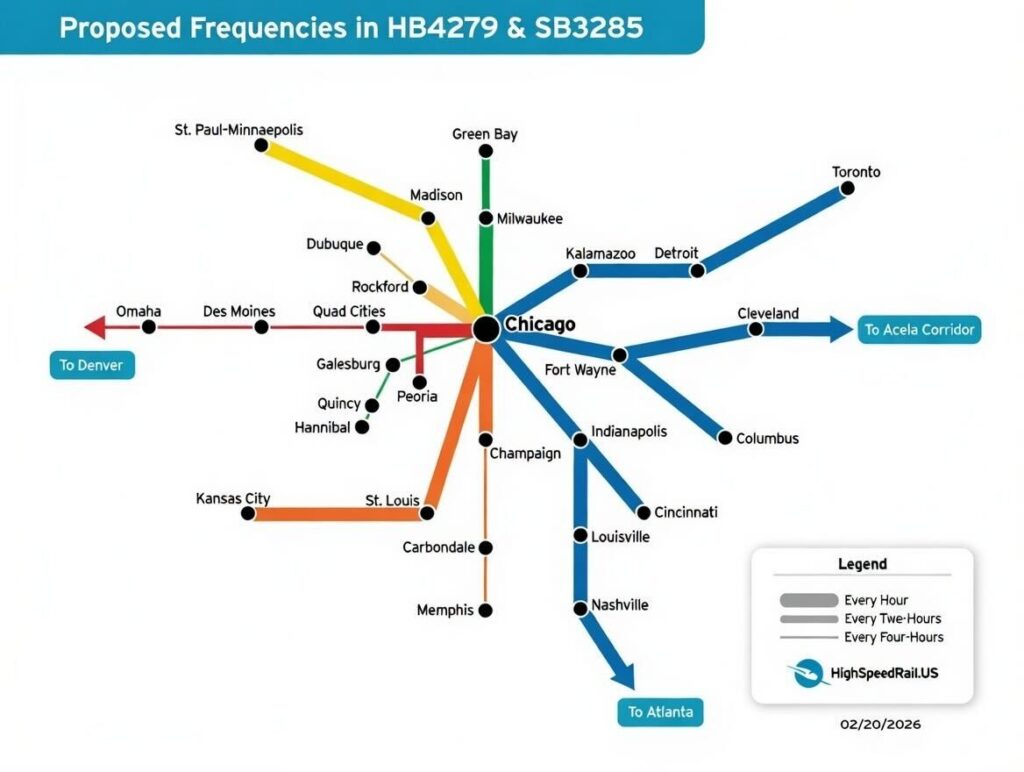
Under the proposal, state planners would be required to include aspirational service goals for routes radiating from Chicago. For Champaign-Urbana, the target would be at least hourly passenger rail service, with trains every four hours extending south to Carbondale and Memphis.
Mayfield said the bill is meant to push Illinois toward a more reliable and accessible rail network.
“Travel is a part of daily life — for work, for family, for healthcare,” Mayfield said. “Passenger rail used to be central to how this country moved people. It’s time we plan to make it dependable again.”
Why Champaign-Urbana stands to gain
Advocates say Champaign-Urbana is especially well-positioned to benefit from more frequent rail service because of its growing role in research, higher education and advanced technology.
Harnish pointed to the multi-state effort centered in Urbana to develop the world’s first functional quantum computer, a project he said depends on frequent collaboration between Champaign-Urbana and Chicago.
“These projects don’t work if you have to plan your entire day around one train,” he said. “If a meeting runs long or gets scheduled last-minute, people need to know they can still get home. Hourly service changes how people work together.”
Harnish said the bill would signal to developers and institutions that Champaign-Urbana could become more closely connected to Chicago’s economy.
“If this passes … Champaign will be closer to the Chicago economy,” he said. “If people have the confidence that they can hop on a train and go to an opera and still get back the same day … it really makes a difference.”
Infrastructure limits remain a major hurdle
Despite the bill’s goals, passenger rail service between Champaign and Chicago currently faces significant physical constraints.
Harnish noted much of the corridor relies on single-track rail with limited passing sidings, creating bottlenecks that slow trains and limit how many can run each day.
“There’s really only one track in key sections,” he said. “To get frequent service, you need at least two.”
The bill would also require local transit agencies and regional planning organizations to align their plans with the state’s rail goals. In Champaign-Urbana, that could mean expanding bus service, rethinking station areas and preparing for additional platforms.
A policy bill, not a funding package
Lawmakers stressed the Passenger Rail Planning Act does not include funding for construction or new trains to run on a more frequent schedule. Instead, it would establish a long-term planning framework to be used for future budgets and projects.
“There’s no fiscal impact this year,” Harnish said. “But for the first time, the state would be saying: this is the goal, and everything else should move us closer to it.”
Mayfield added the approach could help the bill gain bipartisan support.
“Everyone wants to get from point A to point B,” the representative said. “This is about giving people options.”
If lawmakers adopt the measure, the bill would shape future updates to Illinois’ state rail plan and long-range transportation plan, which are both updated on multi-year cycles. Harnish said public engagement will be critical to turning planning goals into real service improvements.
“For students and residents dealing with sold-out trains and delays,” he said, “this only becomes real if people tell lawmakers that what we have now isn’t good enough.”