

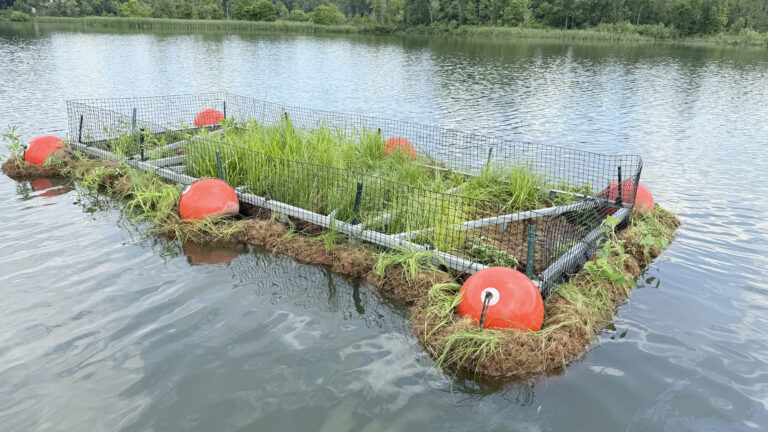
DECATUR — As winter approaches, the durability of two new floating wetlands in Lake Decatur will be tested. These man-made structures were installed on the lake this summer with the goal of improving water quality and creating a habitat for wildlife.
Natural wetlands have many environmental benefits, but in Illinois, many natural wetlands no longer receive federal protections due to a 2023 Supreme Court decision that narrowed protections offered in the U.S. Clean Water Act. Because of this, many have been filled in for development.
Susan McIntyre, an ecologist with the Illinois Natural History Survey, said man-made wetlands can provide similar benefits as natural ones.
“Wetland loss in Illinois has been huge, and we’re trying to do restoration,” she said. “We can potentially create this habitat out in the middle of the water body that is doing some of the same functions that we would have on the shoreline wetlands.”
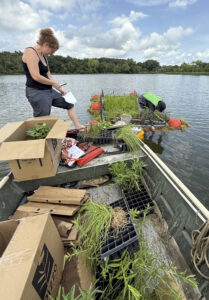
McIntyre is part of a collaboration between the Prairie Research Institute and the Grainger College of Engineering. The team worked together to find a design that was structurally sound while also making a positive environmental impact.
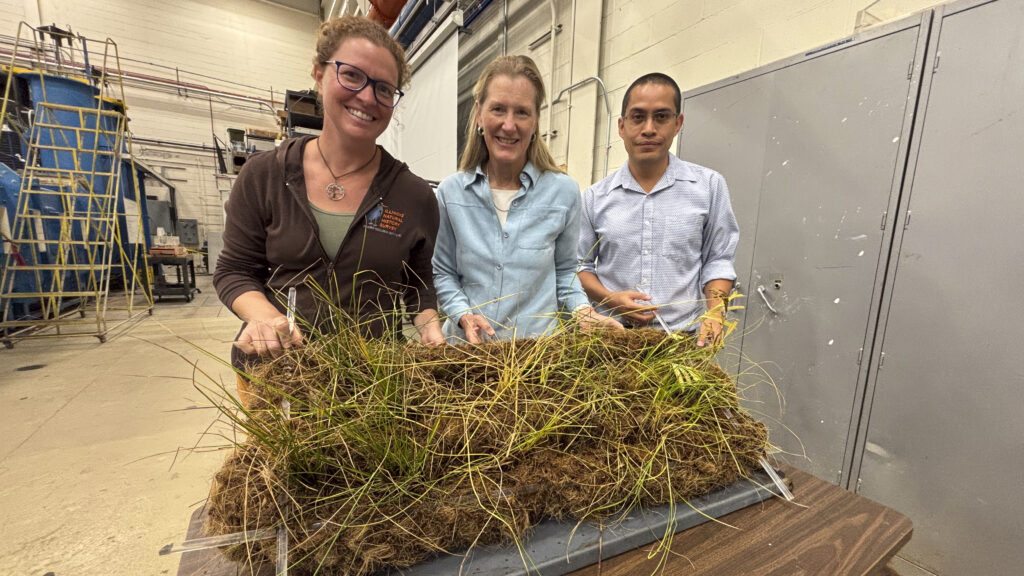
The wetland rafts are composed of a steel frame that holds coconut husk fibers called coir, in which nine native plant species are planted. As the roots grow long enough to fall below the raft, they impact the flow behavior in the water while absorbing nutrients that hurt water quality. Similar models have been planted in the Chicago River.
An alternative to dredging
When too much sediment accumulates in the bottom of the lake, it needs to be dredged, a process of removing the excess silt, sand and rock particles. Jennifer Gunter, water resource and lake manager in Decatur, said soil gets washed into the lake from nearby farmland.
“When a farmer will plow his field, it loosens the dirt and then it’s sitting on top,” she said. “When it gets a big rain, then that sediment will wash down through the rivers and go into our lake.”
The movement and accumulation of sediment can cause a lake to shrink in size, according to Illinois State Water Survey research scientist Erin Bauer.
In the past, Lake Decatur has been dredged – a costly process that involves removing sediment to make the lake deeper. Floating wetlands may provide an alternative to dredging, according to the U of I team.
The root structures in the wetlands act as a trap that slows down the flow of water that carries the sediment particles. This allows the lake to deepen in concentrated areas, according to Bauer.
“We’re trying to see if we can finagle a way out of this [dredging],” Bauer said. “To maybe focus sedimentation into these traps… in those small focused areas, instead of across the whole lake.”
Soaking up nitrates to improve water quality
Lake Decatur has reports of heavy concentrations of the nutrient nitrate, which Gunter said usually comes from sources like fertilized soil entering the water body. Nitrates and other nutrients can negatively affect water quality.
“Our main goal was to suck up the excess nitrates. The plants will suck up the nutrients, keeping the nitrates out of Lake Decatur.” Gunter said.
Bauer said that the plants thrive off of the nitrates, while preventing nutrient pollution in the water.
“[The plants are] just going to absorb the nutrients, because they need those nutrients to grow. If they’ve got plenty of nutrients, they’re going to grow like gangbusters,” she said.
Selecting the right plants was a key part of the process. The structure of the roots impacts the effectiveness of the raft, according to Rafael Tinoco, associate professor of civil and environmental engineering at the U of I.
It is much harder to see how the root structures interact with the water in Lake Decatur due to low visibility, he said, leading him to test many different aspects of the structure of the roots in the lab.
“We can very accurately control in the lab to see if the size of the roots is important for the exchange with nutrients in the water, if the depth at which those roots can can extrude is also important, or if the type of plants will make a difference on how they are absorbing these nutrients,” Tinoco said.
A new habitat for wildlife
New animals found their way onto the rafts shortly after their installation, according to McIntyre.
“We had snails, spiders, water beetles, larvae of various insects living on it and among the plants,” she said. “It’s already creating habitat. Pretty much almost as soon as we put it out there, things found it and started using it.”
The wetland can also become a “floating buffet”: The researchers have already observed at least one animal eating the plants and they plan to put a camera on the raft to monitor wildlife behavior.
But floating wetlands also pose a risk of being a home to invasive species. For example, the nonnative cattail can spread its fluff and seeds easily to new habitats.
“If you’re very successful at creating habitat, then there are a lot of species that are going to start getting to these areas,” Tinoco said. “The million-dollar question is: How do you prevent those [invasive] species from getting there?”
While the team said that there’s not much that can be done to prevent this from happening, if the native plants continue to thrive, it decreases the chances of unwanted species from latching on.
What’s next for the floating wetlands
Now that the team has successfully installed the wetland, the next step is to see how it will survive in the winter when Lake Decatur freezes over.
McIntyre said the plants should be able to survive the ice because the coir acts as a buffer, like soil does for land plants, to protect the cells from dying.
“As long as it doesn’t completely freeze and destroy all of the cells, then it theoretically could come back next spring,” she said.
Tinoco said the team will be looking to see how the wetland can improve.
“First we needed to see: Can we build it, and will the plants survive?” he said. “Now we can optimize the design, and now we can focus on what type of instrumentation we have and what type of data we can collect on the next round.”