

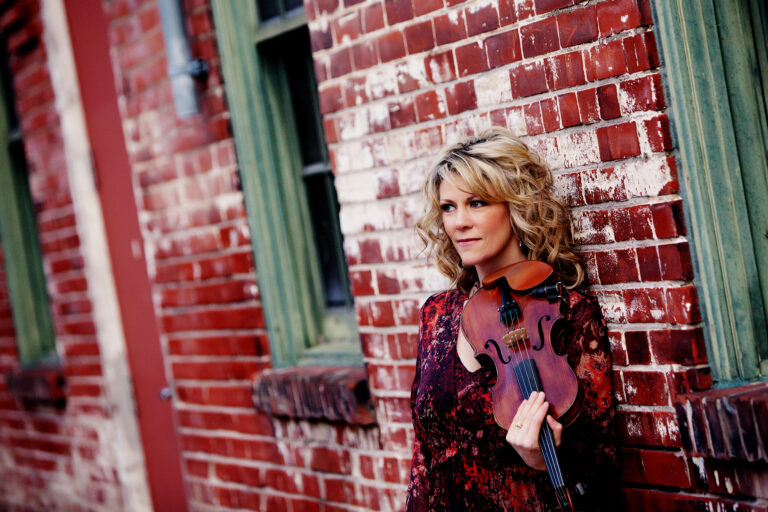
URBANA — Award-winning performer Natalie MacMaster, a staple in Celtic music and fiddling, is coming to Krannert Center for the Performing Arts with her championship fiddler husband Donnell Leahy, and The Celtic All Stars on Tuesday, March 3 at 7:30 p.m. Morning Edition host Kimberly Schofield spoke with MacMaster in a phone interview, where a piano tuner was working in the background. MacMaster discussed her career, family, recently released memoir, and the upcoming performance in Urbana.
This interview has been edited for clarity and conciseness.
NATALIE MACMASTER: They say there are more fiddlers in Cape Breton per capita than anywhere in the world. I grew up right in the thick of that. My parents loved fiddle music. We went to all the fiddle functions. My uncle was the most famous of Cape Breton fiddlers. His name was Buddy McMaster and my mother was a very well known step dancer. My parents just really loved that music and I grew up with it as well. And from a young age, I was listening to both live and recorded fiddle music in the house and in the community.
KIMBERLY SCHOFIELD: You have a large family who also is musical. What was it like figuring out how to incorporate the at-home lifestyle with traveling and continuing to be a professional musician?
MACMASTER: I mean, it’s a balance, and there’s two versions of that. There’s the version I did when I was younger and on my own, and there’s the version I do of that now, being responsible for seven children and our home life and having a husband who also plays fiddle. Back then, there were so many unknowns, and it was such an exciting time, and I was building towards something, and I was getting a lot of attention, and I just put one foot in front of the other and followed the path. There wasn’t a lot of thought given to it. I basically took everything that came along. Now we have to be more calculating. Now we have careers. You know, back then, I was in school. I didn’t plan on having a career in fiddle music. I didn’t know it was possible. I went to teacher’s college to become a teacher, and loved fiddling, and knew I’d always do that, but thought, well, I better have something else because no one just plays fiddle … anyway in those days, but I never did set foot in the classroom. I did finish my degree, but I ended up finishing to correspondence part-time because I was so busy with the fiddle. And it was very obvious in my second year that I would probably never step foot in the classroom. And I never did.
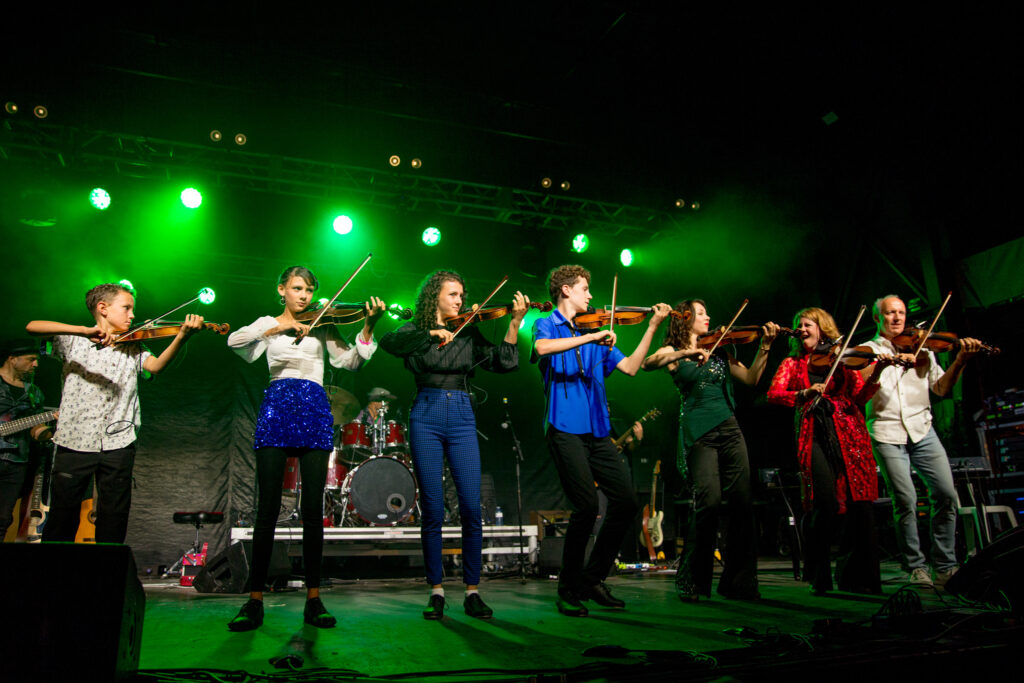
But now, you know, everything’s so much more calculated, because now this is my career. This is the career of my husband. We have to choose wisely, you know, for the direction of what you’ve built. You don’t want to lose that and you want to always build upon it. And so now we don’t just take everything that comes along. You have to calculate. Now there’s radius clauses that you sign in contracts that say, ‘well, you can’t play anywhere in this broad area for three months before your performance here’ and things like that. So much more of a business now. And especially the biggest factor being having seven children. You can’t be away from your kids for that long. And growing up, they came with us everywhere. Luckily, I could take them with me. But now that they’re teenagers and have their own lives and school is more important than it used to be, and, you know, making sure that they’re getting in on all their classes and getting good grades and having extracurricular life outside of music, those are important things. We tour about half as much as we used to.
SCHOFIELD: You also released a book. In September it was published. What inspired you to write a book? You just listed so many things with your family and touring and your job and balancing life at home. How did you have time to write a book and why did you feel the need to?
MACMASTER: Holy Moly, I didn’t have time. Oh, that part was pure awful torture, trying to carve out time. It was insane. So you ask yourself, like, ‘why would I do that?’ Because I was so pulled to do it. I had something in me that was just, it’s unexplainable, other than it’s not of this world. I had such a strong pull to write that book. I had a fire burning within me that had to come out. And it was all motivated through hearing so much terrible news, so much evil in the world, and just being so overwhelmed one day thinking, ‘what kind of a world do my kids have to live in?’ I started thinking about my family and thinking about how I’ve been so lucky. Look what I’ve been given. I had such a great existence in Cape Breton, and I’ve had such a great family, my parents and my brothers and this whole music community, and then the music career, and then meeting my husband, and then having my own kids, my husband’s fatherhood, and the kids are great, and I love my family. I just became overwhelmed. I started crying and saying out loud, ‘thank you God, thank you, God.’ And I had this thought come in my head, a realization, ‘oh my gosh, I have my own love story’ and I just never thought of it in that way before. And I thought maybe the world just doesn’t realize, with all the hollering and screaming going on about different things in the world, maybe people don’t realize the value of just everyday, simple, quiet love … how it fuels and anchors a person for a lifetime, and the value of that and the importance of that. I’ve received so much just from simple things, like my mom cooking me meals. I didn’t realize what an anchoring in love that was, and so it was just to talk about love and its simplicity and the everydayness of it, and it doesn’t have to be grand. It’s just basic. And that is what I think will just save the world. Just start young. I’m so people often say to me, ‘oh, you’re so grounded, you’re so grounded.’ I mean, it’s all of that. It’s all of what I’ve been given.
SCHOFIELD: When people come to see the performance at Krannert Center for the Performing Arts or in any performances that you do, is there something that you hope that the audience takes away from the performances?
MACMASTER: I want them to go away with something that’s left in them and that can be whatever it is. People experience all sorts of different things. I don’t think I’ve ever heard anyone going away angry or, you know, leaving with less than they came or feeling down. That’s music, you know. I think that is the gift of music. It gives to people in its own very unique way. It’s so individual. And so looking forward to playing with these all stars from, you know, around the globe and in our Celtic circle. Just high-end musicians and they’re going to pull out of us our musicality in a new way. Playing with a new person that you haven’t played with before always pulls out another side of your musicianship, and it’ll be new one again, new again. And this level of musicianship that we’re playing with, they’re just such broadly, richly musically diverse players that the magic will happen.
Krannert Center for the Performing Arts is a financial supporter of Illinois Public Media.