

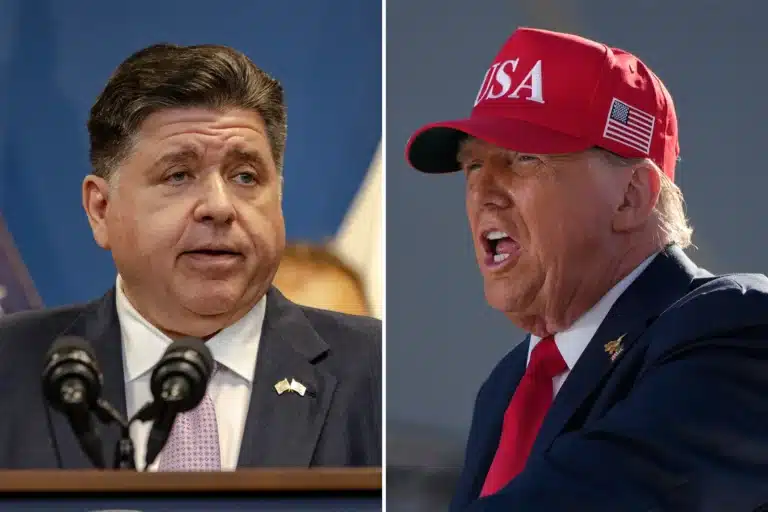
Illinois and Chicago sued President Donald Trump Monday to prevent the deployment of National Guard troops here from any state, setting up one of the biggest legal clashes yet between the Republican president and Illinois’ Democratic leaders.
The lawsuit came hours after a federal judge in Oregon barred Trump from deploying federalized members of any National Guard troops under Trump’s command to Oregon.
The lawsuit calls the deployment “illegal, dangerous, and unconstitutional.” The state is also seeking a temporary restraining order blocking Secretary of Defense Pete Hegseth from calling members of the Illinois and Texas national guards into federal service.
Pritzker announced Sunday that Trump had ordered 400 members of the Texas National Guard to deploy into Illinois, Oregon and elsewhere. The news came after more than a month of threats from Trump, as well as the start of an aggressive deportation campaign here.
“We must now start calling this what it is: Trump’s Invasion,” Pritzker, a possible 2028 presidential candidate, said Sunday evening.
Illinois Attorney General Kwame Raoul’s office filed the lawsuit hours after a federal judge in Oregon blocked the Trump administration from deploying any National Guard troops under Trump’s command into the state of Oregon.
U.S. District Judge Karin Immergut had earlier stopped the deployment of only Oregon National Guard troops. That led to reports that the Trump administration might send troops from California or Texas to Oregon instead.
During a hearing Sunday night, Immergut asked Justice Department lawyer Eric Hamilton whether the White House was “simply circumventing my order.” She then issued a broader ruling and refused to delay its effect.
That all laid the groundwork for a hearing Monday at the Dirksen Federal Courthouse in Chicago before U.S. District Judge April Perry. Christopher Wells, a lawyer with the Illinois attorney general’s office, pointed to the federal government’s conduct in Oregon and insisted that “we need a [temporary restraining order] immediately.”
Hamilton, the same lawyer from Sunday’s Oregon hearing, asked for a week to respond to the lawsuit.
When Perry asked Hamilton whether the troop deployment could also wait a week, Hamilton told her, “I am not able to represent that we will do that.”
Wells then accused the Trump administration of a “concerted effort to target disfavored jurisdictions that the president doesn’t like.” He told Perry that “that pattern has to stop, and this court, like the court in Oregon, has to put a stop to it.”
Perry said she was “also very troubled” by Hamilton’s inability to answer certain questions, like where the troops would be deployed. But she said the Trump administration deserves a chance to read the complaint. She ordered a response by midnight Wednesday and said oral arguments would take place Thursday.
Perry is the judge whose nomination to be U.S. attorney in Chicago was blocked by then-Sen. JD Vance.