

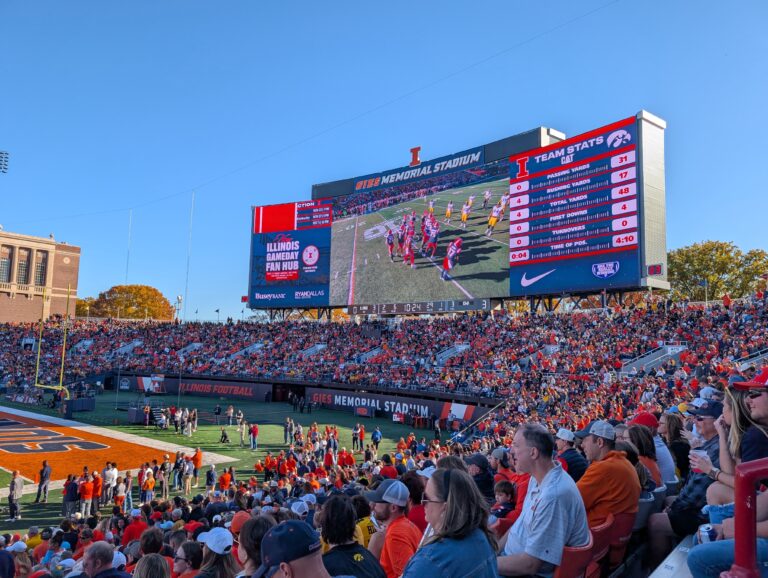
CHAMPAIGN – The new scoreboard at Gies Memorial Stadium towers over the south end zone. Stats from the game and ads flash across the screen. With 16 million pixels, the instant replays look clearer on the scoreboard than with your own two eyes. When the Fighting Illini score, orange and blue graphics explode across the screen in celebration.
The University of Illinois Urbana-Champaign unveiled the 250-foot-wide scoreboard, the largest in college football, earlier this year. The scoreboard itself cost $20 million and was part of a $40 million project to upgrade the stadium’s technology, according to University of Illinois Athletics.
Saturday’s game against the Iowa Hawkeyes was Champaign resident and Illini fan Lilly Graham’s first time seeing the new scoreboard.
“I am excited about it, especially since I just saw the fireworks go out a couple minutes ago, so now I am excited about it,” she said.
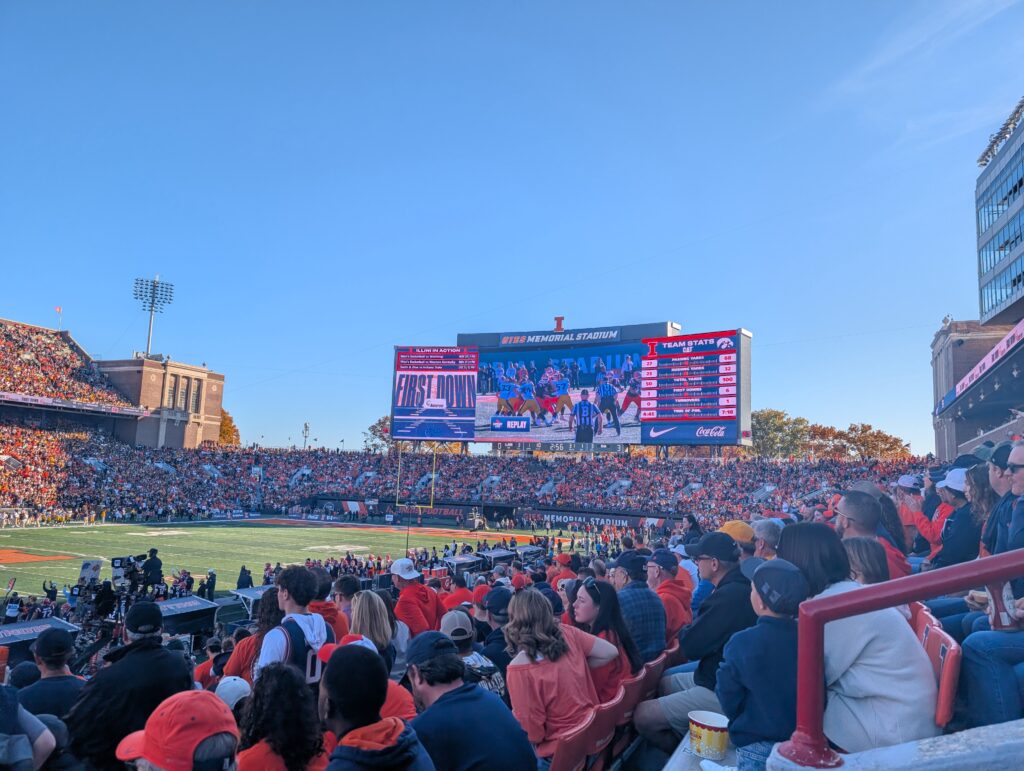
It even received praise from Iowa fans during the game, like student Marshall Smith.
“I am really really excited to see the scoreboard and hopefully how much it reflects the Iowa win today,” he said, “but I’ve heard nothing but good things.”
Iowa went on to beat the Illini 34 to 17.
Concerns about light pollution
But outside of the excitement from the sold-out stadium, the scoreboard has gotten mixed reviews from some Champaign-Urbana residents. On social media, people have claimed they can see the glow of the scoreboard at night from more than 15 miles away. Some people say they can even see the flashing lights from Gibson City, which is30 miles away.
That’s raised concerns about the scoreboard’s impact on light pollution and local wildlife.
A spokesperson for the University of Illinois Athletics could not confirm if an environmental study or any mitigation efforts were conducted before the scoreboard was constructed beyond the “regularly required policies and procedures for that project.”
Research has shown light pollution doesn’t just reduce the ability to see the night sky.
“It can disrupt our circadian rhythms. It can disrupt plant growth,” Erik Johnson, a professor of astronomy at Parkland College, explained. “They have seen how light pollution actually affects how various crops grow around certain streetlamps.”
Light pollution can also disorient birds while they’re migrating and impact where they breed, according to Mike Ward, a professor studying bird behavior and ecology at the University of Illinois.
“There’s species that don’t want to breed near artificial lights,” he said. “We do research on a bird called whippoorwill, which is a nocturnal bird, and they avoid areas with lots of artificial light.”
Other sources of light pollution in C-U besides scoreboard
But can one scoreboard – albeit a very bright scoreboard – make a significant impact on light pollution? Johnson doesn’t think so.
“One single instrument’s not going to completely ruin our ability to enjoy the night sky,” he said. “It’s those cumulative effects.”
The scoreboard is just one of many sources of artificial light in Champaign-Urbana. The area’s streetlights, floodlights, billboards, storefronts and neon signs all contribute to light pollution.
“The scoreboard’s probably no worse than just the lights that are shining down onto the field,” Johnson added.
Ward said the scoreboard itself also isn’t enough to confuse migratory birds.

“Given it’s on for a few hours and off, I think for migrating birds it just is part of the overall brightness of Champaign-Urbana,” he added.
There are ways to reduce light pollution. Johnson said turning off outdoor lights, especially during the fall and spring migrations, can be very effective.
“They’ve been trying to turn off the lights on places like the Gateway Arch at certain times of the year, just so they didn’t interfere with those birds trying to fly south in the fall.”
Ward said there are even things you can do in your own backyard to support migrating birds, like growing tall grasses and trees and reducing pesticide use.
After seven home games this season, the Illini head to Evanston to play Northwestern this Saturday. And when they’re back in Gies Memorial Stadium next season, college football’s biggest scoreboard will be there to welcome them, win or lose.