
The measure aims to promote accountability among the most powerful AI models
Following in the footsteps of New York and California, Illinois state lawmakers passed a bill Wednesday that seeks to increase transparency and accountability among the largest and most capable artificial intelligence models.
Senate Bill 315 passed unanimously in the House with Wednesday and now heads to the governor for consideration.
Legislators modeled the bill after 2025 laws in New York and California, hoping to further a national standard they say is lacking at the federal level.
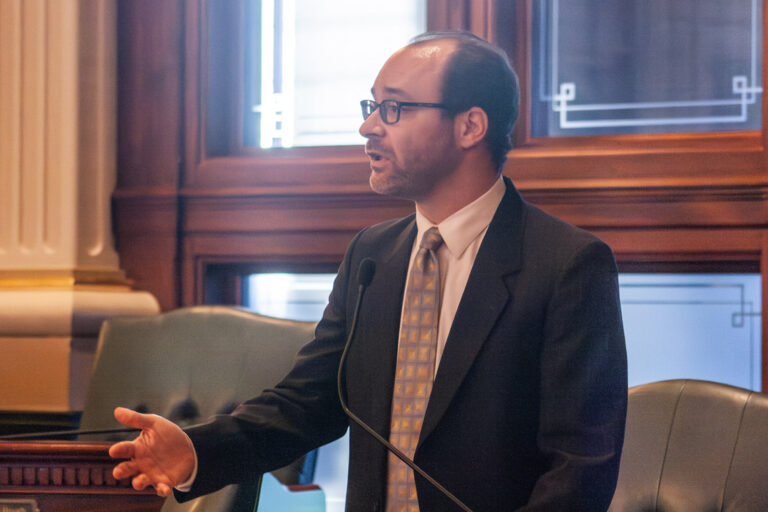
“This legislation enacts critical protections against the most catastrophic risks that advanced AI systems pose to public safety,” House sponsor Rep. Daniel Didech, D-Buffalo Grove, said. “Artificial intelligence is among the most significant technological developments of modern time. It has the potential to drastically improve the quality of life of people throughout the world, but only if deployed and developed responsibly.”
SB315 is targeted towards the most capable models developed by the largest companies through its thresholds — $500 million in revenue and a massive computing measurement. OpenAI and Anthropic both supported the bill throughout its process and it passed the House 110-0.
“As these models grow more powerful, this kind of enforceable accountability matters more than ever,” Cesar Fernandez, Anthropic’s head of U.S., state and local government relations said in a statement Wednesday. “Illinois lawmakers have set a new standard, and we hope other states and the federal government build on their dedication to AI safety.”
Senate sponsor Sen. Mary Edly-Allen, D-Libertyville, compared the technology to the “wild, wild West,” and said lawmakers can’t take the same approach they did with social media, an approach that was minimal until recently.
“This is not about stopping innovation, but rather about balancing the great promise of AI with its potential harms,” Edly-Allen said while introducing the bill in committee on May 13.
In a 52-5 vote, state senators approved the bill last week.
The bill would require developers to create and publish a transparency framework explaining how the company applies industry standards, measures model capabilities and chance of catastrophic risk, and identifies and responds to safety incidents.
Developers would also be required to employ third-party auditors to ensure compliance with the framework, a provision that is still a point of contention for some industry stakeholders, including TechNet, a coalition of tech executives across the industry.
“We remain concerned that Illinois would effectively be requiring private actors to make highly subjective determinations requiring AI safety compliance without established national standards, certifications, or clear regulatory guardrails,” TechNet representative Ninia Linero said in committee May 20.
Advocates like Secure AI, a nonprofit seeking meaningful AI regulations, supported the third-party requirement.
Didech said he had conversations with House legal staff and the AI working group of lawmakers conducted research to see if there are companies that can effectively conduct those audits.
“Given … the fact that there is already a developing robust ecosystem of these small boutique firms, and also the large international accounting firms that have the capabilities to perform these audits, we were comfortable keeping it in the bill,” Didech said.
Later amendments also addressed concerns from Senate Republicans, Secure AI, Anthropic and the Illinois Emergency Management Agency by clarifying third party qualifications, what the audit should include and protocols for protecting proprietary information. Lawmakers also extended the effective date from 2027 to 2028 and added an amendment saying the bill doesn’t create a pathway for private citizens to sue.
The Illinois attorney general would have exclusive authority to enforce civil penalties up to $3 million per violation.
Amendments also require large frontier developers to file disclosure statements with primary contacts and places of business and to pay proportional fees to cover the expense of administering the act.
The bill now heads to Gov. JB Pritzker, who said he looks forward to signing it in a post he made on social media Wednesday evening.