

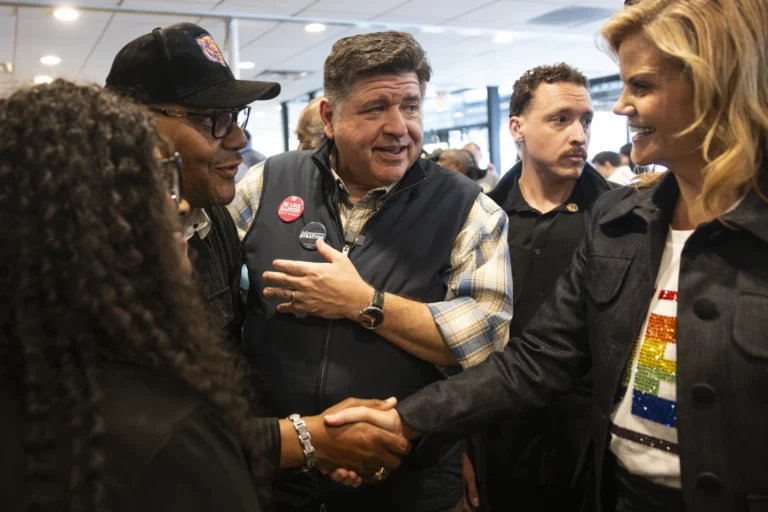
For the second time in four years, it was a quick election night in the Illinois governor race, which the Associated Press called for Pritzker within a few minutes.
Gov. JB Pritzker sailed to a rare third term as Illinois’ chief executive Tuesday with his second consecutive reelection victory over Republican challenger Darren Bailey, lining up the incumbent to become the longest-serving Democratic governor in state history.
But a quick election night for Pritzker only underscored the question of just how long he intends to stay in the governor’s mansion — and when he might announce a run for president as the 2028 field of contenders takes shape.
The Associated Press called the race for Pritzker within minutes of the polls closing, just like it did in 2022 when the billionaire governor trounced Bailey, a southern Illinois farmer and former state legislator, by nearly 13 percentage points.
With Pritzker’s bottomless campaign resources towering over a fractured Illinois Republican Party, the only question for most Springfield observers after Bailey crushed the field in March’s four-way GOP primary was whether the hardline conservative challenger could keep his vote deficit from ballooning further in reliably blue Illinois.
About a thousand Pritzker supporters packed Navy Pier’s Aon Grand Ballroom, erupting in cheers as results were broadcast shortly after 7 p.m., with the sitting governor easily topping Bailey and Collin Corbett, a socially moderate, fiscal conservative who mounted an independent campaign.
Bailey and other Republicans have long accused Pritzker of eyeing his latest reelection as a stepping stone to the White House, an ambition that Pritzker has hardly downplayed while bolstering a nationwide Democratic network and becoming a fixture on cable news denouncing President Donald Trump.
But Pritzker maintains that he has unfinished business in Springfield after two terms spanning some of the most tumultuous years in state history, from a global pandemic to a chaotic federal deportation campaign and numerous run-ins with the Trump administration throughout it all.
“I’m somebody that still believes in getting big things done,” Pritzker told the Sun-Times before Election Day. “Eight years later, I think I’ve learned a lot about how to protect people in this state from Donald Trump and from his policies, and I’m going to continue to do that.”
Whether or not his focus is solely on his current job, Pritzker becomes the first three-term Illinois governor since Republican Jim Thompson won the third of his record four terms in 1982.
An heir to the Hyatt hotel fortune, Pritzker used his astronomical financial advantage in the race to remind voters of the state’s 12 credit rating upgrades and a slew of progressive legislative victories he has shepherded through the General Assembly since unseating GOP former Gov. Bruce Rauner in 2018. That includes raising the state minimum wage, legalizing recreational marijuana and sports betting; setting ambitious clean-energy goals, implementing a $45 billion capital infrastructure upgrade program and banning assault weapons.
Pritzker’s self-funded, $90 million-plus campaign also blanketed the internet and airwaves with ads painting Bailey as a lackey of President Donald Trump, who campaigned alongside Bailey four years ago and endorsed him once again.
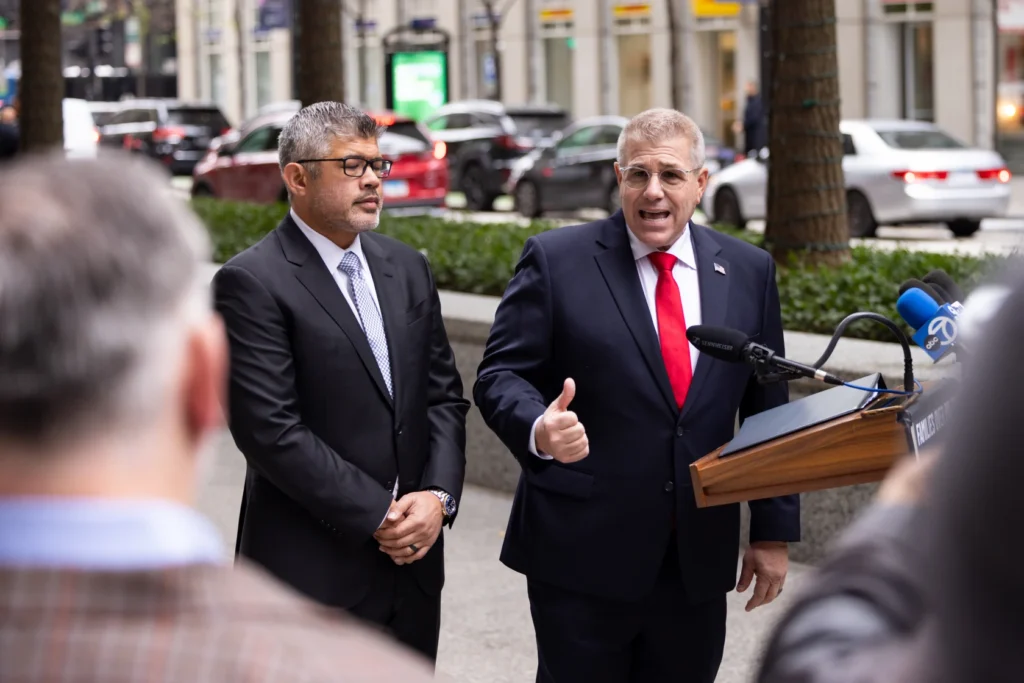
Several dozen people were on hand for Bailey’s election night watch party at an Effingham hotel, many supporters clad in red campaign merchandise and one decked out as a full-on Abraham Lincoln impersonator.
Momentum proved elusive for a campaign that tried to distance itself from Trump, who remains unpopular with voters in Cook County and the collar counties, that once-fertile ground for the Illinois GOP.
Instead, Bailey labored to keep the focus on concerns around the rising cost-of-living, which critics can tie to the president’s tariffs and war in Iran; crime, during a year when Chicago has seen a historic drop in homicides; and the education system, which is heavily reliant on the property taxes that Bailey pledged to cut.
Bailey, who raised his profile in the Illinois General Assembly early in the COVID-19 pandemic as a vociferous opponent of Pritzker’s mitigation measures, was also hamstrung by his failure to draw conservative megadonors to help broadcast his message. He remained unfazed with about a half million dollars on hand for the home stretch of the race.
“People are ready for change,” Bailey told the Sun-Times in mid-October. “We didn’t really sense that so much four years ago here in the city, but the high cost of living, the high cost of doing business seems to be taking a toll now.”
Bailey moved into a Chicago apartment in an effort to win over city voters who soundly rejected him once before. But the effort also drew an election board complaint in the process from the Democratic Party of Illinois for not reporting the city rent on campaign finance reports.
By the final week of the race, he and running mate Aaron Del Mar spent much of their time downstate urging their GOP base to turn out to vote.
Contributing: Isabela Nieto, WBEZ