

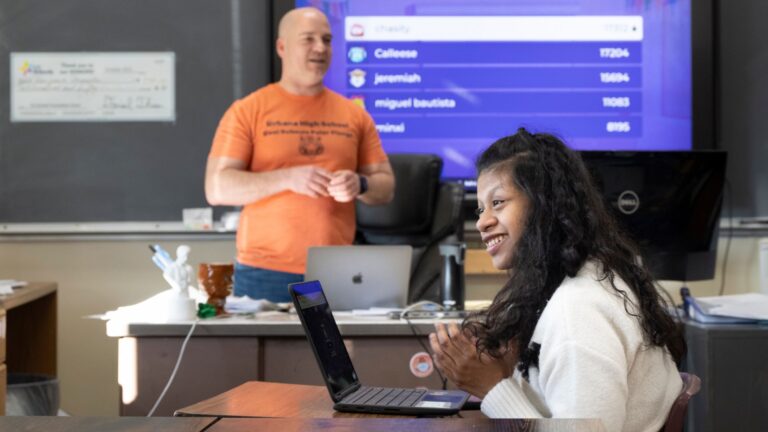
URBANA — As Illinois prepares to release statewide guidelines on artificial intelligence in K-12 classrooms this summer, one Urbana High School teacher is already experimenting with how the technology can support, but not replace, student thinking and learning.
“We want to teach kids how to think for themselves, how to analyze information and go through facts without the use of AI,” said Benjamin Unander, a special education and civics teacher at Urbana High School.
He wants AI to be a tool for his students, not a crutch. When his students recently prepared a mock election in his civics class, he encouraged them to use AI to create the campaign poster.
He said he’d noticed that many of his students are already familiar with ChatGPT, so he challenged them to find new uses of AI technology.
“I don’t want them to use what they already have some understanding of,” he said. “So we’re going to use AI to generate images, information about their platform, research — that type of thing.”
The Urbana School District is ahead of the new state law on use of AI that requires Illinois education officials to publish AI guidelines for schools; the guidance is due by July.
In January, the district released guidance for teachers that included policies about the effective use of AI in classrooms. The guidelines say teachers are expected to communicate with students about the use of AI in classrooms.
The district encourages teachers to use a stoplight metaphor to indicate whether students are encouraged to use AI on an assignment (green light), use it to help brainstorm or in another specific way (yellow), or whether they are not allowed to use it at all (red).
The guidelines says students can use otter.ai to summarize lectures or translate texts. Unander said he also uses AI to help keep track of students’ reading levels and generate homework questions and unique assignments tailored to their levels, interests and career trajectories, in a way he couldn’t do before.
“With AI, I can say, ‘Give me a reading problem about squirrels,’ or whatever I want, and have it be at the 5th-grade level and include five questions for kids to answer and make them multiple choices,” he said. “Stuff like that saves time.”
Unander said he can guide students to use AI to help parse long emails and identify important information.
He said one of the students plans to go into welding and has set a goal of being “able to read an email [from a supervisor], identify specific meetings times, places, tasks.” While Unander doesn’t know much about welding, with the help of an AI tool, he was able to write a plausible supervisor email for that student.
Unander said AI tools can also help with tasks such as adding meetings to his calendar or looking up obscure facts for his lesson plans.
Other students in Unander’s classroom said they’re more hesitant about using AI tools.
Students “can use their own thinking thoughts instead of using AI,” said Minxi Bautista, a senior in the class.
Chasity Robinson, another senior in Unander’s class, said AI can be helpful for tasks like writing emails to teachers.
“I would check it and see if I’m sure I have confidence in it,” making sure the information and grammar is correct, Robinson said.
She said she thinks many students use AI for tasks like writing school papers. But Robinson, who also works with second-graders at Dr. Preston L. Williams Elementary School in Urbana School District as an assistant to the teacher, said she doesn’t think that’s a good idea.
“Because it’s not your paper,” she said. “You’re letting someone else write it for you, it’s not your paper. It’s more AI’s than yours.”
Emily Hays, IPM News education reporter, contributed reporting.