

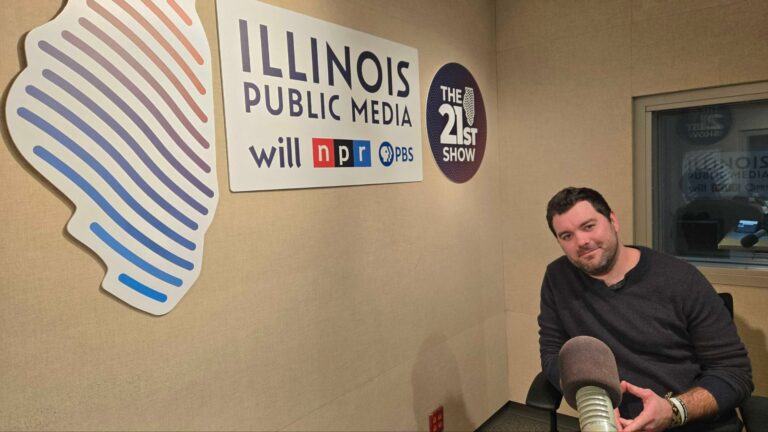
The race to succeed Dick Durbin as U.S. Senator for Illinois continues … and today, we bring you the latest in our series of conversations with candidates in the primaries.
There are 16 candidates in total including both Democrats and Republicans. Bryan Maxwell is one of the 10 people hoping to represent the Democratic Party in this fall’s election. He’s an environmental research scientist at the University of Illinois Urbana-Champaign- making him one of the few candidates in the race not to be based in Chicago.
Maxwell was raised in Charlotte, North Carolina, and earned a doctorate in agricultural engineering from North Carolina State University. Postdoctoral work took him to Champaign-Urbana in 2020-where he’s resided ever since. Maxwell has been involved in political volunteer work -supporting progressives running for local office and anti-war causes. Now, he’s running as a first-time candidate in the Senate race. He shared his views on different issues- from local to international with the 21st show’s Brian Mackey.
Interview Highlights
On Gaza and Palestinians post-war
“Palestinians need to be at the negotiating table right now. We’re seeing the Trump administration forming this Gaza Board of Peace. You know who’s going to manage Gaza after this has all been said and done, and there are no Palestinians. And this is important to Illinois. You know, Illinois has the highest Muslim per capita, Muslim per capita population in the country. We have the largest Palestinian American community in the country, and their voices are not being heard at all.”
On economic sanctions
“You know, some of the largest migrant outflows around the world have been from countries that have been under US backed sanctions for 20 to 30 years. We’ve seen Venezuela be under sanctions for last 30 years. We’ve seen Iran be under sanctions for something roughly 20 to 30 years. We’ve seen Cuba be under sanctions for over 50 years. U.S. sanctions are one of the most damaging foreign policy things that we do around the world, and they’re one that least understood by people in this country. They’re seen as a form of soft power, soft influence, when in fact, is extremely damaging. It is basically siege warfare.”
On socialist policies
“I do support socialist policies because we see them succeed all across Europe, and we have many socialist policies here in the U.S., with respect to even some health care policies. How we, you know, essentially subsidize public roads in this country. The status quo has not worked for the working class in this country for decades, we’ve seen more and more of our country’s wealth, and the value and wealth produced by the working class primarily ends up in the hands of a smaller and smaller number of people.”
On rural communities and farmers in southern Illinois
“I don’t think that farmers and rural communities’ voices are being heard. And in our federal leadership, farmers are in a mental health crisis right now. Farmers have some of the highest rates of suicide in this country, and that needs that’s a public health crisis, and that’s a national security crisis, in my mind. And we need to be doing investments in rural health care, access to virtual mental health services, and we need to be helping build more reliable agricultural economies, which we are not doing.”