

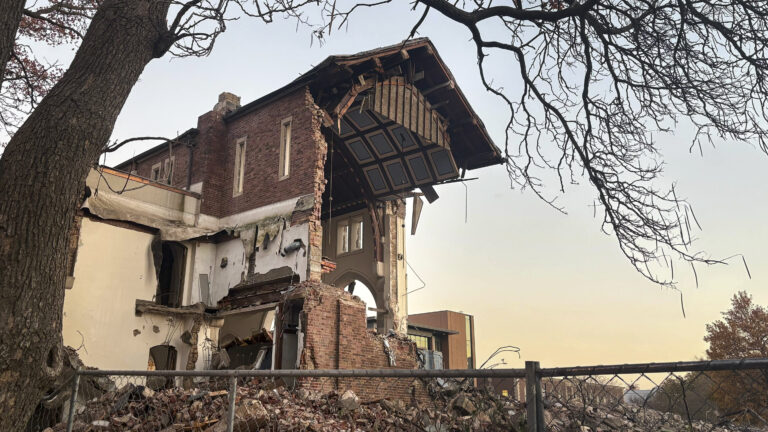
CHAMPAIGN — On a Sunday in mid-September, under the dark wood ceiling at University Place Christian Church, sunlight streamed through the stained-glass windows. The pews were packed for the final worship service held inside the church building, which had been slated for demolition to make way for a new apartment complex on the northwest corner of Wright St. and Springfield Ave. in Champaign.
Church leaders made the difficult choice earlier this year to sell the building, after deciding that its dwindling congregation could no longer support the neo-Gothic building and its high maintenance costs.
What’s happened to UniPlace is reflective of a national trend driven by the shifting demographics of religion. In 2020, the average size of a Christian congregation was less than half what it was two decades prior. In recent years, the U.S. has seen a sharp uptick in people with no religious affiliation.
With churches no longer playing as central a role in many people’s lives, more congregations are faced with hard decisions regarding their historic buildings, said David Albouy, an economics professor at the University of Illinois Urbana-Champaign.
“Attendance at mainline Protestant churches has been falling for over the century, especially among the more educated,” he said. “Many, many churches have been demolished or repurposed.”
Faced with a wrecking ball
Many congregants at the final service in the historic building on Sept. 14 had spent decades with University Place Christian Church. Kay Mahannah was among them.
“My husband and I married 14 years ago in this sanctuary, and he has since passed. So this holds a very special place in my heart,” Mahannah said.

Over the years, Mahannah said the congregation had been fighting a losing battle to maintain the building’s aging structure.
“I’ve been a part of all the cleanups when there was water. The pipes had corroded badly and were behind the walls, and the walls had asbestos in them,” she said.
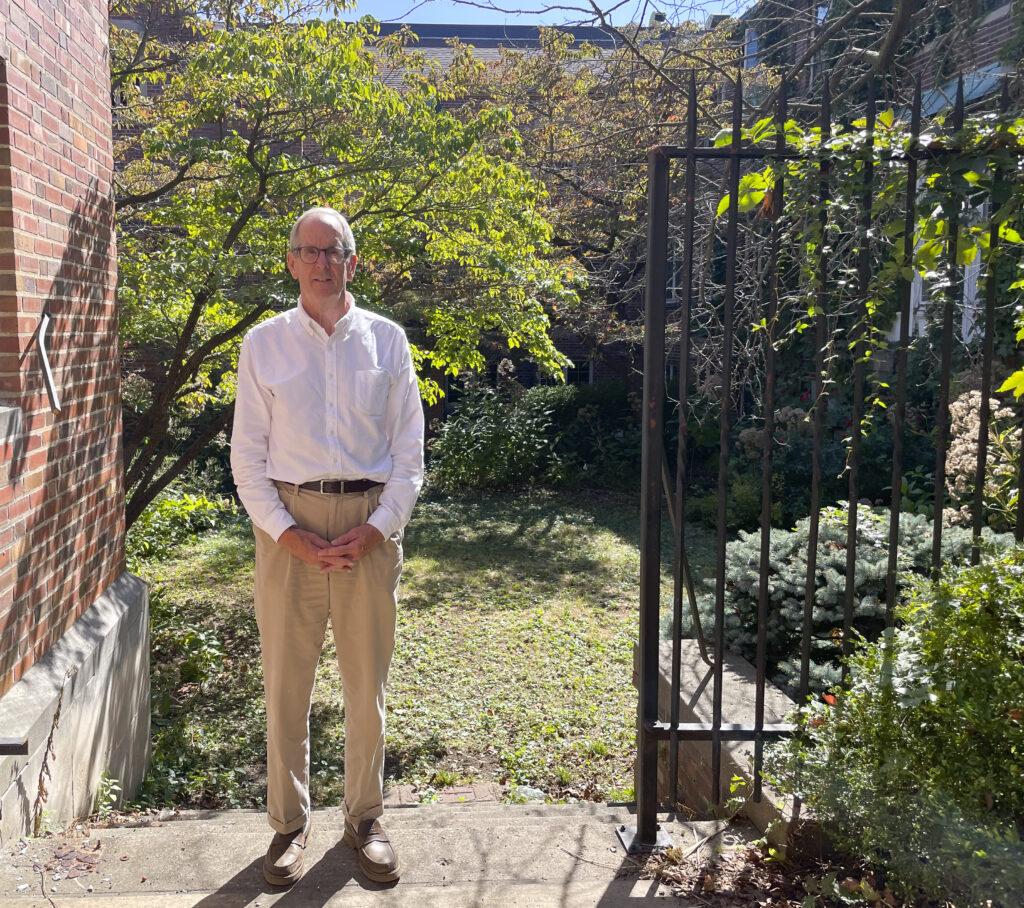
Despite the efforts to preserve the building, Eric Freyfogle, the chair of the church’s board of trustees, said multiple factors contributed to the demolition decision. He said ultimately it came down to “whether the wrecking ball is going to hit the church building or whether it’s going to hit the congregation.”
The church sanctuary was built in 1934 to accommodate 600 worshippers. In the 1990s, weekly attendance was 300 people. By the end of this summer, it was down to about 50.
Economist David Albouy said land uses are changing, and it’s a reflection of our values as a society: “People don’t value going to church in the aggregate as much as they used to.”
The decision to sell the building was made in March, after Fairlawn Realty expressed interest in purchasing it at the appraised value of $4.1 million.
An appeal to preserve the building
When former church member Leslie Colbert Baker learned the building would be demolished, she set out to stop it.
Baker, who now lives in Michigan, filed an application to designate the church as a historical landmark, which would prevent the demolition. Baker said she and her entire family were active members of the church, and to them, the church was more than just a building.
“I’m doing this for my grandparents, my parents, and for really, for all of the generations of University Place Christian church members and community members, both past and present, who worked and sacrificed over the decades to build this beautiful church from the ground up,” she said.
Nancy Hays, another former church member, said she sides with Baker.
“You walk in this building and you are awestruck with its value,” Hays said. “You walk up the narrow staircase and there’s sun beaming in on a wooden ceiling that you only see in England or in Europe.”
According to Hays, the church building is an architecturally significant example of the Late Gothic Revival. Its stained glass was designed by the Willet Stained Glass Company of Philadelphia — the same company that designed the windows at the National Cathedral in Washington, D.C.
To get a building designated as a landmark in Champaign, it has to be approved at three levels. First, the Historic Preservation Commission looks at whether it has historical or architectural significance. Then a separate commission weighs in at a public hearing.

It’s ultimately up to the City Council to make the final call. The council denied Baker’s landmark designation request, taking into account the rising maintenance costs and the fact that the contract to sell the building was already in place.
The church’s deal with Fairlawn closed at the end of October, and the building was demolished. Fairlawn has submitted plans to develop the site into a five-story, 283-unit apartment building called “The Mosaic.”
Preserving memories
The congregation salvaged key architectural features, including the woodwork. The pipe organ is now in a Roman Catholic church in Jackson, Missouri. Some of the stained glass windows were removed before demolition and broken into pieces to distribute as mementos to church members.
Freyfogle said the pieces of stained glass are akin to a photo on the wall of a beloved ancestor, deeply missed — a reminder of the continuity among generations.
Although the church will continue its services at the University’s YMCA, Freyfogle said the memories from the time in their historic church building will be hard to replace.
“There’s so many memories in this building. We can look around and just remember people who used to sit in various pews who are no longer alive, and the ceremonies here, the funerals, the weddings, all sorts of occasions that people remember,” he said. “And those are much more difficult to transport to a new location.”
Some, like Leslie Baker, will carry that sadness with them.
“I just assumed that my future funeral would be at University Place Christian Church,” she said. “So that was just kind of a hard realization that… [I] and many other people may not have that choice in the future.”