

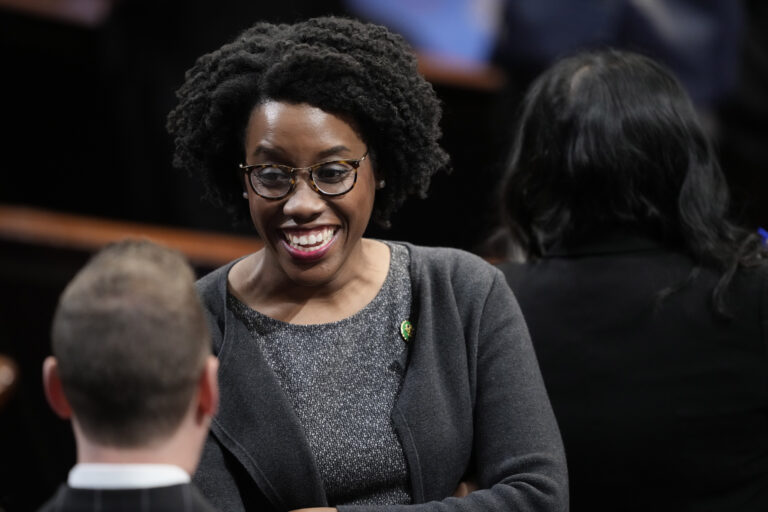
U.S. Rep. Lauren Underwood (D-Naperville) has represented Illinois’ 14th Congressional District since 2019. The district encompasses a large triangle in north-central Illinois, bounded by Joliet, DeKalb, and LaSalle-Peru.
The Democrat joined The 21st Show last week. She’s facing a challenge from Republican Jim Marter as she seeks another term. Marter joined the program in September.
Underwood weighed in on a range of issues, including the war in Iran, tariffs, SNAP, government regulation of AI, and the struggle for many Illinoisans to keep up with rising costs.
Interview Highlights
On the economic effects of the Iran war
“The cost of gas has continued to rise. The cost of diesel is so high during this harvest season, it’s really taking a toll on our farmers and producers across our rural communities in the 14th. And then obviously it’s been holding up goods that are passing through the Strait of Hormuz and really driving up the costs. And you know, we’ve been grappling with high prices since Trump initiated his failed tariff policy. And so it’s just been one failed economic policy after another, but this war in Iran has been a disaster.”
On Trump’s tariff policies
“The idea that the president is going to initiate, instigate a trade war with our closest ally and partner, and certainly our regional economies are intertwined — I’m talking about the Canadians — it is absurd, Brian. And you know, just talking with small business owners, farmers and producers, folks, and then, you know, just moms in our community.
Everybody can tell us that everything is more expensive. Everything. Across the board, it’s more expensive. And that, you know, the administration even continues to defy court orders which tell them that these tariffs are illegal. It’s the Congress’s role in Article One of the Constitution to advance tax policy, and tariffs are taxes. And what we have seen is this administration defying the law to advance these tariffs that raise costs on American consumers.”
On data center Development
“I’ve written legislation to increase transparency on the cost — particularly related to electricity and water usage — for surrounding communities that are, you know, seeing data center development come in, and, you know, there’s a lot of fear.
But beyond that, I think, you know, certainly in the near term, we can be facing significant unemployment. There are real national security risks — like urgent, urgent, urgent national security risks — associated with these AI capabilities. And then, you know, more broadly, our economy … is really intertwined with artificial intelligence, and that wealth generation is really concentrated. And I think that we need to be open-minded to things like a sovereign wealth fund, you know, and an idea that all Americans could benefit from the global use and the U.S. role in developing and sustaining these, you know, extremely profitable, successful AI companies.”
On changes to SNAP
“Our food banks have lines, have waiting lists. The demand for our food banks — in my community we use the Northern Illinois Food Bank … the folks [there] have told me that demand is almost exceeding COVID-level demand. Like those early phase-one pandemic days when there was high need for food assistance — that’s where we’re at, singularly because of this cruel, reckless policy.
And so the way that we move forward is that there is a bipartisan agreement, at least in the Senate, to overturn these SNAP requirements, and it’s in the Farm Bill.”